"According to official statistics,
Pervez Hoodbhoy,
chair of the department of physics at
That's bad, really bad. Pakistanis in the
My published articles are archived at iSteve.com -- Steve Sailer
"According to official statistics,
Pervez Hoodbhoy,
chair of the department of physics at
That's bad, really bad. Pakistanis in the
My published articles are archived at iSteve.com -- Steve Sailer
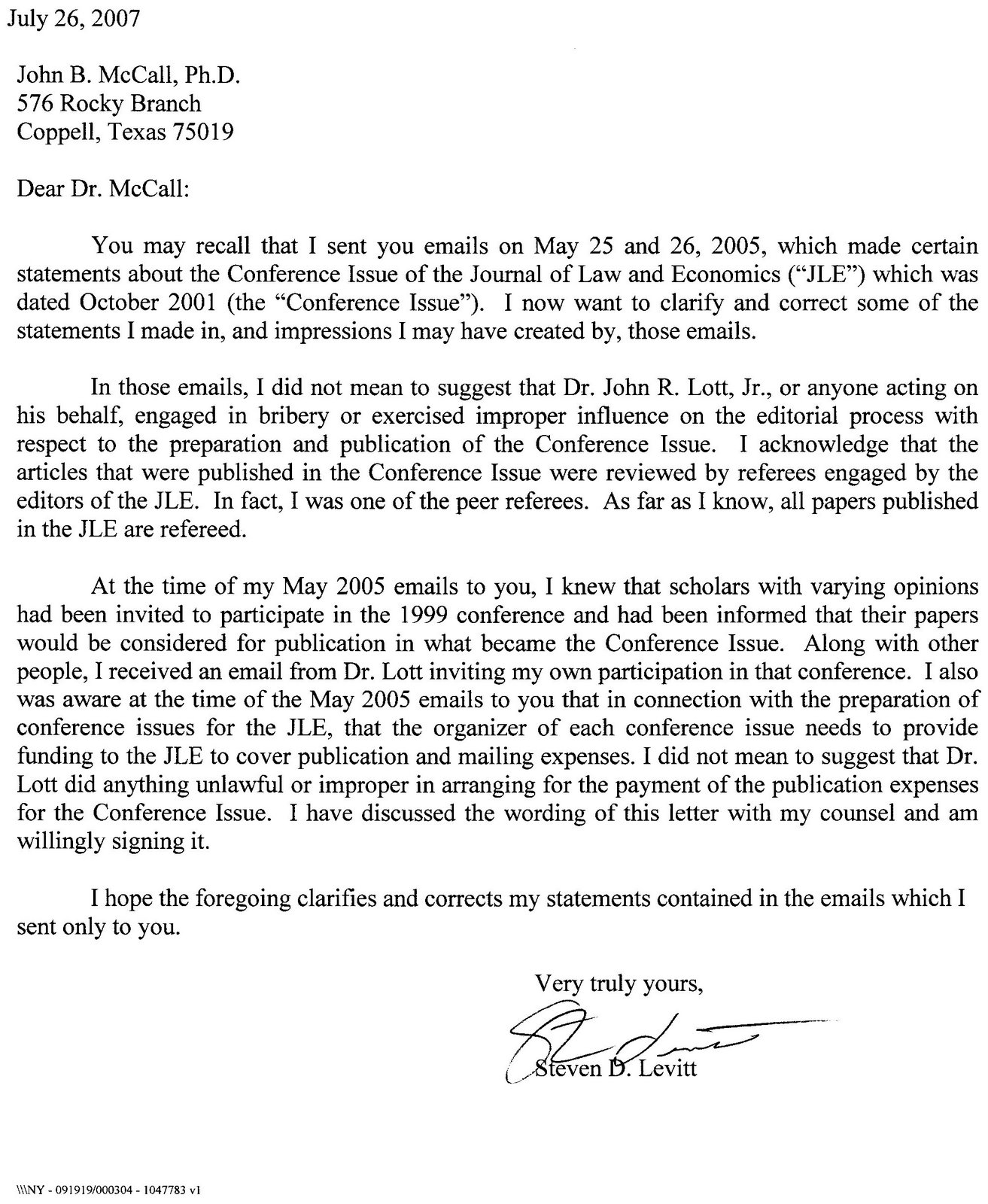
The New York Times brings Steven D. Levitt's Freakonomics blog on-board as an official NYT feature right at the moment we get to see Levitt's embarrassing "letter of clarification" in settlement of John Lott's defamation case against him!
Will the NYT ever report on this latest story involving their valuable asset? In 2005, the NYT, unlike the Wall Street Journal and The Economist, didn't report on Christopher Foote's and Christopher Goetz's discovery that their columnist's famous abortion-cut-crime theory was based on two errors Levitt had made.
So, probably not. As I wrote in the Washington Times in my review of Lott's anti-Levitt Freedomnomics: "Someone should write Celebrityonomics: Why Being Famous Beats Being Right."
As for defamation lawsuits, the Mahalanobis blog has some interesting reflections:
I have a lot of legal experience recently as a defendant, so in the Levitt vs Lott defamation spat, I found myself sympathetic to the defendant, Levitt. Levitt's admission that he said things to the effect that Lott was manipulating his results, and just plain dumb, I figured was his rightful opinion. Heck, if we are to make it illegal to have bad opinions, we would all be in jail. ... People have to learn to live with the fact that no one but Kim Jong-Il or Fidel Castro get 100% approval ratings. In sum, that someone thinks you are dumb or corrupt is so common it is hardly worth a legal remedy.
I had read the one sentence from Freakonomics that Lott found offensive, and was unmoved, as was the judge. But I just read the email that Levitt wrote to John McCall, where he asserts in a private e-mail that Lott's work published in a volume of the Journal of Law and Economics was a puff piece, bought and paid for by Lott or his puppet masters. As Levitt is a powerful person in economics (Editor of the highly respected Journal of Political Economy), whose opinion is therefore important to other people, with power comes responsibility. He is not a politician, so I think he should be free to say whatever he wants in public, no matter how mean or petty. To the extent he slanders or libels someone in public, its good advertising, because no one gets really mad when someone says 2+2=5, they get mad when you make good points.
But private correspondence is more problematic. If behind the scenes a powerful man is slandering someone, there's no accountability, it generates damages, and basically constitutes a conspiracy. This is especially so in this case because Levitt appears to have acted in bad faith, misstating known facts about things like whether something was refereed, ...
Another reminder that economists, like everyone else, are all too human. I hope Levitt takes this lesson to heart.
Personally, I might favor the law affording people a "one defamation margin of error:" if Levitt had more than once emailed somebody with this kind of thing, it would constitute a pattern. At present, however, all we know is that he did this once. (Another concern about suing over private emails is that a satirical statement not intended seriously might be taken literally, although that doesn't seem to apply here.)
Finally, to add some context, here's a paragraph from an earlier David Glenn article in the Chronicle of Higher Education:
"A participant in the conference told The Chronicle last year that Mr. Levitt's characterization of the issue as not peer-refereed was an exaggeration but not an outrageous untruth. Other participants, however, insisted that the issue was vigorously peer-reviewed. They said they had the impression that their work would have been rejected if they had not dealt with the reviewers' concerns."
My published articles are archived at iSteve.com -- Steve Sailer
I've long felt that the individual film critic's job isn't really to give you a thumbs-up or thumbs-down on whether a movie is good or not. You'd be better off looking up on Rotten Tomatoes an aggregation of critics' ratings to even out the random perturbations.
Now, there are a tiny number of unjustly-overlooked movies that I've helped call to public attention -- "Idiocracy," of course, but also Stephen Fry's Evelyn Waugh adaptation "Bright Young Things" and bring back to the conversation John Huston's "Man Who Would Be King" during the Afghan War, but, in general, I'm too old to care whether I'm succeeding in imposing my personal tastes upon the world. (Which is good, because I'm not!)
Instead, I see my job in my movie reviews as adding value. Some critics do this by being amusingly snarky, but I'm more earnest. I go read the book, Google the history, think about the issues the movie brings up. For example, my review of the Oscar-winning "Capote" came to the same conclusion as everybody else's: Philip Seymour Hoffman is great! I don't have the skills to explain much about why Hoffman was great within 735 words (but not too many other critics do, either). I do think I made some contribution by reading Capote's In Cold Blood and pointing out that the film screenwriter's unthinking bias against capital punishment made the film unfair to Truman Capote and his small but influential place in literary history.
Anyway, I don't think it's very hard to give a reasonably accurate thumbs up or thumbs down on individual movies, and most critics aren't bad at that aspect of the job. As I wrote to The Audacious Epigone:
There is a fair amount of agreement between critics and the public on movies within various classes: e.g., that "Saving Private Ryan" was better than "Flags of Our Fathers," or that "Gladiator" was better than "Alexander." Movies tend to "work" or not work, rather like a good band within a musical genre is pretty clearly better than a bad band.
Fortunately, he took me up on this and crunched the numbers on the correlation between critics' ratings and box office dollars. In "Movie Critics and Movie Mavens," he reports:
Steve's comment is borne out for the most part--critics do well ... by genre, except for horror (which they despise) and romance (which, not surprisingly, they just don't seem to get). Criticism and cynicism are often mistakenly thought to be synonyms, and this provides some justification for that confusion, as these genres are the two most susceptible to it. In action and science fiction, they do very well (.55 and .59 r-values, respectively). The disdain for horror extends across the board, as it received the lowest average score of all of the genres considered. For drama and children's movies, they perform about as well as movies at large.
Drama films are most likely to be heavily politically or culturally ideological, which is probably why critics don't do so well in this serious genre. It's similarly a tough one for the general public, as the characters and the actions they take are often judged in many gradations, open to more interpretation than say, concluding that Scar is a bad dude.
Fat Knowledge, in wondering how the general public fared compared to the critics, pointed me to Yahoo, which constructs an average user score based on thousands of online ratings. The folks obliterate the critics. Rotten Tomatoes' critic scores, the most reliable relative to box office receipts of the different services looked at, correlate with revenue at .295 to the Yahoo users' .405.
While the critics do a little better by genre than by all movies in general, Yahoo users beat the critics in every genre, excepting action and science fiction, by slim margins. Romance is the most glaring. Critic scores and box office performance correlate at a meaningless .06 to users' .77. That blossoming could never happen in real life! But two cowboys... Horror was similarly divergent. Apparently stuffy critics cannot degrade themselves enough to review horror movies with any seriousness--they all belong in the garbage bin!
The genre-to-revenue relationships (r-values) for professional critics, Yahoo users:
Genre, Pros, Yahoos
Action: .55, .48
Comedy: .41, .58
Drama: .28, .38
Horror: .09, .61
Kids: .27, .79
Romance: .06, .77
Sci-Fi: .59, .55
Thriller: .31, .42
Simply put, if you want to know how a movie will do, ask the moviegoing public that will go to see it. Not only do the movie-maven plebeians do better than the putative experts at predicting actual box office performance, they're a lot more stable across the board, always providing at least a moderate amount of insight. Of course, uppity critics would hate to be amalgamated as a group, so unique are their individual opinions! Find a critic that you feel to be insightful, and his criticism becomes valuable.
The data, via Swivel, is available here.
One addition that could be made to his analysis would be to make it a multiple regression analysis and add in budget as independent variable. Critics tend to grade on the curve, demanding much more from a $100 million movie than a $1 million dollar movie. (Perhaps we assume that the marketing budget is proportional to the production budget, so we can help a small budget movie more than a big budget one.) For example, the tiny Irish musical for heterosexuals "Once" got huge ratings on Rotten Tomatoes, with 97% positive reviews. On an absolute scale, it's really not that good, but it's the "Citizen Kane" of $150,000 movies. And the public seems to agree: it's made $6.5 million domestically, which is a huge return on investment.
My published articles are archived at iSteve.com -- Steve Sailer
To me, one of the hallmarks of nerdishness is a cognitive tendency toward being "object-oriented," as opposed to seeing things in context. I consider object-orientation a masculine mental trait, in some ways the opposite of women's intuition, where a woman processes a variety of clues to come to a holistic insight, typically about social relationships.
I've also argued that East Asians tend to be more masculine-minded than white Americans on average, as shown by having higher SAT Math relative to SAT Verbal scores and being good engineers, and the like.
On the other hand, Robert Nisbett, who has researched East Asian thinking patterns, says they are less object-oriented than white Americans (with East Asian-Americans falling in between) and more context-oriented. Razib reported on GNXP in 2003:
I just read Richard Nisbett's The Geography of Thought. You can read a summary of the book here as a press release from the University of Michigan. The critiques that some of the readers over at Amazon make about the book are spot-on, Nisbett has a collection of studies that he bandies about, which reinforces stereotypes and preconceptions about "Asian thinking" vs. "Western thinking."
·The West is reductionist, the East is holistic
·The East is accepts contradiction, the West must be consistent
·The West focuses on the object, the East observers the context
...and so forth. This is a recapitulation of tried & true generalizations. But I think Nisbett does us a service by showing that psychological tests have indicated quite clearly that these trends are true.
In 1991's Sexual Personae, Camille Paglia also argued that object-orientation is a Western tendency, comparing the European knight in shining armor to the Japanese samurai's much more organic-looking armor.
Perhaps these different mental orientations explain why, say, American engineers are better at inventing big breakthroughs, while Japanese engineers are better at integrating all the pieces into smoothly working systems? At least, that's what the Japanese seem to believe...
My published articles are archived at iSteve.com -- Steve Sailer
The Scott Thomas Beauchamp brouhaha: There's no market for first novels these days, but there's a big market for memoirs, so a variety of autobiographical fiction manuscripts have been relabeled as autobiographies: most notoriously, "A Million Little Pieces," but also, perhaps more relevantly, "Jarhead," a first Gulf War novel that got sold to the public as autobiography and made into a based-on-a-true-story movie, even though it contains a lot of old Marine lore passed off as actually happening to the narrator. (Here's my American Conservative review of "Jarhead.")
My published articles are archived at iSteve.com -- Steve Sailer
Liberals bloggers and readers of Daily Kos have been getting together at an annual convention, and it turns out -- surprise, surprise -- that when you see them in person, this latest manifestation of civil society consists of a whole bunch of white males. From the
A Diversity of Opinion, if Not Opinionators
At the Yearly Kos Bloggers' Convention, a Sea of Middle-Aged White Males
By Jose Antonio Vargas
CHICAGO, Aug. 5 -- It's Sunday, day 4 of Yearly Kos, the major conference for progressive bloggers, and Gina Cooper, the confab's organizer-in-chief, surveys the ballroom of the massive McCormick Place Convention Center. A few hundred remaining conventioneers are having brunch, dining on eggs, bagels and sausage.
Seven of the eight Democratic presidential candidates have paid their respects this weekend, and some 200 members of the credentialed press have filed their stories. A mere curiosity just two years ago, the progressive blogosphere has gone mainstream. But Cooper sees a problem.
"It's mostly white. More male than female," says the former high school math and science teacher turned activist. "It's not very diverse."
There goes the open secret of the netroots, or those who make up the community of the Internet grass-roots movement.
For all the talk about the increasing influence of this growing group -- "We are a community . . . a movement . . . an institution," Cooper said in a speech Saturday night -- what gets scant attention is its demography. While the Huffington Post and
Walking around
Historically, the progressive movement has included a myriad of special-interest and single-issue groups, and the challenge has always been to find common ground. The same is true on the Internet, but with an added twist. The Internet, after all, is not a "push" medium like television, where information flows out, but a "pull" medium, where people are drawn in.
Build a liberal site such as Daily Kos, as the Persian Gulf War veteran and former Republican Markos "Kos" Moulitsas Zuniga did five years ago, and bloggers either join the discussion or not. For two years now, Moulitsas has lent his name to the conference. But on Saturday, Cooper announced that next year the event will be called "Netroots Nation."
Cooper is worried about generating more "inclusion," using the word no less than six times in 15 minutes. ...
It's hard to think of another movement that has affected politics in such a short period of time, and the blogging culture is an informal, friendly community that has no one leader or single issue -- except, perhaps, strong opposition to the war in Iraq. Last year's Blogads Reader Survey found that the median political blog reader is a 43-year-old male who has an annual family income of $80,000, and judging by the number of middle-aged men who attended one panel after the next here, it's hard to argue with that. ...
Stoller half-jokingly says that the netroots community is full of "white liberal men," then quickly points out that Moulitsas is part Latino. (The other half is Greek.)
A lot of the influential segments of American society are almost as white male-dominated as in 1960, especially those where affirmative action doesn't apply, such as at liberal netroots conferences or as CEOs of Fortune 500 firms, which are about 99% white.
Political blogging, for example, is overwhelmingly dominated by white males, plus the occasional upper-caste Indian. Writing
In general, white males still tend to most of the interesting new things in the world.
So why are semi-elite non-quota organizations staying white male-dominated? Here are some hypotheses, focusing on the liberal netroots issue, but more widely applicable as well. Of course, they are, based on statistical generalizations. (I realize that thinking statistically is politically incorrect, but the universe works stochastically):
- Apparently, African-Americans have in recent decades tended to lose interest in fields that they can't dominate numerically and thus culturally: e.g., they've come to dominate the NBA and NFL, while losing interest in baseball. Blacks don't seem to want to be tokens anymore. For instance, from 1964-1986, five different black guys won a total of 23 PGA golf tournaments. In the last 20 years, however, only the 1/4th black Tiger Woods has won anything on the PGA.
Going to a netroots conference, for instance, probably strikes most black guys as something for particularly lame white nerds.
- Hispanics are vastly under-represented in most influential fields of civil society, perhaps for deep cultural reasons -- e.g., there's little civil society in
What's particularly striking is the under-representation of Hispanics, who now make up 1-7th of the residents of the country, in just about any quasi-elite organization, other than legislatures where the Voting Rights Act mandates the creation of majority-minority districts, and other affirmative-action influenced entities.
That Matthew Yglesias is on the verge of being the best-known Spanish-surnamed pundit in the country is bizarrely ironic.
- East Asians are doing well, but tend to be a little less assertive and little less interested in politics and the like.
- Women just aren't that interested in broadcasting their opinions to the world. They love to tell you their opinions personally, but telling the world about how to reform telecom policy tends to strike them as a waste of time.
- So, that leaves the main exception, South Asians, who tend to be very well-educated, quite verbal, and quite interested in politics and public affairs.
My published articles are archived at iSteve.com -- Steve Sailer
From the New York Times:
In Dusty Archives, a Theory of Affluence
By NICHOLAS WADE
For thousands of years, most people on earth lived in abject poverty, first as hunters and gatherers, then as peasants or laborers. But with the Industrial Revolution, some societies traded this ancient poverty for amazing affluence.
Historians and economists have long struggled to understand how this transition occurred and why it took place only in some countries. A scholar who has spent the last 20 years scanning medieval English archives has now emerged with startling answers for both questions.
Gregory Clark, an economic historian at the University of California, Davis, believes that the Industrial Revolution — the surge in economic growth that occurred first in England around 1800 — occurred because of a change in the nature of the human population. The change was one in which people gradually developed the strange new behaviors required to make a modern economy work. The middle-class values of nonviolence, literacy, long working hours and a willingness to save emerged only recently in human history, Dr. Clark argues.
Because they grew more common in the centuries before 1800, whether by cultural transmission or evolutionary adaptation, the English population at last became productive enough to escape from poverty, followed quickly by other countries with the same long agrarian past.
Dr. Clark’s ideas have been circulating in articles and manuscripts for several years and are to be published as a book next month, “A Farewell to Alms” (Princeton University Press). Economic historians have high praise for his thesis, though many disagree with parts of it. …
The basis of Dr. Clark’s work is his recovery of data from which he can reconstruct many features of the English economy from 1200 to 1800. From this data, he shows, far more clearly than has been possible before, that the economy was locked in a Malthusian trap _ — each time new technology increased the efficiency of production a little, the population grew, the extra mouths ate up the surplus, and average income fell back to its former level.
This income was pitifully low in terms of the amount of wheat it could buy. By 1790, the average person’s consumption in
… The tendency of population to grow faster than the food supply, keeping most people at the edge of starvation, was described by Thomas Malthus in a 1798 book, “An Essay on the Principle of Population.” This Malthusian trap, Dr. Clark’s data show, governed the English economy from 1200 until the Industrial Revolution and has in his view probably constrained humankind throughout its existence. The only respite was during disasters like the Black Death, when population plummeted, and for several generations the survivors had more to eat. … Dr. Clark started to wonder whether natural selection had indeed changed the nature of the population in some way and, if so, whether this might be the missing explanation for the Industrial Revolution. …
A way to test the idea, he realized, was through analysis of ancient wills, which might reveal a connection between wealth and the number of progeny. The wills did that, , but in quite the opposite direction to what he had expected.
Generation after generation, the rich had more surviving children than the poor, his research showed. That meant there must have been constant downward social mobility as the poor failed to reproduce themselves and the progeny of the rich took over their occupations. “The modern population of the English is largely descended from the economic upper classes of the Middle Ages,” he concluded.
As the progeny of the rich pervaded all levels of society, Dr. Clark considered, the behaviors that made for wealth could have spread with them. He has documented that several aspects of what might now be called middle-class values changed significantly from the days of hunter gatherer societies to 1800. Work hours increased, literacy and numeracy rose, and the level of interpersonal violence dropped.
Another significant change in behavior, Dr. Clark argues, was an increase in people’s preference for saving over instant consumption, which he sees reflected in the steady decline in interest rates from 1200 to 1800.
“Thrift, prudence, negotiation and hard work were becoming values for communities that previously had been spendthrift, impulsive, violent and leisure loving,” Dr. Clark writes.
Around 1790, a steady upward trend in production efficiency first emerges in the English economy. It was this significant acceleration in the rate of productivity growth that at last made possible
In the rest of Europe and
It is puzzling that the Industrial Revolution did not occur first in the much larger populations of
Hmmhmmh, well the Japanese and Chinese seem to be awfully bourgeois anyway, so I'm not sure what Dr. Clark's point is here … My guess is that the Industrial Revolution took both the bourgeois virtues, which the Japanese had in spades, and a little of the old "stroke of zigzag lighting in the brain" that the Japanese have always claimed they don't have compared to the more creative Europeans.
After the Industrial Revolution, the gap in living standards between the richest and the poorest countries started to accelerate, from a wealth disparity of about 4 to 1 in 1800 to more than 50 to 1 today. Just as there is no agreed explanation for the Industrial Revolution, economists cannot account well for the divergence between rich and poor nations or they would have better remedies to offer.
Many commentators point to a failure of political and social institutions as the reason that poor countries remain poor. But the proposed medicine of institutional reform “has failed repeatedly to cure the patient,” Dr. Clark writes. He likens the “cult centers” of the World Bank and International Monetary Fund to prescientific physicians who prescribed bloodletting for ailments they did not understand.
If the Industrial Revolution was caused by changes in people’s behavior, then populations that have not had time to adapt to the Malthusian constraints of agrarian economies will not be able to achieve the same production efficiencies, his thesis implies.
Dr. Clark says the middle-class values needed for productivity could have been transmitted either culturally or genetically. But in some passages, he seems to lean toward evolution as the explanation. “Through the long agrarian passage leading up to the Industrial Revolution, man was becoming biologically more adapted to the modern economic world,” he writes. And, “The triumph of capitalism in the modern world thus may lie as much in our genes as in ideology or rationality.”
What was being inherited, in his view, was not greater intelligence — being a hunter in a foraging society requires considerably greater skill than the repetitive actions of an agricultural laborer.
Okay, but, according to Clark, the people whose descendents survived in
Rather, it was “a repertoire of skills and dispositions that were very different from those of the pre-agrarian world.”
Reaction to Dr. Clark’s thesis from other economic historians seems largely favorable, although few agree with all of it, and many are skeptical of the most novel part, his suggestion that evolutionary change is a factor to be considered in history.
Historians used to accept changes in people’s behavior as an explanation for economic events, like Max Weber’s thesis linking the rise of capitalism with Protestantism. But most have now swung to the economists’ view that all people are alike and will respond in the same way to the same incentives. Hence they seek to explain events like the Industrial Revolution in terms of changes in institutions, not people.
Dr. Clark’s view is that institutions and incentives have been much the same all along and explain very little, which is why there is so little agreement on the causes of the Industrial Revolution. In saying the answer lies in people’s behavior, he is asking his fellow economic historians to revert to a type of explanation they had mostly abandoned and in addition is evoking an idea that historians seldom consider as an explanatory variable, that of evolution.
The decline in English interest rates, for example, could have been caused by the state’s providing better domestic security and enforcing property rights, Dr. Hoffman said, not by a change in people’s willingness to save, as Dr. Clark asserts. … [More]
Australian law prof Andrew Fraser offered a somewhat similar explanation for the English breakthrough a couple of years ago in an article that was censored by the Deakin Law Review. As I summarized in VDARE.com:
Perhaps the most intriguing of Fraser's many themes: his paradox that the same high level of "trust" (to use Francis Fukuyama's term) extending beyond kin that has allowed the English-speaking peoples to build self-governing institutions that square the circle of reconciling individualism with cooperation also threatens to undermine the Anglosphere—by making us suckers for self-sacrificing ideologies that more clannish immigrants laugh at.
In most countries, in most eras, you needed to belong to an extended family "mafia" for protection. Upper-middle class individuals in English-speaking countries, at least when not watching The Sopranos, generally just don't get the importance of extended families in the rest of the world. Anglosphere intellectuals are especially oblivious, for emotional reasons—they tend to despise their relatives, who often aren't as smart as they are, but frequently make more money.
The English were perhaps the first to break out of this rut. Fraser notes:
"Over time, individualistic social structures encouraged the emergence in
Some of the cultural attributes that emerged in
"Only a people such as the English, characterized by the ‘non-kinship based forms of reciprocity’ associated with Protestant Christianity, monogamy and companionate marriage, nuclear families, a marked de-emphasis on extended kinship relations, and a strong tendency towards individualism could possibly succeed in creating such a 'society of strangers.’"
Fraser speculates that these attributes have genetic roots. While that’s certainly possible scientifically, we're still a number of years away from being able to test that idea empirically.
But even if the roots of our civic societies were purely cultural in origin, as they may well be, these are not tendencies that immigrants can or will choose to adopt immediately—especially in our era, which glorifies multiculturalism and denigrates the host culture's traditional values.
Fraser argues:
"This exposes a fundamental paradox built into the free and open societies of the West: The only racial groups able to fit seamlessly into the society of strangers constituting a civic nation are those whose members can easily shed the deeply-ingrained ethnocentrism and xenophobia characterizing most non-European peoples."
My published articles are archived at iSteve.com -- Steve Sailer
I think this rather long column will help readers understand a little better why the "genealogical perspective" is so crucial for understanding human affairs:
Two Cheers For Pinker On Genealogy…But What About Race?
By Steve Sailer
Genealogy—the study of who a person's ancestors are—is viewed by American intellectuals as a quaint hobby of only individual interest. But it's actually one of the most under-explored paths to better understanding humanity.
So I was quite pleased to see the cover story in the August 6, 2007 issue of The New Republic, "The Genealogy Craze in America: Strangled by Roots" [Free registration required, or read it here.] by Steven Pinker, the Harvard psychologist and author of the outstanding 2002 bestseller The Blank Slate: The Modern Denial of Human Nature.
Pinker has become perhaps the pre-eminent spokesman for the human sciences. His next book, The Stuff of Thought: Language as a Window Into Human Nature, will be out in September.
I was especially happy because Pinker's article cogently articulates many of the ideas about the overlooked importance of kinship that he and I kicked around via email in the late 1990s, and which have provided the basis for many of my VDARE.com articles ever since. ...
[More]
My published articles are archived at iSteve.com -- Steve Sailer
From the New York Times:
Who’s a Nerd, Anyway?
By BENJAMIN NUGENT
What is a nerd? Mary Bucholtz, a linguist at the
While the word “nerd” has been used since the 1950s, its origin remains elusive. Nerds, however, are easy to find everywhere. Being a nerd has become a widely accepted and even proud identity, and nerds have carved out a comfortable niche in popular culture; “nerdcore” rappers, who wear pocket protectors and write paeans to computer routing devices, are in vogue, and TV networks continue to run shows with titles like “Beauty and the Geek.” As a linguist, Bucholtz understands nerdiness first and foremost as a way of using language. In a 2001 paper, “The Whiteness of Nerds: Superstandard English and Racial Markedness,” and other works, including a book in progress, Bucholtz notes that the “hegemonic” “cool white” kids use a limited amount of African-American vernacular English; they may say “blood” in lieu of “friend,” or drop the “g” in “playing.” But the nerds she has interviewed, mostly white kids, punctiliously adhere to Standard English. They often favor Greco-Latinate words over Germanic ones (“it’s my observation” instead of “I think”), a preference that lends an air of scientific detachment. They’re aware they speak distinctively, and they use language as a badge of membership in their cliques. One nerd girl Bucholtz observed performed a typically nerdy feat when asked to discuss “blood” as a slang term; she replied: “B-L-O-O-D. The word is blood,” evoking the format of a spelling bee. She went on, “That’s the stuff which is inside of your veins,” humorously using a literal definition. Nerds are not simply victims of the prevailing social codes about what’s appropriate and what’s cool; they actively shape their own identities and put those codes in question.
Though Bucholtz uses the term “hyperwhite” to describe nerd language in particular, she claims that the “symbolic resources of an extreme whiteness” can be used elsewhere. After all, “trends in music, dance, fashion, sports and language in a variety of youth subcultures are often traceable to an African-American source,” but “unlike the styles of cool European American students, in nerdiness, African-American culture and language [do] not play even a covert role.” Certainly, “hyperwhite” seems a good word for the sartorial choices of paradigmatic nerds. While a stereotypical black youth, from the zoot-suit era through the bling years, wears flashy clothes, chosen for their aesthetic value, nerdy clothing is purely practical: pocket protectors, belt sheaths for gadgets, short shorts for excessive heat, etc. Indeed, “hyperwhite” works as a description for nearly everything we intuitively associate with nerds, which is why Hollywood has long traded in jokes that try to capitalize on the emotional dissonance of nerds acting black (Eugene Levy saying, “You got me straight trippin’, boo”) and black people being nerds (the characters Urkel and Carlton in the sitcoms “Family Matters” and “The Fresh Prince of Bel-Air”).
But of course, this being the NYT, there has to be a deconstructionist coda that makes it the fault of white people:
By cultivating an identity perceived as white to the point of excess, nerds deny themselves the aura of normality that is usually one of the perks of being white. Bucholtz sees something to admire here. In declining to appropriate African-American youth culture, thereby “refusing to exercise the racial privilege upon which white youth cultures are founded,” she writes, nerds may even be viewed as “traitors to whiteness.” You might say they know that a culture based on theft is a culture not worth having. On the other hand, the code of conspicuous intellectualism in the nerd cliques Bucholtz observed may shut out “black students who chose not to openly display their abilities.” This is especially disturbing at a time when African-American students can be stigmatized by other African-American students if they’re too obviously diligent about school. Even more problematic, “Nerds’ dismissal of black cultural practices often led them to discount the possibility of friendship with black students,” even if the nerds were involved in political activities like protesting against the dismantling of affirmative action in
Of course, in
As I wrote in 1999 in "Nerdishness: The Unexplored Cornerstone of the Modern World:"
Nerdishness appears to me to be one of the main manifestations of masculinity, although radically different from the more famous hunter/warrior/jock/leader mode (let's use a term from African politics and designate representatives of the better known form of masculinity as "Big Men"). Certain fundamental trade-offs tend to distinguish nerds from Big Men. In the realm of intellectual traits:
1. Nerds are more "object-oriented," Big Men are more people-oriented.
2. Nerds tend to focus narrowly but deeply (single-tasking), Big Men broadly but shallowly (multitasking). Nerds lack the "situational awareness" that the Air Force prizes in fighter pilots, but their ability to concentrate obsessively makes them good at designing the planes that pilots fly.
3. Nerds work best asynchronously (as Howard Bloom says, they never say the right thing at the right time -- I can vividly recall walking along after a college history class, thinking about the Austro-Hungarian Empire, when some black friend passing by said, "Hey, what's happening?" "Hmmhmmh????," I thought to myself in consternation, "What exactly is happening? Well, the Austro-Hungarian Empire is definitely not happening, but what is?" About five minutes later, I came up with a clever, but by now useless, reply, which later I could never seem to remember the next time somebody asked me "What's happening?). In contrast, Big Men are better when they are "in the flow" (of the discussion, the hunt, the battle, the basketball game, or whatever).
Interestingly, in terms of cerebral skills, nerds tend to be more stereotypically masculine than Big Men, who benefit from stereotypically female mental skills like emotional intuition and multi-tasking. In contrast, nerds tend to be less traditionally masculine than Big Men in physical/emotional traits like muscularity, self-confidence, aggressiveness, etc.
As Mike Waller points out, cave-nerds probably made the stone axes for early cave-Big Men to hunt with. I suspect that nerdishness has been symbiotically related to the prosperity of communities. (Howard Bloom makes a similar point.) In nomadic hunter-gatherer tribes, nerds' object-orientation would not be very useful since objects tend to be heavy to carry. Similarly, in tribes that need just about every man to hunt, nerds' ineptness at making correct split-second decisions would tend to get them eaten by wild beasts, or at least shunned by women who want men who bring home meat. On the other hand, sedentary communities that have been able to free some men up from food provisioning or war-making, make greater degrees of specialization possible, allowing nerds to flourish as craftsmen. In turn, these nerdy technologists make the tools that allow even more men to stop hunting and farming and turn to nerd-work. Thus begins a virtuous cycle of economic growth. ...
These trade-offs between nerdishness vs. charismatic masculine leadership are readily apparent among different ethnic groups in industrial world, too. Allow me to quote a section from my review of Harvard economic historian David Landes' "The Wealth and Poverty of Nations: Why some are so rich and some so poor," which appeared in National Review on 4/6/98. In it I launched the following trial balloon:
"Interestingly, many of the most striking racial differences can be thought of as resembling faint sex differences. For example, contrast the triumph of Japanese manufacturing with
"Why? Japanese talents include a set of extremely masculine intellectual skills. Tests show they tend to excel at objective abilities like mathematics and mentally manipulating 3-d objects through "single-tasking" (focusing deeply upon a single impersonal logical problem). Blacks, on the other hand, are often better at typically feminine, more subjective cerebral skills like verbalization, emotional intuition and expression, sense of rhythm, sense of style, improvisation, situational awareness, and mental multi-tasking. Michael Jordan's brain, for instance, enables him to anticipate his opponent's every move while simultaneously demoralizing his foe with nonstop trash-talking. (Try it sometime. It's not easy.)
"Next, think about physical and emotional/personality traits. Here the races are arrayed in the opposite order. Blacks tend to display more of typically male qualities like muscularity, aggressiveness, self-esteem, need for dominance, and impulsiveness. In contrast, the Japanese economy benefits from a male workforce endowed with more typically feminine virtues like small fingers and fine motor skills, cooperativeness, humility and anxiety, loyalty, long-term orientation, diligence, and carefulness. Combined with their first-rate masculine mental skills, these make Japanese companies powerhouses at exporting superbly engineered machinery.
"Compared to Japanese organizations, black communities tend to be physically and psychologically masculine, sometimes to the point of disorderliness. Yet a relatively high percentage of individual black men achieve fame by possessing charismatically masculine looks and personalities, without the nerdishness that Dilbert-style male intellectual skills often induce."
My published articles are archived at iSteve.com -- Steve Sailer
The LA Times reports on the campaign for governor of the northern half of
He offers reporters drinks of his favorite tequila, custom-brewed by a Chinese-Mexican restaurateur and fermented with rattlesnake hides and penises of lions and tigers, which the father of 19 swears makes him virile.
On a recent swing through the Valle de Mexicali, Hank took the wheel of a van carrying 14 volunteers and screeched around tight turns, ran stop signs and blew through red lights. In the rush to keep up, one volunteer almost slammed the door on a woman trying to give Hank a letter.
Hank, 51, is PRI royalty, the son of Carlos Hank Gonzalez, an early party stalwart and former governor of the state of Mexico and Mexico City mayor who amassed a billion-dollar fortune and, according to legend, coined the phrase, "A politician who is poor is a poor politician."
The younger Hank moved to Tijuana in 1985 to run the historic Agua Caliente track, which features dog races. The enormous grandstand is the showcase property in an empire that includes shopping centers, hotels and off-track betting parlors.
Hank, who inherited half his father's wealth, estimates his worth has doubled to $1 billion in the last three years.
To many, he appears to spend every penny of it.
This year he flew in superstar singers Julio Iglesias and Luis Miguel to entertain at personal parties. He owns about 30 cars and a house in Vail, Colo. Three times a year, he throws open the doors at the racetrack for gift-giving extravaganzas. On Mother's Day, thousands of women cart home stoves, refrigerators and other appliances.
Behind his home he keeps an enormous private zoo. It has bears and lions, kangaroos and ostriches, and three rare white tigers. The zoo, which has 20,000 animals, isn't that impressive, Hank says. "Any sultan or guy in Africa has a zoo," he once said. ...In a comic book distributed to children at events, Hank is depicted as a caped superhero, Hombre H., a fearless crime fighter and protector of the poor.
Fun stuff.
So, it's not true that the American media doesn't cover Mexico, but what's lacking is any kind of resonance in the NY-DC media echo chamber. This kind of south-of-the-border color gets dutifully reported upon, but that's as far as it goes in the press.
For example, while Jorge Hank Rhon is the out-of-control Sonny-Fredo member of the Hank family, his brother Carlos Hank Rhon is more the Michael Corleone-type, who has had ties to lots of big timers in American politics, including the President of the United States. But who cares about boring stuff like that?
My published articles are archived at iSteve.com -- Steve Sailer
Here's an email from a new public school teacher in
Those who can, do.
Those who can't, teach.
Those who can't teach get a Ph.D. in Education so they can implement instruction for instructional implementers.
My published articles are archived at iSteve.com -- Steve Sailer
Have you ever noticed how vastly much more attention is paid in the America press to Israel, a country of 6 million an ocean away, than to Mexico, a country of 109 million that shares a 1,952 mile border with us?
I'm not talking here about press bias for or against
For example, last year a leftist uprising that started among school teachers seized control of the big Mexican city of Oaxaca, a common destination for American tourists, and held it against federale attacks for quite a long time, but this seemingly interesting news created barely a ripple in the American media compared to the tsunami of reporting and commentating on Israel.
My published articles are archived at iSteve.com -- Steve Sailer
By the most detailed account, Bonds didn't start juicing until after all the hoopla over Mark McGwire and Sammy Sosa's jet-fueled home run chase in 1998 made him jealous and frustrated. He turned 34 in the second half of 1998, his 13th season, finishing the year with 411 homers, having hit 42, 40, and 37 over 1996-98.
My best guess is that if Bonds had stayed clean, right about now he'd wrapping up his career at age 43, probably playing DH in the American League, and trying to hang around to reach 600 homeruns. A normal looking Bonds hitting 189 homers over 1999-2007, or 21 per year, seems quite plausible. That would have moved him ahead of Frank Robinson, who had long been in fourth place with 586, behind Hank Aaron (755), Babe Ruth (714), and Willie Mays (660). (Sammy Sosa, who was likely a juicer, just passed 600, while Ken Griffey Jr., who certainly looked clean during his prime, is at 588 and counting.)
Assume Bonds had hit 600 homers, clean and while playing in pitchers parks most of his career. Add to that 500 stolen bases, a huge number of walks (e.g., 151 in 1996), a ton of runs scored, and good defense, that would likely have moved him past Frank Robinson and into contention with the great triumvirate of Willie Mays, Mickey Mantle, and Hank Aaron to contend for the honor of the greatest player since WWII. As time goes by and the statistics of the cheaters fall into disrepute, Bonds clean numbers would have stood out more gloriously.
But he decided to throw it all away to beat the cheaters at their own game.
My published articles are archived at iSteve.com -- Steve Sailer
In the wake of the
- Road-building is a national disgrace. It's corrupt -- Mayor Daley's closest buddies in Chicago are the road-builders who finance his campaigns in return for enormous contracts -- and thus the quality of our roads intentionally stink, wearing down our cars and lowering our gas mileage. They're supposed to fall apart because that puts more money in campaign donors' pockets. Roads in
- The more densely populated the country gets, the harder it is to build infrastructure because of Not In My Backyardism, which increases with the number of backyards. There will never be another freeway built in
- Compared to 1950, it takes forever to build anything these days, largely because of environmentalism, but every activist has his hand out too. To finish the Century Freeway to LAX, for example, CalTrans had to payoff hundreds of "community" organizations, including an AIDS group in
- The simplest way to slow the worsening of the population-to-infrastructure ratio is to cut back on immigration, just as it's also the simplest way to lessen the increasing stress on other problem spots, such as public schools, inequality, and health insurance. Instead, what we constantly hear is: "Oh, no, all we have to do is fix the public schools [inequality] [health care] [or various other problems that we have no likelihood of ever coming up with a magic bullet fix for].
My published articles are archived at iSteve.com -- Steve Sailer
The Atlanta Falcons quarterback who is facing trial on charges of horrific abuse of dogs while holding dog fights at his mansion, has one of the world's greatest bodies, but not, by most accounts, one of the world's greatest brains.
A reader sent me a link to a Randall Parker Future Pundit item from 2006 that was prescient:
High Testosterone Men More Abusive To Dogs
Another reader noted Peter King's obituary in Sports Illustrated for the brilliant football innovator Bill Walsh, who, more than anybody else, invented the modern pass-crazy NFL offensive style. King quotes Walsh from 1991, which might have some relevance to Vick:
"As a coach, I know I have to start with smart players. It might not have been so important in past years, but today we're asking players to do so much and to know so many schemes. Without basic intelligence, they simply can't play. And if they're not just plain smart, they're not going to be able to do the things a sophisticated coach is going to ask. With the speed on the field today, their technique and knowledge of what they have to do has to be keen or they'll get buried. A player like Bill Ring of the 49ers, who wasn't physically gifted, was a great contributor, despite his lack of speed and size and quickness, because he was a tremendous student of the game.
"As you'll see in this book, intelligent players have an infinitely better chance to succeed. On offense, they have to cope more and more with things like the no-huddle and quick snaps. In a few years, who knows? Maybe there won't be huddles. On defense, they have to cope with different schemes and all the substitution. When I look for players now, even at Stanford, I can rule out a lot of people fast. They have to have above-average intelligence combined with the ability to function under stress ...
My published articles are archived at iSteve.com -- Steve Sailer
I hadn't been paying much attention to economist John R. Lott's defamation lawsuit against Freakonomist Steven D. Levitt: I don't like lawsuits. But now I've finally read the two 2005 emails at the heart of one count of Lott's suit. I'm sure I don't understand all the details of the situation, but they seem pretty eye-opening.
They were between an economist named John McCall and Levitt, and they touch upon the October 2001 issue of the
From: John McCall
Subject: Freakonomics note yesterday to you
To: steve levitt
Hi Steve,
I went to the website you recommended -- have not gone after the round table proceedings yet -- I also found the following citations -- have not read any of them yet, but it appears they all replicate Lott's research. The Journal of Law and Economics is not chopped liver.
Have you read through any of these?
http://johnrlott.tripod.com/postsbyday/RTCResearch.html
Cordially,
John McCall PhD
Levitt replied:
From: slevitt@[deleted for anti-spam purposes]
Date: Wed May 25, 2005 9:18:28 PM US/Central
To: John McCall
Subject: Re: Freakonomics note yesterday to you
John,
It was not a peer refereed edition of the Journal. For $15,000 he was able to buy an issue and put in only work that supported him. My best friend was the editor and was outraged the press let Lott do this.
Steve
The Chronicle of Higher Education now writes:
"Mr. Levitt's letter of clarification, which was included in Friday's filing, offers a doozy of a concession. In his 2005 message, Mr. Levitt told Mr. McCall that "it was not a peer-refereed edition of the Journal." But in his letter of clarification, Mr. Levitt writes: "I acknowledge that the articles that were published in the conference issue were reviewed by referees engaged by the editors of the JLE. In fact, I was one of the peer referees."
"Mr. Levitt's letter also concedes that he had been invited to present a paper at the 1999 conference. (He did not do so.) That admission undermines his e-mail message's statement that Mr. Lott had "put in only work that supported him."
"In his letter of clarification to Mr. McCall, Mr. Levitt said, "At the time of my May 2005 e-mails to you, I knew that scholars with varying opinions had been invited to participate in the 1999 conference and had been informed that their papers would be considered for publication in what became the conference issue."
If Dr. Levitt wishes an opportunity to further clarify what has emerged so far of his letter of clarification, he is welcome to post in my comments.
Update: Mario Delgado posts some relevant information in a comment on the Deltoid blog, including a quote from a participant in the conference: "A participant in the conference told The Chronicle last year that Mr. Levitt's characterization of the issue as not peer-refereed was an exaggeration but not an outrageous untruth."
My published articles are archived at iSteve.com -- Steve Sailer
A friend's phone number is one digit off from the local recruiting office of the U.S. Marines, so their dinner is occasionally interrupted by young men calling to enlist. His daughter ordered the last caller to "Drop and give me 50!" Huffing and puffing ensued out of the phone.
In related news, the Sikhs are the War Nerd's kind of guys: "Sikh to Death."
My published articles are archived at iSteve.com -- Steve Sailer
A Lieutenant Colonel writes from
I just read your 2003 article, "Cousin Marriage Conundrum." You're right on the money about
On the other hand, pure tribal identity still plays a big role in
There is an interesting counterpoint to the enduring nature of tribal loyalty in
It doesn't always turn out this well, however.
My published articles are archived at iSteve.com -- Steve Sailer
Because I have one of those $9.97 subscriptions to the New Republic, I can't tell if Steven Pinker's cover story in the August 6th issue, which does such a fine job of summarizing a lot of my approach to thinking about humanity (with one obvious exception), is available to nonsubscribers. Can you get to the full article from here? Or, how about from there?
My published articles are archived at iSteve.com -- Steve Sailer

 Posts
All Comments
Posts
All Comments

 Posts
All Comments
Posts
All Comments
 Posts
All Comments
Posts
All Comments




 Posts
All Comments
Posts
All Comments