Showing posts sorted by relevance for query "Dreams from my father". Sort by date Show all posts

September 25, 2009

Obama and Ayers and "Dreams from My Father"

Veteran celebrity journalist Christopher Andersen, who has written dozen of quick books about famous folks like Jackie O, has a new book out, Barack and Michelle: Portrait of an American Marriage. In it, Andersen states, in an unfortunately unsourced fashion, that unrepentant terrorist Bill Ayers at least copy-edited the President's memoir Dreams from My Father. Did he also write it, as Jack Cashill has long maintained?

In either case, it supports the inference that Obama was, in his lawyerly way, being intentionally misleading when he said in a primary debate in response to a George Stephanopolous question about Ayers:

OBAMA: George, but this is an example of what I'm talking about. This is a guy who lives in my neighborhood, who's a professor of English in Chicago who I know and who I have not received some official endorsement from. He's not somebody who I exchange ideas from on a regular basis.

And the notion that somehow as a consequence of me knowing somebody who engaged in detestable acts 40 years ago, when I was 8 years old, somehow reflects on me and my values doesn't make much sense, George.

You can search through Andersen's book on Amazon.

Andersen writes on p. 165:
What did interest Barack were Ayers's proven abilities as a writer. Unlike Barack, Ayers had written and cowritten scores of articles and treatises, as well as several nonfiction books beginning with Education: An American Problem in 1968. But it was the tone Ayers had set in his latest book -- To Teach (1993) -- that Barack hoped to emulate.

The tale of a maverick teacher who takes her students onto the streets of New York to teach them firsthand about history, culture, and survival, To Teach was written in a fluid, novelistic style. Barack asked for Ayers's input, and Ayers, who like so many in his circle was greatly impressed by the charismatic young activist, obliged.

To flesh out his family history, Barack had also taped interviews with Toot, Gramps, Ann, Maya, and his Kenyan relatives. These oral histories, along with his partial manuscript and a trunkload of notes, were given to Ayers. "Everyone knew they were friends and that they worked on various projects together," another Hyde Park neighbor pointed out. "It was not secret. Why would it be? People liked them both."

In the end, Ayers's contribution to Barack's Dreams from My Father would be significant -- so much so that the book's language, oddly specific references, literary devices, and themes would bear a jarring similarity to Ayers's own writings. ...

There was a good deal of literary back-scratching going on in Hyde Park," said writer Jack Cashill ... Thanks to the help from the veteran writer Ayers, Barack would be able to submit a manuscript to his editors at Times Books. With some minor cuts and polishing, the book would be on track for publication in the early summer of 1995. In the meantime, he began showing the rough draft to a chosen few relatives.

Andersen's notes for the chapter appear on p. 309-310 but, unfortunately, they're not terribly informative as to his sources for any particular assertion. Did he do original interviews on the Ayers question? He'll need to get a lot more specific to make this stick. Obviously, there's no chance that any bigfoot Washington reporter will ever ask Obama about it.

Andersen's reference to Ayers' 1993 book To Teach is interesting because the soporific prose style of To Teach appears closer to Dreams from My Father than the livelier prose style in Ayers' own 1999 autobiography Fugitive Days, which begins with the unObama-like sentence: "Memory is a m-----------."

I certainly find it plausible that Ayers copy-edited Dreams from My Father. For example, as I pointed out in February, the Annenberg Project that Obama chaired had the same mailing address as Ayers's Small Schools Workshop, both on the third floor of a small office building: 115 S. Sangamon St., Third Floor. I've never seen anybody ask whether they were run out of the same exact office.

But, some reporter needs to get somebody from Hyde Park on record as saying that Ayers helped Obama write Dreams. Perhaps a disgruntled old radical might spill the beans. Has anybody asked, say, Rev. Dr. Jeremiah A. Wright, Jr. about this?

My published articles are archived at iSteve.com -- Steve Sailer

March 12, 2008

A pundit reads (!) "Dreams from My Father"

Mona Charen writes:

"In search of answers that go deeper than the Congressional Record, I read his first book, "Dreams from My Father: A Story of Race and Inheritance." Once you get past the happy surprise of finding a politician who can actually write, the book contains some disquieting elements.

"Obama is the product of a union between a white Kansan and a black Kenyan who met in Hawaii. I had assumed, before reading his memoir, that Obama viewed himself as a natural bridge between the races and that his message of unity sprang in part from his biology. That was wrong. From his earliest years, Obama engaged in a preoccupying internal struggle to make himself a fully authentic black man."

James Fulford points out that it's about time more pundits read the Democratic frontrunner's memoir.

I think a lot of people just assumed that what they knew about Tiger Woods -- came from a stable mixed race home, didn't favor one part of his heritage over another, had a rock-solid psyche, etc. -- also applied to Obama. I realize that doesn't make one bit of sense, but stupid ideas can get stuck in people's heads for stupid reasons -- like all the doctors who assume that whooping cough is practically extinct because whooping cranes are practically extinct.

Charen very nicely sums up the slipperiness of the book:

"Left-wing ideas are not so much articulated in this memoir as presumed."

Which means you have to read the book to get a sense of where he's coming from. There are no soundbites in it.

You hear a lot of talk about whom Obama's role model might be: Martin Luther King? Malcolm X? Ronald Reagan? Obama's campaign kickoff rally in Springfield, Illinois last year was carefully crafted to remind voters of Abraham Lincoln.

And yet, Obama's most important role model would seem to be another Harvard Law School grad (Class of 1966), one who was nominated to the U.S. Supreme Court during the summer between Obama's second and third years at Harvard Law School: David Souter, the "stealth nominee" with almost no paper trail. In contrast to the outspoken Robert Bork in 1987, Souter cruised to easy approval by the Senate.

It seems silly to accuse a man who published his autobiography at age 33 of hiding his views like Souter. And yet ...

One idea I had was to take random swatches of Obama's prose from Dreams from My Father and paste it into Word and run the Spelling and Grammar checker to get Readability Statistics. My guess is that the average sentence length in Dreams is very high.

But where can I find slabs of vintage prose from a man who abhorred leaving a paper trail? I thought about checking this statistic from quotations from Dreams in my articles, but I tended to pick more easily comprehensible excerpts and/or replace unnecessary clauses with ellipses to try to make his words less eye-glazing.

All I could find online was Obama's Preface to the 2004 edition of Dreams, which may not be representative of his 1995 book, since he says in it, "I have the urge to cut the book by fifty pages or so, possessed as I am with a keener appreciation for brevity."

For that 2004 selection, the Flesch-Kincaid Grade Level is 12.2 (first year of college). I really don't know how the Flesch-Kincaid Grade Level is arrived at.

By way of comparison, Obama's 2004 Preface is rated for a lower grade level than my 2007 American Conservative article, "Obama's Identity Crisis," about the book (13.2). Interestingly, though, Obama's average sentence length is 30.4, compared to my 23.8. And that's including two comically serpentine sentences I quoted from John Updike's The Coup (average length 48 words and Grade Level of 21.1, or 6th year of postgraduate work!)

March 12, 2007

Obama, Identity Artist

More journalists are starting to read Sen. Barack Obama's elegant autobiography Dreams from My Father: A Story of Race and Inheritance all the way through and ask questions. (My big article in the 3/26/07 American Conservative on Obama's first 33 years is now in the online edition.)

The contrast between the suave master politician we see on screen and the racially traumatized young man described in his autobiography remain a mystery, one that needs to be solved before the 2008 election. We elected a pig in a poke President in 2000 and are paying the price today. With George W. Bush, we at least had the excuse for not making the effort to understand him that he turns out to be not very interesting to understand -- he's Chauncey Gardiner with a mean streak and some Daddy issues. Obama, in contrast, is a man of parts, a superior individual who rewards investigation.

Here's a new article from the LA Times:


Obama classmates saw a smile, but no racial turmoil
His Hawaii peers had no idea of the inner conflict his memoir describes. They recall a happy kid who fit in.
By Richard A. Serrano

Today, Obama is a campaign sensation, in part because he is seen as the first black presidential candidate who might be able to reach beyond race, building support among Americans of all backgrounds.

That capacity does not surprise the students who knew Obama at Punahou School, which carefully nurtured a respect for diversity. "We had chapel sessions on the Bahai faith, Islam, Judaism, and all forms of Christianity," said Bernice G. Bowers, a classmate. "The message was that diversity made for a richer community."

Dressed like other boys in the required collared shirts and khaki pants, Obama was one of a small number of blacks, but the student body included large numbers of kids with Chinese, Japanese, Samoan and native Hawaiian ancestry, as well as many whites. "We didn't think about his blackness," said Mark Hebing, who went to school with Obama for eight years…

Punahou was where Obama first awakened to these issues, and to the complexities of being black in America. In his bestselling memoir, "Dreams From My Father," he writes that during his time at the school — from fifth grade through his high school graduation in 1979 — he felt the first stirrings of anger toward whites. He says he also delved into black nationalism. He also experimented with marijuana and occasionally cocaine, which were prevalent in the '70s but presented what Obama in his book calls special dangers for young black men. …

Obama says that as he found his way in the world, he learned there were limits to the desirability of advertising his race. "People were satisfied so long as you were courteous and smiled and made no sudden moves," he writes in "Dreams." "They were more than satisfied; they were relieved — such a pleasant surprise to find a well-mannered young black man who didn't seem angry all the time."

Certainly Obama's classmates had little sense of what he says was going on beneath the surface. "His reflections about the race issue surprised all of us," said Kellie Furushima, who knew him well. "He gave no indication of feeling uncomfortable in school, and I never witnessed or heard anyone being unkind to him. [More]


So, what's the story with Obama?

Here's one possibility I've kicked around. I've known a fair number of people who have battled depression, paranoia, and other emotional problems. During the bad spells, they can't remember their past happiness, just disturbing incidents that they string together to make up a story about how they've always been depressed and/or oppressed. Dreams from My Father resembles the kind of depressive's literature that psychiatrist Peter D. Kramer has pointed out is so common that it has become our expectation of what fine writing is like. A cheerful artist such as Nabokov seems like an anomaly to us.

On the other hand, I've never heard of any evidence for Obama being emotionally unstable … other than his own autobiography. Looking at his resume, he seems to have motored along through his career nicely, dotting every I and crossing every T so that at age 45 he's a serious candidate for President.

There is little market these days for a literary first novel, but a large one for "memoirs" of unhappy young people, so the publishing industry has been channeling creative writers into claiming a degree of veracity for their efforts that has led to numerous scandals, such as the exposures of A Million Little Pieces and The Heart Is Deceitful Above All Things as hoaxes. Obama's not that creative, but perhaps Dreams from My Father should be read as an autobiographical novel rather than as an autobiography?


My published articles are archived at iSteve.com -- Steve Sailer

April 8, 2008

Barack Obama Sr.'s Mugabeist plan for Kenya

Kenya was a Cold War ally of the U.S. For example, Kenya boycotted the 1980 Moscow Olympic Games at President Jimmy Carter's request, a bigger sacrifice for Kenya than most of other 28 countries that boycotted, since the Olympic running events provide Kenya with its main shot at glory on the international stage. The international prestige of Kenya's first President, Jomo Kenyatta and Kenya's relatively successful evolution, meant that Kenya's "pro-capitalist" (in truth, crony capitalist) policies were a valuable counterexample during the Cold War struggle for hearts and minds of Third World countries.

No thanks, however, to Harvard-trained economist Barack Obama Sr., who consistently argued within Kenya's elite for socialism and ditching the pro-American orientation. In an important piece of original research, Greg Ransom of PrestoPundit shows that leftism was the Dream from My Father:
There's a big mystery at the heart of Barack Obama's Dreams For My Father: A Story of Race and Inheritance. What was Barack Obama doing seeking out Marxist professors in college? Why did Obama choose a Communist Party USA member as his socio- political counselor in high school? Why was he spending his time studying neocolonialism and the writings of Frantz Fanon, the pro-violence author of "the Communist Manifesto of neocolonialsm", in college? Why did he take time out from his studies at Columbia to attend socialist conferences at Cooper Union?

And there is more mystery in the book. Why does Obama consider working in a consulting house for international business like being "a spy behind enemy lines?" Why does he repeatedly find it so hard to explain his political views to others? Why was he driven to become a left-aligned political organizer? It's a question Obama again and again can't seem to answer to the satisfaction of the interlocutors in his own memoir.

If there is a mystery at the heart of Barack Obama's Dreams For My Father, one thing is not left a mystery, the fact that Barack Obama organized his life on the ideals given to him by his Kenyan father. Obama tells us, "All of my life, I carried a single image of my father, one that I .. tried to take as my own." (p. 220) And what was that image? It was "the father of my dreams, the man in my mother's stories, full of high-blown ideals .." (p. 278) What is more, Obama tells us that, "It was into my father's image .. that I'd packed all the attributes I sought in myself." And also that, "I did feel that there was something to prove .. to my father" in his efforts at political organizing. (p. 230)

So we know that his father's ideals were a driving force in his life, but the one thing that Obama does not give us are the contents of those ideals. ...

A bit of research at the library reveals the answers about Barack Obama's father and his father's convictions which Obama withholds from his readers. A first hint comes from authors E. S. Atieno Odhiambo and David William Cohen in their book The Risks of Knowledge (Ohio U. Press, 2004). On page 182 of their book they describe how Barack Obama's father, a Harvard trained economist, attacked the economic proposals of pro-Western 'third way" leader Tom Mboya from the socialist left, siding with communist-allied leader Oginga Odinga [father of current Luo leader Raila Odinga, who recently claimed to be Sen. Obama's cousin], in a paper Barack Obama's father for the for the East Africa Journal. As Odhiambo and Cohen write:

"The debates [over economic policy] pitted .. Mboya against .. Oginga Odinga and radical economists Dharam Ghai and Barrack Obama, who critiqued the document for being neither African nor socialist enough."

Ransom dug up from the stacks at UCLA the 1965 paper "Problems Facing Our Socialism" by Barack H. Obama in the East Africa Journal.

... The paper is as describe by Odhiambo and Cohen, a cutting attack from the left on Tom Mboya's historically important policy paper "African Socialism and Its Applicability to Planning in Kenya." The author is given as "Barak H. Obama" and his paper is titled "Problems Facing Our Socialism," published July, 1965 in the East African Journal, pp. 26-33.

Obama stakes out the following positions in his attacks on the white paper produced by Mboya's Ministry of Economic Planning and Development:

1. Obama advocated the communal ownership of land and the forced confiscation of privately controlled land, as part of a forced "development plan", an important element of his attack on the government's advocacy of private ownership, land titles, and property registration. (p. 29)

2. Obama advocated the nationalization of "European" and "Asian" owned enterprises, including hotels, with the control of these operations handed over to the "indigenous" black population. (pp. 32 -33)

3. Obama advocated dramatically increasing taxation on "the rich" even up to the 100% level, ...

4. Obama contrasts the ill-defined and weak-tea notion of "African Socialism" negatively with the well-defined ideology of "scientific socialism", i.e. communism. Obama views "African Socialism" pioneers like Nkrumah, Nyerere, and Toure as having diverted only "a little" from the capitalist system. (p. 26)

5. Obama advocates an "active" rather than a "passive" program to achieve a classless society through the removal of economic disparities between black Africans and Asian and Europeans. (p. 28) "While we welcome the idea of a prevention [of class problems], we should try to cure what has slipped in .. we .. need to eliminate power structures that have been built through excessive accumulation so that not only a few individuals shall control a vast magnitude of resources as is the case now .. so long as we maintain free enterprise one cannot deny that some will accumulate more than others .. " (pp. 29-30) ...

8. Obama strongly supports the governments assertion of a "non-aligned" status in the contest between Western nations and communist nations aligned with the Soviet Union and China. (p. 26)
[More]

In short, the Presidential frontrunner's father's policy views were similar to Robert Mugabe's.

In Obama's memoirs, he plays up his father's failure to achieve the brilliant career seemingly open to him in the mid-1960s as due to ethnic politics (he was a Luo, Kenyatta a Kikuyu), and, later, due to his father's drinking. But the Presidential candidate skips over the more politically relevant ideological clash between his father and Kenyatta. As Mona Charen noted, leftism is more assumed than articulated in Obama's slippery autobiography.

Although, Barack Obama Jr. spent only one month of his life with his father, when he came to visit Hawaii when his son was a schoolboy at Punahou prep, the young man heard plenty about his father's brilliance and high ideals from his leftist mother, who remained a lifelong defender of her ex-husband, and leftist paternal grandfather.

Obviously, Obama is not going to impose his father's Mugabeist ideals on America. He's clearly evolved ideologically. Still, Ransom's important work raises the essential question: How far has he evolved? And has his heart kept up with head? The nominating process is practically over and we're only now beginning to understand just how far to the left Obama started out, and we really don't have a clue what the future trajectory of his personal ideology would look like.

Perhaps one of our thousands of political reporters should ask him?

My published articles are archived at iSteve.com -- Steve Sailer

October 30, 2008

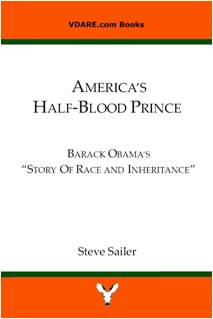
The Introduction to my book: "America's Half-Blood Prince: Barack Obama's Story of Race and Inheritance"

We've posted online my entire 264 page book, America's Half-Blood Prince: Barack Obama's Story of Race and Inheritance. You'll be able soon to order a paperback copy for $29.95, but in the meantime, you can start reading it online here:


To give you a taste, here's the first chapter. (The killer chapter, though, is the second, which tells why Obama's mother indoctrinated him in the dreams from his father.)

1. Introduction

I am new enough on the national political scene that I serve as a blank screen on which people of vastly different political stripes project their own views. As such, I am bound to disappoint some, if not all, of them. Which perhaps indicates a second, more intimate theme to this book–namely, how I, or anybody in public office, can avoid the pitfalls of fame, the hunger to please, the fear of loss, and thereby retain that kernel of truth, that singular voice within each of us that reminds us of our deepest commitments.

Barack Obama
The Audacity of Hope, 2006


The fundamental irony of Sen. Barack Obama’s Presidential candidacy is that no nominee in living memory has been so misunderstood by the press and public, and yet no other candidate has ever written so intimately or eloquently (or, to be frank, endlessly) about his “deepest commitments.”

While journalists have swarmed to Alaska with admirable alacrity to ferret out every detail of Sarah Palin‘s energetic life, the media have drawn a curtain of admiring incomprehension in front of Obama’s own exquisitely written autobiography, Dreams from My Father. Because few have taken the trouble to appreciate Obama on his own terms, the politician functions as our national blank slate upon which we sketch out our social fantasies.

Although many have supported Obama in 2008 because he seems to them better than the alternatives, he has also famously electrified throngs of voters. Yet, the reasons for their enthusiasm are often contradictory.

For example, many Americans, whether for Obama, McCain, or None of the Above, appreciate the patriotic, anti-racialist sentiment in the most famous sentence of Obama’s keynote address to the 2004 Democratic Convention: “There is not a Black America and a White America and Latino America and Asian America—there’s the United States of America.”

Yet, Obama’s white enthusiasts are often excited by the candidate’s race, and for diverse motivations. More than a few white people, for instance, wish to demonstrate their moral and cultural superiority over more backward members of their own race. As Christian Lander’s popular website Stuff White People Like acerbically documents, white people strive endlessly for prestige relative to other whites, scanning constantly for methods to claw their way to the top of the heap. In this status struggle, nonwhites seldom register on white people’s radar screens as rivals. Instead, white people see minorities more as useful props in the eternal scuffle to gain the upper hand over other whites. High on Lander’s list of stuff white people like is:

#8 Barack Obama
Because white people are afraid that if they don’t like him that they will be called racist.

As one of Hillary Clinton’s advisers explained to The Guardian:

If you have a social need, you’re with Hillary. If you want Obama to be your imaginary hip black friend and you’re young and you have no social needs, then he’s cool.

Other white Obama devotees have very different rationales in mind. Some are eager to put white guilt behind them, assuming that Obama’s election will prove there is no more need for affirmative action. Stuart Taylor Jr. exulted in The Atlantic in an article called “The Great Black-White Hope:”

The ascent of Obama is the best hope for focusing the attention of black Americans on the opportunities that await them instead of on the oppression of their ancestors.

And some white Obamaniacs wish to enthrone the princely Obama to serve as a more suitable exemplar for young African-Americans than the gangsta rappers they presently idolize. (Don't be so black. Act more Ba-rack!) Jonathan Alter rhapsodized in Newsweek:

[Obama’s] most exciting potential for moral leadership could be in the African-American community. Remember the 1998 movie Bulworth, where Warren Beatty … tells astonished black Democrats that it’s time for them to “put down the chicken and the malt liquor…”

That the candidate is black offers the country a potential advantage: it makes his intellectual facility and verbal adeptness more acceptable to the bulk of voters, many of whom found Al Gore and his 1355 SAT score too inhumanly cerebral to trust. If Obama, a superb prose stylist, were white, he’d be written off as an effete intellectual. But white voters are hungry for a well-educated role model for blacks. And blacks hope that his wife Michelle and his long membership in Rev. Dr. Jeremiah A. Wright, Jr.’s Trinity United Church of Christ are evidence that he is, as Michelle says, keeping it real.

Whatever their reasons, conscious or unconscious, white Obama zealots are prone to assume that Obama is the Tiger Woods of politics: as the postracial product of a happy mixed race family, he must be the anti-Jesse Jackson. His election will enable America to put all that tiresome tumult over ethnicity behind us.

Since 2004, Obama has himself stoked the popular hope among whites that his admixture of black and white genes means that “trying to promote mutual understanding” is “in my DNA,” as he asserted at the April 29, 2008 press conference in which he finally disowned his longtime pastor.

Obama’s 2004 keynote address tapped into an omnipresent theme in our popular culture, which is currently dominated by fantasy and science fiction epics largely about orphans predestined by their unique heredity and/or upbringing to save the world, such as Harry Potter, Star Wars, Superman, Terminator, Lord of the Rings, and Batman.

Likewise, in politics, a fascination with breeding is both very old (going back to the days of hereditary monarchy) and very contemporary. The main qualifications for the Presidency of the current Chief Executive, Mr. Bush, and the Democratic runner-up in 2008, Mrs. Clinton, consist of being, respectively, the scion and consort of ex-Presidents.

More subtly, Obama launched himself on the national stage at the 2004 convention by devoting the first 380 words of his speech to detailing the two stocks, black and white, from which he was crossbred. He implied that, like the mutual heir to a dynastic merger of yore—think of England’s King Henry VIII, offspring of the Lancaster-York marriage that ended the War of the Roses—he is the one we’ve been waiting for to end the War of the Races.

In Richard III, Shakespeare concludes his cycle of history plays with the victorious Lancastrian Richmond (Henry Tudor, now to become King Henry VII) proclaiming his dynastic marriage to Elizabeth of York:

We will unite the white rose and the red …
All this divided York and Lancaster,
Divided in their dire division,
O, now, let Richmond and Elizabeth,
The true succeeders of each royal house,
By God’s fair ordinance conjoin together!
And let their heirs—God, if Thy will be so—
Enrich the time to come with smooth-faced peace,
With smiling plenty and fair prosperous days!

Correspondingly, America’s half-blood prince reassures us that, as the son of what he called his parents' “improbable love,” he will unite the white race and the black.

In contrast, many African Americans, after an initial period of uncertainty about a man sequestered throughout his childhood thousands of miles from any black community, have come to view Obama as their racial champion. They hope he will do in the White House what he tried to accomplish in his earlier careers on the left margin of Chicago‘s one-party Democratic political system as a community organizer, discrimination lawyer, foundation grant dispenser, and inner city politician: namely (to put it crassly), to get money for blacks from whites. That Senator and Mrs. Obama donated $53,770 to Rev. Wright‘s church as recently as 2005 through 2007 suggests that this hope is not wholly delusionary.

Nonetheless, judging by his predominantly white campaign staff, the circumspect Obama would likely field an Administration in which minority appointees would not hold all that much more power than in the Bush Administration of Condoleezza Rice, Colin Powell, and Albert Gonzales.

Which one is the real Barack Obama? How can we decipher The Obama Code? What is the Rosebud that reveals the inner Obama?

The overarching thesis of my book is extremely simple: that there’s no secret about Obama’s big secret. He spelled out exactly what he considers the central mandates of his existence in the subtitle of his graceful 1995 memoir Dreams from My Father. To Obama, his autobiography is most definitely not a postracial parable. Instead, it is A Story of Race and Inheritance.

The then 33-year-old Obama who wrote Dreams from My Father is obsessed with ethnicity and ancestry, as he relentlessly documents across nearly each of the book’s 460 pages. For 150,000 words, nothing diverts Obama from the subject of his racial identity.

What is the precise concern about race and inheritance that galvanizes Obama’s innermost emotions?

Once again, it’s not exactly a mystery.

Obama’s 1995 memoir reveals a genetically biracial young man raised by his white relatives who incessantly interrogates himself with the same question that the 139,000 mostly turgid articles and web postings catalogued by Google have asked about him: Is he black enough?

In particular, is Obama black enough to fulfill the dreams from his father and become a leader of the black race? Or will his half-blood nature and nonblack nurture leave him forever outside the racial community he treasures?

Doubts over whether he is black enough have tormented Obama since his youth. His psychological trauma helps make him a more captivating personality to contemplate than, say, his vanquished rival for the Democratic nomination, Bill Richardson, the New Mexico governor. Richardson‘s unusual life story (raised among the elite of Mexico City, the descendent of one WASP and three Mexican grandparents) would seem at least as relevant to contemporary American politics as Obama’s famously exotic background. Yet, nobody paid Richardson any attention. That’s partly because Americans evidently find Hispanics less interesting than blacks, even though Latinos now significantly outnumber African Americans—and partly because Richardson is a hack, while Obama is something more refined and intriguing.

Despite Obama’s aesthetic talents, his actual politics aren't terribly innovative. As conservative literary critic Shelby Steele, who is also the son of a black father and white mother, points out in A Bound Man, “For Obama, liberalism is blackness.” To be black enough is tied up in Obama’s mind with being left enough. As someone brought up by whites far from the black mainstream, Obama lacks the freedom to be politically unorthodox enjoyed by men of such iconic blackness as boxing promoter Don King, or funk singer James Brown and basketball giant Wilt Chamberlain, both of whom endorsed Richard Nixon in 1972.

(Why Obama being “black enough” would be in the interest of the 7/8ths of the electorate that isn't black has never been answered. That’s hardly surprising, because the press has barely even thought to ask why Obama’s 460 pages about his feelings of race loyalty might concern any nonblack. It’s a question that wouldn't occur to the typical 21st Century reporter. That’s the kind of thing that just isn't written about in polite society.)

Remarkably, much of Obama’s campaign image—the transcender of race, the redeemed Christian, the bipartisan moderate, etc.—is debunked in Obama’s own 1995 memoir. Obama’s potential Achilles heel has always been that he has such a gift for self-expression combined with so much introspective self-absorption that he can't help revealing himself to the few who invest the effort to read carefully his polished and subtle (but fussy and enervating) prose.

For example, Obama has spent millions in 2008 to advertise his mother’s race in order to ingratiate himself to whites. Obama supporter Matthew Yglesias blogged that one of the candidate’s June 2008 TV spots laden with pictures of the white side of his family should have been entitled “My Mom’s White! And I‘m from America!” Yet, Obama boasted in the Introduction to Dreams (p. xv) that he had “ceased to advertise my mother’s race at the age of twelve or thirteen, when I began to suspect that by doing so I was ingratiating myself to whites.”

Similarly, around Obama’s 27th birthday in 1988, between his three years as a racial activist in Chicago and his three years at Harvard Law School, he traveled to his father’s Kenya for the first time. On his way to Africa, he spent three weeks touring Europe. But his racial resentments made his European vacation a nightmare. He found sightseeing amidst the beautiful ancestral monuments of the white race to be wounding to his racial team pride:

And by the end of the first week or so, I realized that I‘d made a mistake. It wasn’t that Europe wasn’t beautiful; everything was just as I‘d imagined it. It just wasn’t mine. [pp. 301-302]

Obama in Europe was like a Boston Red Sox fan in Yankee Stadium in New York. Sure, the House that Ruth Built was magnificently large and echoing with glorious baseball history, but that just makes it more hateful to a Red Sox rooter. In Europe,

I felt as if I were living out someone else’s romance; the incompleteness of my own history stood between me and the sites I saw like a hard pane of glass. I began to suspect that my European stop was just one more means of delay, one more attempt to avoid coming to terms with the Old Man. Stripped of language, stripped of work and routine—stripped even of the racial obsessions to which I‘d become so accustomed and which I had taken (perversely) as a sign of my own maturation—I had been forced to look inside myself and had found only a great emptiness there. [pp. 301-302]

On the other hand, Obama may be home free, because it can take a lot of effort to follow his Story of Race and Inheritance.

The main happy ending in Dreams, for instance, occurs in Kenya when a friend of his father points out to him that even Kenyan culture isn’t purely authentically black African (the tea they love to drink was introduced by the British, and so forth). That even Africans aren’t wholly black by culture means to Obama, that, despite his background, he can be black enough to be a leader of the black race. He summarizes this revelation in his memoir’s brief but almost impenetrable Introduction.

So far, I‘ve minimized the number of lengthy quotes from Dreams from My Father because large dollops of Obama’s calculatedly perplexing prose can be daunting and disconcerting to the unprepared reader. Obama, who was already planning his Chicago political career when he published Dreams, eschews any sentence that could be turned into a soundbite. He has little desire to assist those readers and voters with merely normal attention spans grasp who he feels he is.

In his Introduction, Obama uncoils two serpentine sentences of importance. The first explains what his book is about, while the second reveals a primary lesson learned.

At some point, then, in spite of a stubborn desire to protect myself from scrutiny, in spite of the periodic impulse to abandon the entire project, what has found its way onto these pages is a record of a personal, interior journey—a boy’s search for his father, and through that search a workable meaning for his life as a black American. [p. xvi]

Okay, that sentence wasn't too hard to follow: Obama, like one of those questing orphan-heroes elucidated by Joseph Campbell (the professor of comparative mythology who influenced George Lucas’s Star Wars), goes on a semi-metaphorical journey in which he learns how to be “a black American.” Not, bear in mind, “a postracial American” or “a mixed race American” or “a black and white American” or just “an American American.” He wasn't looking for “a workable meaning” for any of the identities that a citizen whose knowledge of Obama doesn't go back farther than the reinvented image debuted during his first statewide campaign in 2004 might assume. No, Obama’s accomplishment was becoming “a black American.”

Next, after some literary pedantry about whether or not Dreams could be considered an autobiography, Obama delivers this doozy of a sentence in which he unveils, wedged between dashes and obscured by lawyerly stipulations, something crucial he’s discovered about himself:

I can’t even hold up my experience as being somehow representative of the black American experience (“After all, you don’t come from an underprivileged background,” a Manhattan publisher helpfully points out to me); indeed, learning to accept that particular truth—that I can embrace my black brothers and sisters, whether in this country or in Africa, and affirm a common destiny without pretending to speak to, or for, all our various struggles—is part of what this book’s about. [p. xvi]

That’s the kind of sentence that Sister Elizabeth, my 8th grade English grammar teacher, would force kids who shot spitballs in class to diagram on the blackboard.

Let’s unpack it slowly. Obama says that “part of what this book’s about” is “learning to accept that particular truth.” And what’s that truth? That, even though his life is not at all “representative of the black American experience,” he still “can embrace my black brothers and sisters, whether in this country or in Africa.”

What then does he want to do with his racial brethren and sistren in America and Africa? “Affirm a common destiny.” And what does our Nietzsche-reading Man of Destiny mean by that? That’s where Sister Elizabeth can't help us anymore. With Sen. Obama leading in the polls as I write this in mid-October 2008, it looks like we'll just have to wait and see.

Obama’s most primal emotions are stirred by race and inheritance, as this overwrought paragraph from Dreams’ Introduction about how the “tragedy” of his life is also the tragedy of us all illustrates:

Privately, they guess at my troubled heart, I suppose—the mixed blood, the divided soul, the ghostly image of the tragic mulatto trapped between two worlds. And if I were to explain that no, the tragedy is not mine, or at least not mine alone, it is yours, sons and daughters of Plymouth Rock and Ellis Island, it is yours, children of Africa, it is the tragedy of both my wife’s six-year-old cousin and his white first grade classmates, so that you need not guess at what troubles me, it’s on the nightly news for all to see, and that if we could acknowledge at least that much then the tragic cycle begins to break down…well, I suspect that I sound incurably naive, wedded to lost hopes, like those Communists who peddle their newspapers on the fringes of various college towns. [p. xv]

Of course, it is possible that since Obama published Dreams while preparing to run for the State Senate in 1996, he has transformed himself ideologically and shed his racialism.

After all, he suffered a soul-crushing rejection by black voters in his early 2000 primary challenge against Rep. Bobby Rush (who had been trounced by Mayor Richard M. Daley in 1999). In emulation of Obama’s hero, the late Harold Washington, the first black mayor of Washington, who had progressed from the Illinois state senate to the U.S. House to the mayor’s office, Obama tried to wrestle the Democratic nomination from the aging Rush, a former Black Panther, in a district that was 65 percent black.

Rush scoffed at Obama in the Chicago Reader, “He went to Harvard and became an educated fool. …Barack is a person who read about the civil-rights protests and thinks he knows all about it.” The third candidate in that race, state senator Donne Trotter, laughed, “Barack is viewed in part to be the white man in blackface in our community.”

Obama carried the white minority, but the Panther thumped the Professor among blacks. Overall, Obama lost 61 percent to 30 percent.

Obama reacted to this racial rejection with “denial, anger, bargaining, despair,” as he described his long post-defeat grief in The Audacity of Hope. Obama apparently realized then that he would never have quite the right pedigree to appeal more to black voters than other black politicians do. (Moreover, Obama’s dream of using a House seat as a stepping stone to reclaiming for the black race Harold Washington‘s old post as mayor of Chicago seemed increasingly implausible for a second reason. It was becoming evident that local voters considered Richie Daley to be the trueborn rightful heir to his famous father’s throne of Mayor-for-Life.)

Eventually, Obama snapped out of his depression. He seems to have decided that even if he weren’t black enough to best Bobby Rush in the hearts of black voters, he is white enough to be the black candidate whom white voters love to like. In 2001, Obama gerrymandered his South Side state senate district to make it, as Ryan Lizza wrote in The New Yorker, “wealthier, whiter, more Jewish, less blue-collar, and better educated,” snaking it all the way up from his base in Hyde Park to include the affluent whites of Chicago‘s North Side Gold Coast.

So, maybe Obama has changed what he called in Audacity his “deepest commitments.”

Or maybe he’s just learned to keep quiet about them …

In his 2004 Preface to the reissue of Dreams, the older Obama denies that he has gained much wisdom in subsequent years:

I cannot honestly say, however, that the voice in this book is not mine—that I would tell the story much differently today than I did ten years ago, even if certain passages have proven to be inconvenient politically, the grist for pundit commentary and opposition research. [p. ix]

Perhaps one of the hundreds of journalists who have followed Obama around for the last two years should have asked the Presidential candidate about the gaping discrepancy in worldview between his two books. When there’s a dispute between a man and his memoir, shouldn’t the burden of proof be on the man who wants to become the most powerful in the world?

Why hasn't Dreams proven “inconvenient politically?” Why have so few in public life noticed that Dreams from My Father is (as it says right there in the subtitle) A Story of Race and Inheritance?

Besides the sheer intricacy of the prose style, racial condescension plays a major role in the conventional misinterpretations of Dreams. Middle-aged white liberals in the media tend to assume that being an authentic black male is a terrible burden for which nobody would aspire. Yet, around the world, hundreds of millions of young hip-hop and basketball fans struggle to reach African-American levels of coolness.

In 2000, without much insight into the real George W. Bush, America elected a pig in a poke to be President. How has that worked out for us? Putting partisan divisions aside, wouldn’t it seem like a good idea, on general principles, to try to understand clearly what a Presidential nominee has written about his innermost identity?

Obama spent the first four decades of his life trying to prove to blacks that he’s black enough. If the public were finally to become well-enough informed about Obama’s own autobiography to compel him to spend the four or eight years of his Presidency trying to prove to the nation as a whole that his “deepest commitments” are to his country rather than to his race, America would be better off.

This book serves as a reader’s guide to Obama’s Dreams from My Father. The would-be President has written a long, luxuriant, and almost incomprehensible book, so I have penned a (relatively) short and brusque book that explains who Obama thinks he is. I mostly follow his life as it unfolds in Dreams, up through his marriage to Michelle in 1992. I especially emphasize the little-understood but critical four years he spent in Indonesia from age six to ten, during which his white mother, for surprising reasons of her own, set about systematically inculcating in him the racial grievances, insecurities, and ambitions that make up the pages of Dreams.

I had once thought of tracking Obama all the way to the present, but I finally realized that book would wind up even longer than Dreams. Like Zeno’s arrow, it would never arrive at its destination. I respect Obama’s 2006 bestseller The Audacity of Hope as an above-average example of the traditional testing-the-waters campaign book. The test-marketed themes he ran by his strategist David Axelrod and dozens of others in the draft stage of the unaudacious Audacity, however, don't hold my attention the way his lonelier first book does.

You may be wondering by what authority I presume to challenge the Presidential candidate. Yet, this isn’t a debate between Barack Obama and some guy named Steve. Fundamentally, this book consists of a debate between Obama and Obama’s own autobiography. I’m emceeing that debate.

In what follows, I‘ve included big slabs of Obama’s prose for two reasons. First, if I just summarized what he wrote in my own words, you wouldn't believe me. You'd think I was making it up.

Second, I enjoy Obama’s writing style. As a professional writer, I envy the sonorous flow of his prose and his eye for novelistic details. I can't write that mellifluously.

Of course, I don't want to, either. By personality, I‘m a reductionist, constantly trying to state complex truths as bluntly as possible. Dreams, in contrast, is allusive, elusive, and inconclusive. Together, between my predilection for Occam’s Razor and Obama’s for Occam’s Butterknife, we make a pretty good team at explaining who Obama is.

(I justify borrowing thousands of words of Obama’s copyrighted prose under the legal doctrine of “fair use.” If he doesn't like it, he can sue me. Just make sure to spell my name right—it’s “Sailer,” with an “e,” not an “o.” I do urge you to buy your own copy of Dreams from My Father to read along with this book, so you can see if I‘m leading you astray. It’s quite lovely in its own self-absorbed artiste way.)

Moreover, both Obama and I have written for many years on the knotty questions of race and ethnicity, of nature and nurture. Most people just think and talk about them, whereas Obama and I have written about them at vast length. Nevertheless, as Obama’s rise, jet-propelled by his race and inheritance, in four years from the Illinois legislature to the threshold of the White House suggests, everybody, deep down, is engrossed by these matters.

I spent many years in the market research industry, to which I was attracted because I have a certain knack for pattern recognition. During a sick leave for chemotherapy in the 1990s, I realized that I wanted to spend the rest of my life, however long that might be, as a writer. Looking around for a market niche to specialize in, I noticed that among topics of great importance, the weakest journalism, in terms of quality of evidence and logic, was found in discussions of race. I set out to become the most intellectually sophisticated writer in that field. (I soon learned, however, why there is so little competition at writing honestly about race: it doesn't pay.)

My approach is that of an empirical realist. I suspect that that by this point in our lives, Obama and I wouldn't disagree much on the facts about race. We would likely differ on what to do about them. Unlike Obama, I advocate colorblind government policies. Of course, ever since he left community organizing in the slums of Chicago for Harvard Law School, Obama’s solution to his failing to solve racial challenges he has set himself has been to get himself promoted.

I don't spend much time banging the drum for my political philosophy because factual matters are so much more engaging, but in case you are wondering, I advocate what I call “citizenism“ as a functional, yet idealistic, alternative to the special-interest abuses of multiculturalism.

Citizenism calls upon Americans to favor the well-being, even at some cost to ourselves, of our current fellow citizens over that of foreigners and internal factions. Among American citizens, it calls for individuals to be treated equally by the state, no matter what their race.

The citizenist sees little need for politically correct browbeating. Today’s omnipresent demand to lie about social realities in the name of “celebrating diversity” becomes ethically irrelevant under citizenism, where the duty toward patriotic solidarity means that the old saying “he’s a son of a bitch, but he’s our son of a bitch” turns into a moral precept.

As I finish my portrait of the politician as a young artist, it’s a few weeks before the election and the financial markets are tottering, likely ensuring Obama’s election. John McCain doesn't seem to have noticed that the Grand Strategy of the Bush Administration—Invade the World, Invite the World, In Hock to the World (or as blogger Daniel Larison put it, “Imperialism, Immigration, and Insolvency")—has driven us into the ditch.

In the event that Obama manages to lose the 2008 election, rendering this book less immediately relevant, I can console my bank account with the knowledge that Obama will be younger on Election Day in 2032, six elections from now, than McCain is in 2008. So, I suspect this book will remain electorally pertinent. Moreover, if Obama somehow loses in 2008, we will hear forever that white racism was the reason, so it would be helpful to have a handy record of Obama’s own feelings on race.

This is not a book about who to vote for in 2008. In case you are wondering, in 2004, I couldn't bring myself to vote for either George W. Bush or John Kerry, so I wrote in the name of my friend Ward Connerly, the campaigner against racial preferences.

In any event, the significance of Obama extends far beyond politics. Win or lose, Obama’s life will continue to illuminate much about modern America.

Nonetheless, the question remains. Would he make a good President?

There is still one secret about Obama. We know how cautious and capacious his head is. Those of us who have read him faithfully know how fervent and unreasoning his heart can be. What we don't know is which will win: head or heart.

Obama may not know that yet, either.

Fortunately, politics never ends. Much to the disappointment of Obama cultists, January 20, 2009 would not mark Day One of the Year Zero. Obama’s inauguration honeymoon would merely provide a brief lull before mundane struggles begin over seeming minutia such as appointments to federal agencies, maneuvers in which Obama’s more racial and radical impulses can be tied up … if enough of the public understands his story of race and inheritance.

You can find my whole 264-page book at:

My published articles are archived at iSteve.com -- Steve Sailer

March 20, 2008

Obama once confessed his fear of black men on the street

"I can no more disown [Rev. Dr. Wright] than I can my white grandmother ... a woman who once confessed her fear of black men who passed by her on the street..." -- Barack Obama, 3/18/08.

More and more, I am being accused of threatening America with disaster by being responsible for Hillary or McCain getting elected in November. Of course, my ongoing plot to make Hillary and/or McCain President consists of me sitting here in my underwear typing into my blog passages from Presidential candidate Barack Obama's bestselling 1995 autobiography Dreams from My Father.

Why am I doing this? Mostly because it's ridiculously easy to come up with relevant posts on the Presidential race by looking up what Sen. Obama had to say about his own life and transcribing it ... but virtually nobody else is doing it.

Here's a topical excerpt from pp. 269-271, which concerns Obama's life in Chicago when he was in his mid-20s. In it, Obama expresses the same supposed anti-black "racism" which he recently attributed to his 85-year-old grandma.

"That night, well past midnight, a car pulls up in front of my apartment building, carrying a troop of teenage boys and a set of stereo speakers so loud that the floor of my apartment begins to shake. I've learned to ignore such disturbances -- where else do they have to go? I say to myself. But on this particular evening I have someone staying over ...

"'Listen, people, are trying to sleep around here. Why don't y'all take it someplace else?'

"The four boys inside say nothing, don't even move. The wind wipes away my drowsiness, and I feel suddenly exposed, standing in a pair of shorts on the sidewalk in the middle of the night.... One of them could be Kyle. One of them could be Roy. One of them could be Johnnie."

Kyle, Roy, and Johnnie are all black male characters in Dreams from My Father -- in other words, as Obama's grandfather might say, the fellas in the car are black. Obama then proceeds to make stereotypical assumptions about young black males:

"I start picturing myself through the eyes of these boys, a figure of random authority, and know the calculations they might now be making, that if one of them can't take me out, the four of them certainly can."

The chapter ends:

"The engine starts, and the car screeches away. I turn back toward my apartment knowing that I've been both stupid and lucky, knowing that I am afraid after all."

Shocking, isn't it?

Most of the effort that goes into my Obama posts consists of my editing out the excess verbiage with which Obama padded his endless autobiography. To make this incident readable, for example, I left out hundreds of intervening words of vintage Obama posturing about what a bad-ass he had been when he was the same age:
"One of them could be me. Standing there, I try to remember days when I would have been sitting in a car like that, full of inarticulate resentments and desperate to prove my place in the world. ... The blood rush of a high school brawl. The swagger that carries me into a classroom drunk or high ... That knotted, howling assertion of self ..."
For the last two Februaries, political reporters from mainland newspapers have been taking expense account trips to Hawaii to research the accuracy of Obama's memories of himself as a high school desperado. The consensus of his prep school classmates' recollections has been that Obama was actually a very nice, cheerful, well-liked schoolboy.

And I also had to leave out most of the trademark Baroque O'Blarney philosophizing about the meaning of it all. Let me quote one sentence to show you why so few people ever finish reading Dreams from My Father:
"As I stand there, I find myself thinking that somewhere down the line both guilt and empathy speak to our own buried sense that an order of some sort is required, not the social order that exists, necessarily, but something more fundamental and more demanding; a sense, further, that one has a stake in this order, a wish that, no matter how fluid this order sometimes appears, it will not drain out of the universe."

I think this means that the Ivy Leaguer has just now realized he's on the side of the cops, not on the side of the crooks.

But getting his point across is not the point of most of Sen. Obama's verbal efforts. (In this respect, Obama is the exact opposite of Rev. Dr. God Damn America, who is a master at distilling his meaning down to an agitating phrase, such as "U.S. of K.K.K.") The candidate's goal is more typically to induce in the reader or listener a trance-like state of admiration of Obama's thoughtfulness. He's expert at implanting the idea, "Surely, such an intelligent person must agree with me. All we need to do to end these wearying partisan disputes is to turn power over to a reasonable man, a man much like, say, Barack Obama!"

My published articles are archived at iSteve.com -- Steve Sailer

September 23, 2010

The Roots of D'Souza's Ransom

From my VDARE.com column on Dinesh D'Souza's infinitely denounced upcoming book:
The Roots of Obama’s Rage is a silly title for a book about a man whose emotional tonality ranges from gracious condescension to wounded amour propre. More accurate, yet equally alliterative, would have been The Roots of Obama’s Resentment.
D’Souza churns out books frequently. (This is his 12th). And in his haste, he’s developed a bit of a reputation for sometimes …  neglecting to give full credit to his inspirations.

D’Souza’s most substantial book, 1995’s The End of Racism, owes much to Jared Taylor’s groundbreaking 1992 book Paved with Good Intentions—as Peter Brimelow politely pointed out in National Review (He Flinched, November  27, 1995).

But D’Souza was not merely unforthcoming about how intellectually indebted he was to Taylor—he even smeared Taylor in The End of Racism as a bad guy, the kind of dangerous white extremist from whom D’Souza’s moderate realism would protect everyone. (Just so his readers would know how to think about Taylor, D’Souza helpfully described him as "gaunt," even though Taylor may well be the most conventionally handsome of all American public intellectuals.)

In his latest book, D’Souza hasn’t actually attacked his most important sources. He’s just avoided mentioning them. 

Most notably, the central piece of evidence in The Roots of Obama’s Rage for D’Souza’s theory about Obama Sr.’s influence is the elder Obama's 1965 article, Problems Facing Our Socialism. This essay criticized the influential Sessional Paper No. 10 by Tom Mboya, a Kenayn labor leader who was financed by the anticommunist AFL-CIO (which, in turn, was financed by the CIA). Mboya had called for capitalism (under regulation) and colorblind treatment of white and Indian-owned businesses in Kenya.

D’Souza writes in Forbes:
“Obama Sr. was an economist, and in 1965 he published an important article in the East Africa Journal called ‘Problems Facing Our Socialism.’ … Remarkably, President Obama, who knows his father's history very well, has never mentioned his father's article. Even more remarkably, there has been virtually no reporting on a document that seems directly relevant to what the junior Obama is doing in the White House.”

This important historical document from 1965 wasn’t online until April 2008, when libertarian blogger Greg Ransom obtained a copy of Obama Sr.’s article from the dusty stacks of the UCLA library. Ransom’s April 7, 2008 blog post for the Ludwig von Mises Institute introducing his discovery, Obama Hid His Father’s Socialism from Readers, reads like a first draft for D’Souza book pitch:
"There’s a big mystery at the heart of Barack Obama’s Dreams from My Father:  A Story of Race and Inheritance. What was Barack Obama doing seeking out Marxist professors in college? Why did Obama choose a Communist Party USA member as his socio-political counselor in high school? Why was he spending his time studying neocolonialism and the writings of Frantz Fanon, the pro-violence author of ‘the Communist Manifesto of neocolonialism,’ in college? Why did he take time out from his studies at Columbia to attend socialist conferences at Cooper Union?"

Ransom noted:
"… one thing is not left a mystery, the fact that Barack Obama organized his life on the ideals given to him by his Kenyan father. Obama tells us, ‘All of my life, I carried a single image of my father, one that I ... tried to take as my own.’ (p. 220) And what was that image? It was ‘the father of my dreams, the man in my mother’s stories, full of high-blown ideals.’ (p. 278) …

“So we know that his father’s ideals were a driving force in his life, but the one thing that Obama does not give us are the contents of those ideals."

But as far as I can tell from searching on Amazon’s online copy of The Roots of Obama’s Rage, the name “Ransom” doesn’t appear in D’Souza’s book.

It’s perfectly fine for D’Souza to profit off Ransom’s enterprise. But it would have been only polite to mention him.

Read the whole thing there and comment upon it below.

March 4, 2013

Celebrities in the news and their philoprogenitive relations

With Dennis Rodman back in the news for his exercise in basketball diplomacy in North Korea, it's worth mentioning Dennis's dad, Philander Rodman Jr., who is the father of between 29 and 47 children, according to various published reports and what kind of mood Philander Jr. is in when reporters visit his Rodman's Rainbow Obamaburger in the Philippines.

No word yet on Philander Rodman Sr.

Also in the news is Barack Obama, whose favorite half-brother and Best Man at his wedding Roy Abong'o Malik Obama is running for governor of Siaya County in Kenya. According to the always informative Daily Mail, Roy-Abong'o Malik has had approximately 12 wives.
Indeed, female members of his extended family accuse him of being a wife-beater and philanderer, who seduced the newest of his estimated 12 wives while she was a 17-year-old schoolgirl — a crime in a country where the legal age of consent is 18. 

As opposed to the United States in November 1960.
To the dismay of teachers and the girl’s mother, Mary, Obama had secret trysts with the girl after spotting her attending prayers at the mosque he has built in Kogelo — he and his brother’s ancestral home — as part of his promotion of the Islamic faith across the country.  
Now in hiding at her mother’s mud house, down a rutted track, Sheila Anyango, 35 years younger than her husband, told me this week that marrying him was the ‘worst decision’ of her life — and confirmed that they had ‘kept a secret’ since she was 17. 
Shy and softly-spoken, Sheila, 20, says: ‘At first he was good, after he started speaking to me at the mosque. But he has changed. Marrying him has been the biggest mistake of my life. He beats me, but mostly he’s just nasty and quarrelsome.’ ...

Dreams from My Father, indeed.
Sheila, who has an 18-month-old daughter by Obama called Hafifa, had spent the past two years living with three of Malik’s other wives at the ‘Barack H Obama Foundation rest and relaxation centre’ — a restaurant complex built by her husband to profit from the visitors attracted to the area by his links to his brother. 
Nor is Sheila the only one of Malik’s wives to accuse him of beating her.
Hafsa Abwanda, now 33, also  married the politician as a teenager, but escaped in 2008 after five years of marriage, saying he beat her and her ‘co-wives’, of whom she says she saw at least 12 come and go over  the years. 
Before Hafsa fled her miserable  marriage to live with relatives, she had a son with Malik, who she took with her when she left. ‘He is a bad man and I don’t want to ever see him again,’ she says. 
With Islam allowing only four wives, former wives and friends say Malik flouts this rule by ‘rotating’ his spouses out to other properties so he lives with only the maximum number at any one time. 
Fabulously rich by Kenyan standards, Malik is nevertheless careful with his money. ...
A former headmaster at the local school in Kogelo, Mr Ogombe knew Malik as a boy, and met Barack on his first visit to his homeland in 1987, when the future U.S. President spent his days in a simple room at his family home, and developed a taste for local home-brewed beers. 
‘Barack was a nice boy,’ he says. ‘He wasn’t used to the heat here, so he spent a lot of time inside resting, but he loved our beers and was very friendly to everyone. Malik and he got along well — but that was when both were nobodies.’ ...
He took a degree in accounting in Nairobi, studied at a madrassa — an Islamic school where students memorise the Koran — and became a committed Muslim. He moved to Washington DC in the Eighties and opened an electronics shop there, though he now divides his time between Kenya and America. 
He is also a regular traveller to Saudi Arabia, where he has taken part in pilgrimages to Mecca. He now spends his time fund-raising for the Barack H Obama Foundation, a body he set up to capitalise on his brother’s election for the ‘good of Kogelo’. 
But there have been questions about where the money has gone from his ‘charity work’, with a probe launched over cash owed to the U.S. taxpayer from his fund-raising activities. Famously, Malik’s conversion to Islam has been saluted by Barack, whose remaining family in Kogelo are all Muslims.  
He asked Malik to be best man at his 1992 wedding to Michelle. In his book Dreams From My Father, the American President wrote: ‘The person who made me proudest was Roy [Malik]. He converted to Islam, and has sworn off pork and tobacco and alcohol. 
‘[His] new lifestyle has left him lean and clear-eyed, and at the wedding, he looked so dignified in his black African gown with white trim and matching cap, that some of our guests mistook him for my father.’

Roy changing his name to Abongo is the happy ending to Dreams from My Father. The President devotes the last four pages of his autobiography to his brother's re-conversion to Islam. Here's the beginning and the end of the last four pages:
The person who made me proudest of all was Roy. Actually, now we call him Abongo, his Luo name, for two years ago he decided to reassert his African heritage. ... Abongo lifted up his glass of fruit juice for a toast. 
"To those who are not here with us," he said. 
"And to a happy ending," I said. 
We dribbled our drinks onto the checkered-tile floor. And for that moment, at least, I felt like the luckiest man alive.  
THE END

And lastly in the news about celebrities and their philoprogenitive relations, Ann Romney said she cried when Mitt lost.

September 15, 2010

Obama the Yankee

With all the brouhaha over Dinesh D'Souza's Forbes article about President Obama's father, a reader comments on the most overlooked facet of the President's heritage. Consider his maternal grandfather:
... Stanley Armour Dunham, who was the son of Ralph Waldo Emerson Dunham, born in Sumner Country, Kansas. Sumner County is named after the Abolitionist senator from Massachusetts, Charles Sumner. Sumner county is so puritanical in origin that it was "dry" until 1986.

Of course, eventually, Stanley Dunham moved his family to Hawaii, which was civilized by missionaries described by Mark Twain as "pious; hard-working; hard-praying; self-sacrificing; hospitable; devoted to the well-being of this people and the interests of Protestantism; bigoted; puritanical; slow; ignorant of all white human nature and natural ways of men, except the remnant of these things that are left in their own class or profession; old fogy - fifty years behind the age..."

Up from Hawaii, Obama managed acceptance to Harvard Law School (college transcripts?), named after the puritan minister, John Harvard.

There seems to be a pattern developing. It's obvious that Obama's big secret, even though it's right there for everyone to see, is that Obama's a Yankee, through and through (though he does play basketball and listen to Jay-Z!).

His silence on his Yankee heritage and, instead, his complete focus on his African heritage is puzzling. Or maybe not, considering how George W Bush became a born again Texas good ol' boy. Were those just cynical moves by each man to appeal to his base or indicative of something deeper?

Obama reminds me of Charles Bon the mulatto, illegimate son of a Mississippi plantation owner in Faulkner's "Absalom, Absalom." Obama actually quoted Faulkner during his big race speech following Pastor-gate, "The past isn't dead and buried. In fact, it isn't even past." Hopefully the future will be better for Obama than it was for Charles Bon.

Meanwhile, I hope Steve will write more about Obama's family and the CIA. another organization that Obama shares in common with the Bush's, other Yankee elite, and Mormons (Yankees once removed.) I'm not going to hold my breathe in anticipation of D'Souza's follow up article on the story of Obama's Yankee inheritance.

That the Obama family engaged in favor-banking with the CIA is pure speculation on my part, but the more I've thought about it over the last 14 months, the less crazy it sounds.

Obama's mother and father, while on the left ideologically, may have been minor players on the American side in the Cold War. The CIA, among other American government and quasi-governmental agencies, liked to recruit non-Communist leftists of cosmopolitan / academic orientation. I'm not sure what the implications would be, but it makes Obama more interesting, and his life story makes a little more sense.

What about his mother's second husband, Lolo Soetoro? Obama writes: "With the help of his brother-in-law [a millionaire muckety-muck in the national oil company], he landed a new job in the government relations office of an American oil company." In other words, he got a great job because he knew people.

These people seem connected.

Think about the President's mother: a girl from Kansas (of solid Yankee family on her mother's side) who keeps marrying politically well-connected men from decolonized countries on the very frontlines of the Cold War in the Third World, Kenya and Indonesia. She keeps showing up at places like the East-West center in Honolulu, the U.S. Embassy in Jakarta, and in Pakistan. How incompetent would the CIA have to be not to notice her? (Granted, I may have just answered my own question: as bad as they gotta be.)

For example, consider this excerpt from the Wikipedia account of the President's mother's life (I've added descriptions of the various organizations in brackets):
Dunham studied at the University of Hawaii [where she met Obama Sr. in Russian class] and the East-West Center [proposed by Senator Lyndon Baines Johnson in 1959 and signed into law by President Eisenhower as part of the Mutual Security Act] and attained a bachelor's, master's, and Ph.D. in anthropology. ... To address the problem of poverty in rural villages, she created microcredit programs while working as a consultant for the United States Agency for International Development [U.S. government agency, often linked to CIA]. Dunham was also employed by the Ford Foundation [flagship of WASP elite, worked closely with the U.S. government in Indonesia after the 1965 coup] in Jakarta and she consulted with the Asian Development Bank [15% owned by the U.S. government] in Pakistan. Towards the latter part of her life, she worked with Bank Rakyat Indonesia [owned by the Indonesian government, which was run by General Suharto, victor in the 1965 coup], where she helped apply her research to the largest microfinance program in the world.[4]

That's a pretty cozy career. At every stop along the way, she likely knew people who knew people who were CIA.

Obama describes in general terms some of his mother's CIA contacts in Dreams from My Father in the chapter on his years in Indonesia [1967-1971]:
She found herself a job right away teaching English to Indonesian businessmen at the American embassy, part of the U.S. foreign aid package to developing countries. ... The Americans were mostly older men, careerists in the State Department, the occasional economist or journalist who would mysteriously disappear for months at a time, their affiliation or function in the embassy never quite clear [i.e., Obama is implying that they were CIA]. ... 

In Obama's account, his mother, a future Ph.D., hadn't paid attention to the world-historical events happening in her fiance's/husband's homeland in 1965-1966 until she heard about them from American diplomats and CIA guys at the American embassy in Jakarta:
These men knew the country, though, or parts of it anyway, the closets where the skeletons were buried. Over lunch or casual conversation they would share with her things she couldn’t learn in the published news reports. They explained how Sukarno had frayed badly the nerves of a U.S. government already obsessed with the march of communism through Indochina, what with his nationalist rhetoric and his politics of nonalignment-he was as bad as Lumumba or Nasser, only worse, given Indonesia’s strategic importance. Word was that the CIA had played a part in the [1965] coup, although nobody knew for sure. More certain was the fact that after the coup the military had swept the countryside for supposed Communist sympathizers. The death toll was anybody’s guess: a few hundred thousand, maybe; half a million. Even the smart guys at the Agency had lost count.

Innuendo, half-whispered asides; that’s how she found out that we had arrived in Djakarta less than a year after one of the more brutal and swift campaigns of suppression in modern times. ... And with each new story, she would go to Lolo in private and ask him: “Is it true?”

I dunno. It sounds very 1968 to me. More likely, Mrs. Soetoro, rather than being totally clueless about her husband's country, had an Agonizing Reappraisal during the Vietnam War.

As for Barack Obama Sr., almost certainly the CIA knew his name from that American Cold War ploy, the Tom Mboya Airlift of young African elites to America, Obama Jr. being on the first one to the U. of Hawaii.

Although he attacked from the left Tom Mboya's pro-American economic policy in his 1965 article Problems of Our Socialism, Mboya, a fellow Luo, didn't seem to hold it against him. David Horowitz's new left magazine Ramparts alleged that Mboya was on the CIA payroll. I don't know about that, but Mboya was well-funded by anti-Communist Americans such as the AFL-CIO. The Kennedy family contributed to the second Tom Mboya Airlift

In anticolonialist terms, Mboya represented the Kenyan center. President Jome Kenyatta was on the side of the British ex-masters, Mboya was in bed with the the Americans, and in the mid-1960s, the other Luo leader, Kenyan vice-president Oginga Odinga, made a deal with the Soviets for aid in return for Kenya joining the Soviet side, sending his son Raila Odinga (the current prime minister) to college in East Germany. At President Jomo Kenyatta's request, Mboya maneuvered Odinga into resigning. But with the Luo Left out of the way, Kenyatta was free to turn on the Luo Center.

Mboya mentored Obama Sr., until Mboya was assassinated by a Kikuyu gunman in front of Obama Sr.'s horrified eyes in 1969, the great crime / conspiracy in Kenyan history. Obama Jr. left this out of Dreams from My Father, but his father claimed to have been the chief witness at the trial of the hitman, who was probably hired by Kenyatta's Kikuyu associates to rub out the most obvious successor to Kenyatta. He claimed to have been persecuted until Kenyatta's death for having testified to the identify of the assassin.

In Dreams from My Father, it's apparent from certain understated details that the Obama family in Kenya hates the memory of Kenyatta.  Overtly, though, Obama's retelling (through the mouth of his half-sister Auma) is bland and leaves out the more fascinating details:

“Then things began to change. When Ruth gave birth to Mark and David, her attention shifted to them. The Old Man, he left the American [oil] company to work in the government, for the Ministry of Tourism. He may have had political ambitions, and at first he was doing well in the government. But by 1966 or 1967, the divisions in Kenya had become more serious. President Kenyatta was from the largest tribe, the Kikuyus. The Luos, the second largest tribe, began to complain that Kikuyus were getting all the best jobs. The government was full of intrigue. The vice-president, Odinga, was a Luo, and he said the government was becoming corrupt. That, instead of serving those who had fought for independence, Kenyan politicians had taken the place of the white colonials, buying up businesses and land that should be redistributed to the people. Odinga tried to start his own party, but was placed under house arrest as a Communist. Another popular Luo minister, Tom M’boya, was killed by a Kikuyu gunman. Luos began to protest in the streets, and the government police cracked down. People were killed. All this created more suspicion between the tribes. “Most of the Old Man’s friends just kept quiet and learned to live with the situation. But the Old Man began to speak up. He would tell people that tribalism was going to ruin the country and that unqualified men were taking the best jobs. His friends tried to warn him about saying such things in public, but he didn’t care. He always thought he knew what was best, you see. When he was passed up for a promotion, he complained loudly. ‘How can you be my senior,’ he would say to one of the ministers, ‘and yet I am teaching you how to do your job properly?’ Word got back to Kenyatta that the Old Man was a troublemaker, and he was called in to see the president. According to the stories, Kenyatta said to the Old Man that, because he could not keep his mouth shut, he would not work again until he had no shoes on his feet."

What's the real story? I don't know. Maybe his hard-drinking father was making up the part about being the chief witness to the Mboya slaying (which would be like being the chief witness to the JFK assassination in the U.S. in terms of undying interest in Kenya, although Mboya was more like RFK in 1968, the heir apparent).

Or maybe it really did happen, making Obama Jr. something of an heir to massacres in Indonesia and Kenya. The word "power" comes up over and over in Dreams from My Father, and Obama implies that, for him, the word has bloody connotations.

If so, that Obama then chose to devote his life to the pursuit of power frightens and impresses me.

July 16, 2013

Obama confesses to racially profiling black youths

Richard Cohen writes in his Washington Post column:
In the meantime, the least we can do is talk honestly about the problem. It does no one any good to merely cite the number of stop-and-frisks involving black males without citing the murder statistics as well. Citing the former and not the latter is an Orwellian exercise in political correctness. It not only censors half of the story but also suggests that racism is the sole reason for the policy. This mindlessness, like racism itself, is repugnant. 
Crime where it intersects with race is given the silent treatment. Everything else is discussed — and if it isn’t, there’s a Dr. Phil or an Oprah saying that it should be. Crime, though, is different. It is, like sex in the Victorian era (or the 1950s), an unmentionable but unmistakable part of life. We all know about it and take appropriate precaution but keep our mouths shut. 
At one time, I thought Barack Obama would bring the problem into the open and remove the racist stigma. Instead, he perpetuated it. In his acclaimed Philadelphia speech on race, he cited his grandmother as “a woman who once confessed her fear of black men who passed her by on the street.” 
How about the former Barry Obama? When he was a Columbia University student living on the lip of then-dangerous Harlem, did he never have the same fear?

Indeed, as I pointed out in March 2008, following the famous Philadelphia "race speech," the Presidential frontrunner's bestseller Dreams from My Father: A Story of Race and Inheritance includes a passage in a Chicago chapter in which he obliquely confesses to racially profiling black youths:
"That night, well past midnight, a car pulls up in front of my apartment building, carrying a troop of teenage boys and a set of stereo speakers so loud that the floor of my apartment begins to shake. I've learned to ignore such disturbances -- where else do they have to go? I say to myself. But on this particular evening I have someone staying over ...
"'Listen, people, are trying to sleep around here. Why don't y'all take it someplace else?' 
"The four boys inside say nothing, don't even move. The wind wipes away my drowsiness, and I feel suddenly exposed, standing in a pair of shorts on the sidewalk in the middle of the night.... One of them could be Kyle. One of them could be Roy. One of them could be Johnnie."

Kyle, Roy, and Johnnie are all black male characters in Dreams from My Father -- in other words, as Obama's grandfather might say, the fellas in the car are black. Obama then proceeds to make stereotypical assumptions about young black males' violent tendencies:
"I start picturing myself through the eyes of these boys, a figure of random authority, and know the calculations they might now be making, that if one of them can't take me out, the four of them certainly can."

The chapter ends:
"The engine starts, and the car screeches away. I turn back toward my apartment knowing that I've been both stupid and lucky, knowing that I am afraid after all."

Shocking, isn't it?

Let me quote one sentence to show you why so few people ever finish reading Dreams from My Father:
"As I stand there, I find myself thinking that somewhere down the line both guilt and empathy speak to our own buried sense that an order of some sort is required, not the social order that exists, necessarily, but something more fundamental and more demanding; a sense, further, that one has a stake in this order, a wish that, no matter how fluid this order sometimes appears, it will not drain out of the universe."

I think this means that the Ivy Leaguer has just now realized he's on the side of the cops, not on the side of the crooks.

But, of course, unlike his grandmother, Obama is allowed to racially profile blacks.

Because he's black.

Have you noticed how 21st Century ethics are just becoming simpler and simpler?