May 30, 2012

I hereby forgive the CIA for Abstract Expressionism

One of the interesting unanswered questions about post-WWII arts and literature (e.g., the Mad Men era) is how much was it funded and molded by the CIA as part of a "twilight struggle" to make America look cooler than the Soviet Union. For example, old CIA agents have long claimed to have played a sizable role in the triumph of abstract expressionist (or "New York School") painting. 

As I've said before, but have to keep repeating in an (almost certainly futile) attempt to prevent people's Conspiracy Theory! Ahhh-ooog-ahh! alarms from going off: It's useful to conceive of the CIA not as omnipotently manipulating everything; instead, think of The Agency as players in an international version of the municipal "favor bank" explicated in The Wire and The Bonfire of the Vanities. Thus, the fact that, say, President Obama's best known private sector job was at a newsletter company, Business International, that had admittedly served as a cover story front for at least four CIA agents doesn't mean that Obama is a creation of the CIA, but it does serve to point to his parents' connections to American power in Indonesia, Pakistan, and Kenya.

What about the CIA as a patron of literature? The highbrow Anglo-American magazine Encounter, co-founded by English poet Stephen Spender and Irving Kristol, was long ago revealed to be something of a CIA front. Questions have also persisted about the funding of the literary magazine The Paris Review, which specialized in introducing new writers,  ever since the magazine's founder, nature writer Peter Matthiessen, admitted to some help from the CIA. The Paris Review was long edited by Matthiessen's friend, bon vivant George Plimpton,

A long new article in Salon fleshes out The Paris Review's relationship with the CIA. I haven't read the whole thing, but I have to say that the idea of my tax dollars being used to fund George Plimpton's lifestyle is probably the best news I've had all day. 

I'm sure nobody under about 45 remembers Plimpton, but he was a consistently delightful figure in the media during my childhood, a Park Avenue honk who would come up with these strange participatory journalistic exercises, such as, in Paper Lion, going through the Detroit Lions training camp as their fourth string quarterback, even quarterbacking three downs in an NFL exhibition game.

A fellow who worked for me in the 1980s repairing personal computers had previously interned at the Paris Review for Plimpton (my friend's grandfather had gone to prep school with Plimpton's father), and he had lots of good Plimpton stories, such as that Plimpton was a professional partygoer. If you were, say, a prosperous orthodontist, you could hire Plimpton to be one of your guests, and he would charm all your other guests and raise your social standing in their eyes.

Also, I noticed that the Salon article by Joel Whitney wanders off to the topic of Yale's American Studies Ph.D. program. I realize the following excerpt will be kind of dull, but I was struck by it because I just recalled another writer, one even more famous that Plimpton, who earned a Ph.D. in American Studies at Yale in 1957, somebody whose name will be back in the news later this year (if all goes according to plan):
The weaponization of culture starts at Yale. Prof. Norman Holmes Pearson is cited on the Paris Review web site as the intelligence officer who recruited Matthiessen (Yale College, 1950) into the CIA. This fact may explain the subtle cultural politics of the supposedly apolitical Paris Review. Pearson’s career is a mashup of literature and spying. A friend of the modernist poet Hilda Doolittle (aka, “H.D.”), he hired H.D.’s daughter as his secretary. She then became that of his assistant, the CIA’s bogeyman, James Jesus Angleton. After an illustrious record during World War II in the Office of Strategic Services alongside CIA founding light William Donovan and CIA director Allen Dulles, Pearson returned to academe to take charge of Yale’s fledgling American Studies program.
How does covert propaganda or intelligence work link up with American Studies? Answer: Monomania and the Cold War. Consider a letter from Yale’s dean at this time to its president:
From such a study we will gain strength, both individually and as a nation … strength, which we need so badly in our time to face the changing, and in part, hostile world  … This is an argument … for the establishment of a strong program of American Studies at Yale, which in many respects is our most native university … In the international scene it is clear that our government has not been too effective in blazoning to Europe and Asia, as a weapon in the “cold war” the merits of our way of thinking and living … Until we put more vigor and conviction into our own cause … it is not likely that we shall be able to convince the wavering peoples of the world that we have something infinitely better than Communism … 
Yale’s American studies “would be ‘positive,’” as one academic has written, “not a matter of preaching against communism, but one of advocacy for the American alternative.” Where the CIA would get into the game — call it cultural propaganda or psychological warfare — it would avail itself of both “positive” and “negative” means, celebrating American cultural achievements on one hand while attacking Soviet ideas and policies on the other. 


For decades I've been reading that "New Journalists," such as Hunter S. Thompson and Tom Wolfe, made themselves the centerpieces of their articles, but I've always found that to be much truer for Thompson than Wolfe. I've read over a million words by Wolfe -- and I'm a rather close reader -- but he remains a somewhat engimatic character to me. 

One reason for Wolfe's relative reticence about himself is that he's an unrepentant white Southerner. His agronomist father edited The Southern Planter and his grandfather fought for the Confederacy.

But, that aside, I'm struck by a couple of bullet points from his biography:

- While Thompson liked to portray himself as a "Doctor of Journalism," Wolfe actually is Dr. Tom Wolfe, holder of a Ph.D. from Yale in American Studies. This doesn't come up much in his books, however. I can recall one passage in which he expresses loathing of grad school poverty. 

- Wolfe covered Castro's Revolution in Cuba as a reporter for the Washington Post. That seems like rich material for any writer to mine in his subsequent works, but, as far as I can recall, Wolfe has been strikingly reticent on the subject. Wolfe's upcoming novel about Miami, Back to Blood, will, presumably, make use in some fashion of his Cuban days

It now occurs to me that there could be common denominator between Wolfe's Yale American Studies Ph.D. and his time in Cuba as a journalist.

Just idle speculation, of course.

Now that I think of it, Wolfe's 1968 bestseller The Electric Kool-Aid Acid Test is a biography of novelist Ken Kesey, who was introduced to LSD in a 1959 Stanford experiment paid for by the CIA.

Economists v. Child Labor and Immigration Laws

Over at Marginal Revolution, Tyler Cowen links to a study of why child labor expanded so much during the laissez-faire era of the industrial revolution. The comments are mostly the usual libertarian chest-pounding, leading up to Roy Swanson's:
I got my first job when I was nine. Worked at a sheet metal factory. In two weeks, I was running the floor. Child labor laws are ruining this country.

Well played, sir. 

On second reading, I've come to believe this is a pitch-perfect parody of 21st Century libertarianism. Having never worked in a sheet metal factory, I couldn't say for sure, but I would guess that there are a lot of opportunities for sheet metal workers to lose fingers or even heads without adequate adult supervision.

[Update: Commenters have pointed out that Rob Swanson is the libertarian Tea Party government bureaucrat (the one who looks like Teddy Roosevelt) on the TV sitcom Parks and Recreation. Sorry about ham-handedly explaining the entire joke. But, at least, I did recognize it was supposed to be funny.]

When I was majoring in economics, history (especially of Britain), and business at Rice in the 1970s, child labor in Dickensian England was a major intellectual sore spot. 

The libertarians were just beginning their ascendance in the academy. Rice, a science / engineering-focused college in the booming oil capital of Houston, was unusual among elite universities because its faculty averaged less to the left than was the norm in the 1970s. While the economics department was increasingly libertarian, it was striking at the time that even the history department had two star converts to pro-market ideas in Allen Matusow and Martin J. Wiener, who is obscure in America but subsequently became hugely controversial in England in the early 1980s because of his influence on Thatcherism via Keith Joseph.

A major PR problem for laissez-faire ideas back then, however, was the extremely well documented history of a previous era when laissez-faire ideas had been dominant: in England in the first 3/4ths of the 19th Century. In particular, nobody who read about the era wanted to go back to not regulating child labor.

Since then, the Dickensian Era has become less of a problem for intellectual libertarians. People don't read Dickens as much. Nobody watches Oliver! the 1968 Best Picture winner (I played Oliver Twist's grandfather, Mr. Brownlow, in the St. Francis De Sales elementary school's 1970 production of Oliver!). Time passes and less and less is remembered.

Over the centuries, laissez-faire argumentation for low wages has shifted from insisting upon the iron necessity of child labor to the wonderfulness of open borders. But the combination of monetary interest driving intellectual arguments remains very similar. 

Perhaps the best critique of the ideological rigidity of laissez-faire England comes from Paul Johnson's 1972 A History of the English People. This preceded his famous conversion to neoconservatism in the brilliant Modern Times of 1983. But in 1972, Johnson was the last heir of Orwell in his English patriotic democratic socialism. In VDARE.com in 2007, I explained how Johnson's analysis could be applied to current debates over immigration:
We don't think of the British as being terribly ideological. But during the second quarter of the 19th Century, their justifiable national pride in developing economics for once overwhelmed the vaunted British common sense. A dogma based on a crude interpretation of the works of Malthus and Ricardo presumed that low wages were crucial to profits, just like the sophomoric economics of today's open borders crowd. 
Back then, the ruling class didn't fulminate over plucking chickens but over sweeping chimneys. 
Consider the fates of the little boys, from age four on up, who were widely employed by master chimney sweeps to clamber up inside long flues and knock down the soot, at horrific cost to their health. Paul Johnson writes in A History of the English People (p.285), “often they were forced up by the use of long pricks, and by applying wisps of flaming straw to their feet. They suffered from a variety of occupational diseases and many died from suffocation.” 
The ruling ideology of the age assumed that, as regrettable as this might be, the laws of economics required it. 
After all, how else would chimneys ever get swept? 
The first bill banning the employment of children under eight from chimney sweeping passed Parliament in 1788. But, like many immigration laws in America today, it was ignored. So was the 1834 act. 
Then, the greatest reformer of the Victorian Era, Anthony Ashley Cooper, the seventh Earl of Shaftesbury, began his almost endless crusade to abolish child labor inside chimneys. Like William Wilberforce, the victor over the slave trade, Shaftesbury was a Tory, an evangelical Anglican, and a relentless parliamentarian.
In 1840, Shaftesbury carried a bill to regulate child chimney sweeps over ”resistance that can only be called fanatical”, in Johnson’s words. 
It also was not enforced. 
Three more of Shaftesbury’s bills failed in Parliament in the 1850s. He succeeded in 1864, but the legislation proved ineffective “due to a general conspiracy of local authorities, magistrates, police, judges, juries, and the public to frustrate the law. Boys continued to die…” including a seven-year-old who suffocated in a flue in 1873. 
Shaftesbury finally succeeded in passing effective legislation in 1875. 
And, of course, that winter everyone in Britain froze to death due to clogged chimneys. 
Oh, wait … sorry, that was in Bizarro Britain, where the reigning interpretations of economics actually applied. Rather like in Senator Kennedy’s Abnormal America, where nobody will be able to afford to eat chicken without the Liberal Lion’s amnesty and guest worker programs. 
In the real Britain, however, the master chimney sweeps quickly found other ways to clean chimneys. 
What we’ve learned since the early Victorian Era is that the world works in ways more responsive to intelligent effort than was imagined by Thomas Malthus: 
- High wages can often spur technological advances that more than make up for their costs. 
- The key to economic prosperity is not low wages but high human capital.
In contrast to Dickensian England, with its Scrooge-like obsession with cheap labor, Americans traditionally enjoyed high wages because the country was underpopulated relative to its natural resources. This inspired American entrepreneurs to invest in labor-saving innovations, which, in a virtuous cycle, allowed even higher wages to be paid. 
The most famous example: Henry Ford doubling his workers’ salaries in 1914 after inventing the moving assembly line. 
In the long run, the cheap labor obsession debilitated the English economy. After the brilliant innovations of the early Industrial Revolution, the English textile industry tended to stagnate. Paul Johnson explains: 
“Factories paid higher wages than domestic industries; all the same, they were very low, chiefly because most of the factory hands were women and children. Low wages kept home consumer demand down; worse still, they removed the chief incentive to replace primitive machinery by the systematic adoption of new technology.” 
And then there was the long run impact on Britain’s economic culture. Johnson writes: 
“State limitations of human exploitation came too late, and were too ineffective, to make the quest for productivity a virtue; the English did not discover it until the twentieth century, by which time the trade union movement had constructed powerful defenses against it.” 
Victorian Scroogeonomics helped engender its own nemesis. It drove the British working class far to the left of the American working class, leading to both the nationalization of major industries in the 1940s and a hatred of productivity improvements among unions, exemplified in the 1959 Peter Sellers’ movie I’m All Right, Jack.

May 29, 2012

Acemogluism

From my column in Taki's Magazine:
MIT’s Daron Acemoglu is a rock star among economists, one of the ten most cited in his profession. This is largely because of the paper the Istanbul-born Armenian cowrote in 2001: The Colonial Origins of Comparative Development. Other economists have found that it provides a suave way to finally answer the embarrassing question of why, in the 21st century, some countries are rich and some are poor. Acemoglu has a big new book out with James A. Robinson, Why Nations Fail: The Origins of Power, Prosperity, and Poverty, that makes his case at great length.
To understand Acemoglu’s professional popularity, you have to grasp how awkward the major features of global economic reality are to careerist economists.

Read the whole thing there.

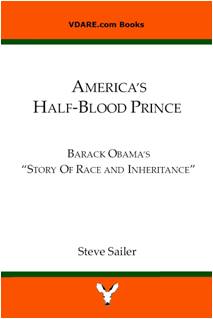
Obama: My high school highs actually a story of race and inheritance, when you stop and think about it

The new revelation that President Obama spent his teen years thoroughly baked is not really that new. As I wrote in VDARE.com in March 2007:
I particularly like how Obama rationalized his preppie drug use as "something that could push questions of who I was out of my mind . . ." His classmates, in contrast, in these articles seemed to find his explanation puzzlingly gratuitous. Many of them smoked dope on the beach, too, but they didn't need a racial identity crisis caused by the white power structure to justify their getting high. It was, like, Hawaii in the 1970s, you know? Maui Wowie, dude!

May 28, 2012

George Orwell's "Animal House"

I don't really know how Twitter works, but you can follow the discussion of George Orwell's Animal House here.
All animals are equal, but some are more fat, drunk and stupid than others, son.

Thilo Sarrazin's new book

Thilo Sarrazin, the former Social Democratic central banker with a doctorate in economics whose previous book on immigration policy has sold 1,100,000 copies in Germany, has a written a new book, Europe Doesn't Need the Euro. In the Atlantic, Miss Heather Horn finds herself disturbed by Sarrazin's sinister reasonableness:
The Controversial German Book Linking the Euro to Holocaust Guilt 
It's hard to think of a good American equivalent to Germany's Thilo Sarrazin, the politician turned best-selling author. The closest one could be Pat Buchanan: in some circles, he and his writings are considered entirely legitimate. In others, they're considered shocking and revolting to the point of scandal. ... 
Now, Sarrazin is addressing the euro crisis. Tuesday, his new book Europe Doesn't Need the Euro, hit the shelves. If you're just paging through idly, it doesn't seem to be as provocative, and, on balance, it really isn't: you'd expect as seasoned a provocateur as Sarrazin, especially with his leanings towards ideas of ethnic and educational superiority, at least to say some obnoxious and offensive things about Greek people or their ability with a balance sheet. He doesn't do that. The book, nevertheless, has immediately drawn fire -- and with good reason.  

I can tell how old I am because I can remember a day long ago when journalists would describe a book as "provocative" and "controversial" to whet readers' interest in the book. Today, the words "provocative" and "controversial" have become code for Move Along, Nothing to See Here.
... Many of the paragraphs are entirely reasonable ... Nevertheless, this is a little bit, like an American treading awfully close to a racial stereotype while prefacing his statement with "now, I don't want to be called a racist." Why? Because what Sarrazin is really saying is that Germans are hostage to their sense of not wanting to be responsible for Europe's failure. Germans are hostage to their sense of historical guilt. To use Der Spiegel's translation for one of the pre-publication excerpts, pro-euro Germans "are driven by that very German reflex, that we can only finally atone for the Holocaust and World War II when we have put all our interests and money into European hands." ...
What we're left with is a book that has some superficial similarities to Günter Grass's controversial poem about Israel and Iran back in April, though Sarrazin's economic credentials are significantly better than the poet's foreign policy credentials. It's not that the arguments themselves don't have merit. It's that the author doesn't seem all that concerned with complexity. Toss in a casual suggestion that Germans are suppressing their natural reactions due to Holocaust guilt, and the whole thing starts to look offensive ... 
The really provocative and revealing part of Sarrazin's book isn't the oft-repeated quote about Holocaust guilt, it's sentences like, "It's certainly very complicated, but on the other hand not as complicated as many want to make it!" or "Everyone who has an opinion on the euro also has either consciously or unconsciously an opinion on Europe." ...
... Outside of Sarrazin's head, it is possible to have an opinion on the euro and have no idea whether Greeks are fundamentally culturally and ethnically similar to Frenchmen. ...

To "have an opinion" on policy while simultaneously to "have no idea" about the facts the policy confronts appears to be the perfect summation of the kind of intellectual discourse that is considered appropriate in the 21st Century. The role model for contemporary thinkers is Sgt. Schultz from Hogan's Heroes: "I know nuffink!"
And it's possible for uneducated immigrants to produce the next generation's engineers and poets -- and, even if they don't, to be no more or less morally deserving than ethnic Germans with a university degree. Thilo Sarrazin's two books, when you get down to mechanics, aren't all that different.

I am shocked, SHOCKED to hear that one of the world's most experienced technocrats has written an extremely well-documented book arguing that the Euro is not a good idea. Well, I never ...  If Germans don't pile all copies of Sarrazin's new book up in their town squares and burn them tonight, somebody might get the idea to translate his 2010 bestseller on immigration into English and publish it in America. And we can't have that, now can we?

May 27, 2012

An old white lefty's view of where Obama is coming from

The late Robert Fitch, a veteran critic of New York real estate insiders, gave a speech to the Harlem Tenants Association on November 14, 2008 applying his brand of analysis to the history of Obama's rise in Chicago. 
In fact, as Obama knows very well, for most of the last two decades in Chicago there’s been in place a very specific economic development plan. The plan was to make the South Side like the North Side. Which is the same kind of project as making the land north of Central Park [i.e., Harlem] like the land south of Central Park. The North Side is the area north of the Loop—Chicago’s midtown central business district—where rich white people live; they root for the Cubs. Their neighborhood is called the Gold Coast. For almost a hundred years in Chicago, blacks have lived on the South Side ...
And in the 1980s, the argument began to be made that the public housing needed to be demolished and the people moved back into private housing. For a while, the election of the city’s first black Mayor, Harold Washington, blocked the demolition. But Washington died of a heart attack while in office, and after a brief interregnum, the Mayor’s office was filled in 1989 by Richard M. Daley—whose father had carried out the first urban renewal. Daley was his father’s son in many ways. By 1993, with subsidies from the Clinton Administration’s HOPE VI program, the public housing units began to be destroyed. And by 2000 he’d put in place something called The Plan for Transformation. It targeted tens of thousands of remaining units. 
With this proviso: That African Americans had to get 50% of the action—white developers had to have black partners; there had to be black contractors. And Daley chose African Americans—as his top administrators and planners for the clearances, demolition and re-settlement. African Americans were prominent in developing and rehabbing the new housing for the refugees from the demolished projects—who were re-settled in communities to the south like Englewood, Roseland and Harvey. Altogether the Plan for Transformation involved the largest demolition of public housing in American history, affecting about 45,000 people—in neighborhoods where eight of the 20 poorest census tracts in the U.S. were located. 
But what does this all have to do with Obama? Just this: the area demolished included the communities that Obama represented as a state senator; and the top black administrators, developers and planners were people like Valerie Jarrett—who served as a member of the Chicago Planning Commission. And Martin Nesbitt who became head of the CHA. Nesbitt serves as Obama campaign finance treasurer; Jarrett as co-chair of the Transition Team. The other co-chair is William Daley, the Mayor’s brother and the Midwest chair of JP Morgan Chase—an institution deeply involved in the transformation of inner-city neighborhoods thorough its support for—what financial institutions call “neighborhood revitalization” and neighborhood activists call gentrification. 

William Daley went on to serve as Obama's second chief of staff, following Rahm Emmanuel, who is now mayor of Chicago.
If we examine more carefully the interests that Obama represents; if we look at his core financial supporters; as well as his inmost circle of advisors, we’ll see that they represent the primary activists in the demolition movement and the primary real estate beneficiaries of this transformation of public housing projects into condos and townhouses: the profitable creep of the Central Business District and elite residential neighborhoods southward; and the shifting of the pile of human misery about three miles further into the South Side and the south suburbs. 
Obama’s political base comes primarily from Chicago FIRE—the finance, insurance and real estate industry. And the wealthiest families—the Pritzkers, the Crowns and the Levins. But it’s more than just Chicago FIRE. Also within Obama’s inner core of support are allies from the non-profit sector: the liberal foundations, the elite universities, the non-profit community developers and the real estate reverends who produce market rate housing with tax breaks from the city and who have been known to shout from the pulpit “give us this day our Daley, Richard Daley bread.” Aggregate them and what emerges is a constellation of interests around Obama that I call “Friendly FIRE.” Fire power disguised by the camouflage of community uplift; augmented by the authority of academia; greased by billions in foundation grants; and wired to conventional FIRE by the terms of the Community Reinvestment Act of 1995. …
Yes, Obama worked with Ayers, but not the Ayers who blew up buildings; but the Ayers who was able to bring down $50 million from the Walter Annenberg foundation, leveraging it to create a $120 million a non-profit organization with Obama as its head. Annenberg was a billionaire friend of Ronald Reagan and Margaret Thatcher. Why would he give mega-millions to a terrorist? Perhaps because he liked Ayers’ new politics. Ayer’s initiative grew out of the backlash against the 1985 Chicago teachers’ strike; his plan promoted “the community” as a third force in education politics between the union and the city administration. Friendly FIRE [i.e., liberal, multiracial Finance, Insurance, and Real Estate interests] wants the same kind of education reform as FIRE: the forces that brought about welfare reform have now moved onto education reform and for the same reason: crippling the power of the union will reduce teachers’ salaries, which will cut real estate taxes which will raise land values. 
Is Obama a minion of Richie Daley? It’s true that Obama has never denounced Daley. He actually endorsed him for Mayor in 2007. Even after federal convictions of Daley’s top aides. After the minority hiring scandals. And after the Hired Truck scandal which showed that the Daley machine shared its favors with The Outfit. But the Daley dynasty has expanded far beyond wiseguy industries. The Mayor’s brother, William Daley, who served on Obama’s transition team, also serves now as a top executive of J.P. Morgan Chase. He heads the Midwest region. And chairs J.P. Morgan Chase Foundation, the core of friendly FIRE. Here’s an excerpt from a recent report: "…[we] achieved significant progress toward our 10-year pledge to invest $800 billion in low- and moderate income communities in the U.S.—the largest commitment by any bank focused on mortgages, small-business lending and community development. In 2006, we committed $87 billion, with total investment to date of $241 billion in the third year of the program. Played a leadership role in the creation of The New York Acquisition Fund, along with 15 lenders and in conjunction with six foundations and the City of New York. The Fund is a $230 million initiative to finance the acquisition of land and buildings to be developed and/or preserved for affordable housing.“ 
It’s also true that key Black members of the Obama inner circle are Daley Administration alumnae—but they’ve moved up—now they’re part of Chicago FIRE. Like Martin Nesbitt. Obama is Nesbitt’s son’s godfather. He’s the African American chairman of the CHA. But his principal occupation is the vice presidency of the Pritzker Realty group. Although they’re not well known outside of Chicago, the Pritzkers rank among the richest families in the U.S. There are ten Pritzkers among the Forbes 400: Thomas is the richest at2.3 billion. Anthony and J.B. are next at $2.2 billion; Penny in fourth, at $2.1 billion—Daniel, James, Gigi, John, Karen, and Linda weigh in with $1.9 billion. Penny is finance chair of the Obama campaign. Martin is the treasurer. 

Daley saw Obama as a potential rival for the mayor's office. After Daley brushed aside Rep. Bobby Rush's challenge for his job in 1999, Daley turned around and provided some quiet aid to Rush in 2000 to help turn back Obama's challenge to Rush. Daley saw Rush, a former Black Panther, as easy to beat, but saw Obama as potentially a greater long term challenge.
Penny Pritzker herself has had a rocky career as a commercial banker. In 1991, she founded something called the Superior Bank of Chicago which pioneered in sub-prime lending to minorities. Superior was an early casualty of the sub-prime meltdown, though, crashing in 2001 when it was seized by the FDIC. Depositors filed a civil suit against Penny charging that Superior was a racketeering organization. The government charged that Superior paid out hundreds of millions of dividends to the Pritzkers and another family while the bank was essentially broke. There was a complex settlement in which the Pritzkers were forced to pay hundreds of millions in penalties; but the agreement contained provisions that may enable the Pritzkers to earn hundreds of millions. Notwithstanding the Superior bank disaster, Penny is being touted as Obama’s next Secretary of Commerce. 
Valerie Jarrett is another black real estate executive. Described as “the other side of Barack’s brain,” she also served as finance chair during his successful 2004 U.S. Senate campaign. Jarrett was Daley’s deputy chief of staff – that was her job when she hired Michelle Obama. Eventually Daley made her the head of city planning. But Jarrett doesn’t work for Daley anymore. She’s CEO of David Levin’s Habitat—one of the largest property managers in Chicago—and the court-appointed overseer of CHA projects. Habitat also managed Grove Parc, the scandal-ridden project in Englewood that left Section 8 tenants, mostly refugees from demolished public housing projects, without heat in the winter but inundated with rats. Grove Parc was developed by Tony Rezko, who’s white. And his long-time partner Allison Davis, who’s black. 
Let’s look at Rezko and then Davis. It was Rezko’s ability to exploit relationships with influential blacks—including Muhammad Ali—that enabled him to become one of Chicago’s preeminent cockroach capitalists.

Rezko was Ali's business manager in the 1980s because he was the business manager for the Muhammad family behind the Nation of Islam.
Altogether, Rezko wound up developing over 1,000 apartments with state and city money. There was more to the Obama-Rezko relationship than the empty lot in Kenwood. Rezko raised over $250,000 for Obama’s state senate campaign. While Obama was a state senator he wrote letters in support of Rezko’s applications for development funds. But Obama ignored the plight of Rezko’s tenants who complained to Obama’s office. Rezko’s Grove Parc partner, Allison Davis, was a witness in the Rezko trial, he’s pretty radioactive too. But you could see why Rezko wanted to hook up with him. 
Davis was the senior partner in Davis Miner Barnhill & Galland, a small, black law firm, where Obama worked for nearly a decade. As the editor of the Harvard Law Review, Obama could have worked anywhere. Why did he choose the Davis firm? Davis had been a noted civil rights attorney and a progressive critic of the first Daley machine. But in 1980 Davis got a call from the Ford Foundation’s poorly known, but immensely influential, affiliate LISC—the Local Initiatives Support Corporation—that had just been founded. LISC, whose present chair is Citigroup’s Robert Rubin, connects small, mainly minority community non-profits with big foundation grants and especially with bank loans and tax credit-driven equity. LISC wanted to co-opt Davis in their ghetto redevelopment program. He agreed and the Davis firm came to specialize in handling legal work for non-profit community development firms. Eventually Davis left the firm to go into partnership with Tony Rezko. Meanwhile, Obama did legal work for the Rezko-Davis partnership. And for Community Development Organizations like Woodlawn Organization. 
In 1994, the LA Times reports, Obama appeared in Cook County court on behalf of Woodlawnn Preservation & Investment Corp., defending it against a suit by the city, which alleged that the company failed to provide heat for low-income tenants on the South Side during the winter. There were several cases of this type, but as the Times observes, Obama doesn’t mention them in Dreams from My Father. In the 1960s, under the leadership of Arthur M. Brazier, Bishop of the Apostolic Church of God, Woodlawn gained a reputation as Chicago’s outstanding Saul Alinsky-stylec ommunity organization. Mainly, TWO [The Woodlawn Organization] battled the University of Chicago’s urban renewal program. But gradually, Brazier’s political direction changed. Now TWO is partnering with UC in efforts to gentrify Woodlawn. When Barack Obama left Jeremiah Wright’s church, he switched to Brazier’s Apostolic Church of God.

I don't believe that's fully true.
Brazier is typical of a much larger group—real estate reverends—who play the Community Development game and in the process have acquired huge real estate portfolios. But it’s really a national phenomenon. Here in New York we have Rev. Calvin Butts whose church has a subsidiary, the Abyssinian Development Corp. In partnership with LISC, the ADC now boasts a portfolio of $500 million in Harlem property alone. Rev. Floyd Flake of the Allen African Methodist Episcopal Church in Jamaica, Queens has a sizeable portfolio of commercial property too. Chicago’s disciples of development include Wilbur Daniel. He’s the Pastor of Antioch Missionary Baptist Church in Englewood who really did exclaim “Give us this day our Daley bread,” meaning free land and free capital for real estate development. Daniel’s prayers were answered in 2001, when with Daley’s help, Antioch was chosen to be the lead church in Fannie Mae’s $55 billion House Chicago plan for the redevelopment of the South Side. How has Obama earned the support and allegiance of friendly FIRE? Where does he stand on the Plan for Transformation? 
Generally speaking, he’s been careful not to leave too many footprints. If you google Obama and public housing, nothing comes up. But in 1995, a year before he ran successfully for state senate seat from South Side, in Dreams from My Father he wrote about his encounters with Rev. Jeremiah Wright. Obama says he was impressed by Wright’s emphasis on the unity of the black community. But he’s a little skeptical of too broad a unity; of achieving unity without conflict. He says, “Would the interest in maintaining such unity allow Reverend Wright to take a forceful stand on the latest proposals to reform public housing?” Here he’s referring to Clinton’s Hope VI—that provided matching federal money for the demolition of public housing. And the corresponding local initiatives, which culminated in the Plan for Transformation. “And if men like Reverend Wright failed to take a stand, if churches like Trinity refused to engage with real power and risk genuine conflict, then what chance would there be in holding the larger community intact?” 
I have to stop now and put Karnak’s envelope to my forehead. What we see is that the Chicago core of the Obama coalition is made up of blacks who’ve moved up by moving poor blacks out of the community. And very wealthy whites who’ve advanced their community development agenda by hiring blacks. Will this be the pattern for the future in an Obama administration? I can’t read the envelope. But I do believe that if we want to disrupt the pattern of the past we have to make some distinctions: between the change they believe in and the change we believe in; between our interests and theirs; between a notion of community that scapegoats the poor and one that respects their human rights—one of which is not to be the object of ethnic cleaning. Between Hope VI and genuine human hope.

Putting this in a larger perspective, it's reasonable to believe that Obama was drawn to Chicago in 1985 by the excitement of the Council Wars racial struggle between Mayor Harold Washington and the retrograde white leader Fast Eddie Vrodolyak in what seemed like a zero sum racial battle. But Obama found, when he finally got to know real life poor blacks in 1985-1988, that they weren't as uplifting as he had assumed from watching PBS fund-raising documentaries about the Civil Rights era. But he slowly started to realize that who he really liked were affluent, well-educated blacks. So, he bailed for Harvard Law School, intending to come back and lead blacks back to power in the mayor's office.

Over time, however, Richie Daley became mayor and he was more than happy to cut reasonable blacks in on the profits that could be made by clearing out Cabrini Green and the like, just as long as they'd play ball with Friendly FIRE. Michelle Obama had a wealth of contacts -- she'd been Jesse Jackson's babysitter, she worked for Daley's deputy Valerie Jarrett, and she liked money -- and Barack Obama was naturally drawn into this little world centered around Jarrett and Penny Pritzker.

On the other hand, let me point out a subtle distinction. I suspect that the secret end game envisioned by the more hardheaded liberal white leaders (I'm looking at you, Mayor Emmanuel) is likely not just to yuppify the Near South Side and move poor blacks to the Far South Side of Chicago where they can still vote in Chicago elections. Instead, the hard men want to use Section 8 rental vouchers to send poor blacks packing clear out of Chicago to hickvilles like Champaign-Urbana, while middle class blacks move themselves to inner ring suburbs, leaving only Obama-like upscale blacks in Chicago. This would slowly destroy black political power in Chicago, leaving behind only token affluent blacks and pockets of black poverty around the worst toxic waste sites in the industrial deep South Side.

For example, last year, Mayor Emmanuel's Chicago Police Department sent a 40-man SWAT team into just about the last two ungentrified houses in Lincoln Park, only seven blocks from Penny Pritzker's new mansion, to find pretexts for evicting the owners, an extended family of poor blacks.

Assume you are Mayor Emmanuel, and assume you want two decades or so in office like both Daleys got. Your job is going to be a lot more fun in 20 years if Chicago follows Manhattan and D.C. in whitifying rather than go down the path of Detroit and Cleveland.

But, as of 1995, Obama and his spiritual adviser, Jeremiah Wright, objected to what was looming on the horizon as a remote possibility: the more massive economic cleansing of blacks from not just the good parts of Chicago like Cabrini Green and the South Lakefront, but from the inland parts, where Wright's church was and where Obama had done his rather feckless community organizing.

Wright is quoted in Dreams, and Obama echoed Wright's argument in a 1995 Chicago Reader interview, that middle class blacks shouldn't flee to the suburbs to keep their sons from being gunned down. They should make a stand in Chicago (at least farther south than the potentially immensely valuable land around the loop and lakefront). Obama said in 1995:
"The right wing talks about this but they keep appealing to that old individualistic bootstrap myth: get a job, get rich, and get out." ... 

So, Obama here is agreeing with Wright's stance against black flight to the suburbs, which in Dreams from My Father is symbolized by Wright telling his secretary not to move to the suburbs to keep her son safe. But, as Fitch suggests, Obama's opaque statement in Dreams -- “And if men like Reverend Wright failed to take a stand, if churches like Trinity refused to engage with real power and risk genuine conflict, then what chance would there be in holding the larger community intact?” -- can be interpreted to mean that Obama wants to play a dual game that Rev. Wright is too stubborn even though it would be in his own interests: Obama wants to play palsy-walsy with people like the Pritzkers, but also to make sure that public housing project blacks are only relocated as far as the South Side, where they can still vote and still attend Rev. Wright's church, not all the way to exurban hickvilles like Round Lake Beach.

Obama told the Reader in 1995:
"I want to do this as much as I can from the grass-roots level, raising as much money for the campaign as possible at coffees, connecting directly with voters," said Obama. "But to organize this district I must get known. And this costs money. I admit that in this transitional period, before I'm known in the district, I'm going to have to rely on some contributions from wealthy people—people who like my ideas but who won't attach strings. This is not ideal, but it is a problem encountered by everyone in their first campaign.
"Once elected, once I'm known, I won't need that kind of money, just as Harold Washington, once he was elected and known, did not need to raise and spend money to get the black vote."
Obama took time off from attending campaign coffees to attend October's Million Man March in Washington, D.C. His experiences there only reinforced his reasons for jumping into politics.
"What I saw was a powerful demonstration of an impulse and need for African-American men to come together to recognize each other and affirm our rightful place in the society," he said. "There was a profound sense that African-American men were ready to make a commitment to bring about change in our communities and lives.
"But what was lacking among march organizers was a positive agenda, a coherent agenda for change. ... 
"But cursing out white folks is not going to get the job done. Anti-Semitic and anti-Asian statements are not going to lift us up. We've got some hard nuts-and-bolts organizing and planning to do. We've got communities to build."

But, of course, in 2000, Obama's plan to follow Harold Washington's career path to the mayor's office by first getting elected to the House of Representatives was derailed by the whupping he got from ex-Black Panther Bobby Rush in black districts. When he recovered from his depression, he gerrymandered his district to include the rich white Gold Coast north of the Loop that, culturally, is his natural base. When Michelle threatened to leave him unless he came up with a workable career strategy, he gave up on winning major power in the callous world of Chicago politics, where voters expect their politicians to be more than just elegant symbols of the electorate's own refinement, but instead to deliver the goods. Obama thus reworked his goals to winning statewide and even national office by taking his ethereal everything-to-everybody act on the road to the more naive parts of white America.

One big question is what precisely was Obama's role in real estate driven changes in Chicago that Fitch outlines. The answer appears to be: eh, not that much. He was there, he looked dignified, he uttered sonorous speeches, he was friends with the players, he tried to foster compromises that would advance the interests of the rich, white and black, without damaging the interests of demagogues like Rev. Wright by driving blacks all the way out of Chicago.

But, as far as I can tell, he doesn't appear to have been a major player himself. He doesn't seem to have been a driving force in the dealmaking. Was this out of scrupulousness (ethical, racial, or careerist)? Or is Obama, on the whole, just more decorative than dynamic?

Postscript:

To flesh out this subtle point about black flight to the suburbs, it's worth quoting from Dreams from My Father at length about Obama's first meeting with Rev. Jeremiah Wright:
Eventually a pretty woman with a brisk, cheerful manner came up and introduced herself as Tracy, one of Reverend Wright’s assistants. She said that the reverend was running a few minutes late and asked if I wanted some coffee. As I followed her back into a kitchen toward the rear of the church, we began to chat, about the church mostly, but also a little about her. It had been a difficult year, she said: Her husband had recently died, and in just a few weeks she’d be moving out to the suburbs. She had wrestled long and hard with the decision, for she had lived most of her life in the city. But she had decided the move would be best for her teenage son. She began to explain how there were a lot more black families in the suburbs these days; how her son would be free to walk down the street without getting harassed; how the school he’d be attending had music courses, a full band, free instruments and uniforms. 
“He’s always wanted to be in a band,” she said softly. 
As we were talking, I noticed a man in his late forties walking toward us. He had silver hair, a silver mustache and goatee; he was dressed in a gray three-piece suit. He moved slowly, methodically, as if conserving energy, sorting through his mail as he walked, humming a simple tune to himself. 
“Barack,” he said as if we were old friends, “let’s see if Tracy here will let me have a minute of your time." ...
“Some people say,” I interrupted, “that the church is too upwardly mobile." 
The reverend’s smile faded. “That’s a lot of bull,” he said sharply. “People who talk that mess reflect their own confusion. They’ve bought into the whole business of class that keeps us from working together. Half of ’em think that the former gang-banger or the former Muslim got no business in a Christian church. Other half think any black man with an education or a job, or any church that respects scholarship, is somehow suspect. 
“We don’t buy into these false divisions here. It’s not about income, Barack. Cops don’t check my bank account when they pull me over and make me spread-eagle against the car. These miseducated brothers, like that sociologist at the University of Chicago [William Julius Wilson], talking about ‘the declining significance of race.’ Now, what country is he living in?” 
But wasn’t there a reality to the class divisions, I wondered? I mentioned the conversation I’d had with his assistant, the tendency of those with means to move out of the line of fire. He took off his glasses and rubbed what I now saw to be a pair of tired eyes. 
“I’ve given Tracy my opinion about moving out of the city,” he said quietly. “That boy of hers is gonna get out there and won’t have a clue about where, or who, he is." 
“It’s tough to take chances with your child’s safety." 
“Life’s not safe for a black man in this country, Barack. Never has been. Probably never will be." 
A secretary buzzed, reminding Reverend Wright of his next appointment. We shook hands, and he agreed to have Tracy prepare a list of members for me to meet. Afterward, in the parking lot, I sat in my car and thumbed through a silver brochure that I’d picked up in the reception area. It contained a set of guiding principles-a “Black Value System”-that the congregation had adopted in 1979. ... There was one particular passage in Trinity’s brochure that stood out, though, a commandment more self-conscious in its tone, requiring greater elaboration. “A Disavowal of the Pursuit of Middleclassness,” the heading read. “While it is permissible to chase ‘middleincomeness’ with all our might,” the text stated, those blessed with the talent or good fortune to achieve success in the American mainstream must avoid the “psychological entrapment of Black ‘middleclassness’ that hypnotizes the successful brother or sister into believing they are better than the rest and teaches them to think in terms of ‘we’ and ‘they’ instead of ‘US’!”

It's informative to quote that "value" in full from Trinity's website, much of which Obama left of Dreams:
8. Disavowal of the Pursuit of “Middleclassness.” Classic methodology on control of captives teaches that captors must be able to identify the “talented tenth” of those subjugated, especially those who show promise of providing the kind of leadership that might threaten the captor’s control. 
Those so identified are separated from the rest of the people by: 
Killing them off directly, and/or fostering a social system that encourages them to kill off one another. 
Placing them in concentration camps, and/or structuring an economic environment that induces captive youth to fill the jails and prisons. 
Seducing them into a socioeconomic class system which, while training them to earn more dollars, hypnotizes them into believing they are better than others and teaches them to think in terms of “we” and “they” instead of “us.” 
So, while it is permissible to chase “middleclassness” with all our might, we must avoid the third separation method – the psychological entrapment of Black “middleclassness.” If we avoid this snare, we will also diminish our “voluntary” contributions to methods A and B. And more importantly, Black people no longer will be deprived of their birthright: the leadership, resourcefulness and example of their own talented persons.

Keep in mind that Senator Barack Obama donated $26,770 to Jeremiah Wright's church in 2007, according to his tax return. That's while he was running for President.

How do we make sense of all of this seemingly conflicting information about Obama? I suspect the simplest answer is that Obama never quite made sense out of it all either.

May 26, 2012

More SoCal deep pockets

From the L.A. Daily News:
LONG BEACH — A former high school football star whose rape conviction was thrown out this week plans to sue the state, but will not sue the woman who recanted the rape and kidnapping charge she made a decade ago. 
An attorney for Brian Banks, 26, said in news reports that his client will seek $100 from the state for every day he was wrongfully incarcerated.

Only $100 per day? This poor bastard has to be the only honest man in Southern California. (See next posting for comparison).
Banks walked free on Thursday in a dramatic, 30-second hearing in Long Beach Superior Court during which Judge Mark Kim vacated his conviction. Banks spent five years and two months in prison after pleading no contest to forcible rape in 2003. 
His accuser, Wanetta Gibson, was a high school sophomore when she accused Banks, then 17, of raping her in 2002 on the campus of Poly High School. 
She received a $1.5 million payment from a civil suit brought by her mother against the Long Beach Unified School District for failing to provide a safe environment. 
School district officials wouldn't comment this week on whether they would seek repayment of the settlement.

I'm sure Wanetta and her mom socked the $1.5 million away in T-bills for a rainy day, so there shouldn't be any trouble recovering the fraudulently obtained funds.
Prosecutors have said they have no plans to charge Gibson, now 24, with making false accusations, saying it would be a tough case to prove. She could not be reached for comment. 
Banks' attorney with the California Innocence Project, Justin Brooks, could not be reached for comment Saturday. 
Brooks told the Los Angeles Times that Banks is entitled to $100 a day for every day he was falsely imprisoned under State Law 4900. 
If successful, the lawsuit against the state of California would net Banks about $188,500. 
Banks, a football standout at Poly, had been heavily recruited by colleges, and had a verbal offer for a scholarship at the University of Southern California. 
He told police he had a consensual sexual encounter with Gibson, a classmate — but always maintained that he did not rape her. He pleaded no contest to forcible rape charges to avoid a possible 41-year-to-life sentence in prison if convicted on all the charges, he said. 
After accepting a plea deal, he served more than five years in prison, and was required to register for life as a sex offender. 
Gibson recanted her story a little more than a year ago after "friending" Banks on Facebook and asked to meet with him. 
"I got on my knees and prayed," Banks said this week after his court hearing. "I asked God to help me play my cards right." 
Gibson refused to tell prosecutors the truth, for fear of having to repay the settlement. But attorneys with the California Innocence Project were eventually able to record her recanting the accusation. [He wore a wire when talking to Wanetta.] 
On Thursday, prosecutors conceded the matter, and the judge immediately vacated Banks' conviction. His record is now wiped clean. 
Banks is training six days a week at a gym in Long Beach, and hopes to revive his chance for a football career.

Long Beach Poly sends about one player per year to the NFL (as many as any high school in the country), so his hopes for a pro career hadn't been just the usual teenage pipedream.

Senile sodomy set-up costs L.A. taxpayers $450k

That gray Japanese robot from outer space on the right preparing to burn down with its flamethrower the beige Los Angeles Cathedral has recently been named The Ramon C. Cortines School of the Visual and Performing Arts. Due to its shape and location right on the 101 Freeway in downtown, the $242 million Ramon C. Cortines School is the most visible public high school in L.A., even more than the $578 million Robert F. Kennedy Schools on Wilshire Blvd.

Which makes the following from the L.A. Daily News even funnier (the details keep piling up as the excerpt goes on):
Los Angeles Unified [School District] will pay $200,000 and give lifetime health benefits to settle a sexual-harassment allegation filed by a facilities executive against retired Superintendent Ramon Cortines, officials said Wednesday. 
Scot Graham, who has worked in the Facilities Division for 12 years and is now director of leasing and asset management, claims that Cortines made unwanted sexual advances during a weekend spent at the superintendent's second home in Kern County in July 2010. 
Graham's attorneys notified the district in March - nearly a year after Cortines retired - that he intended to file a sexual-harassment claim. 
Hoping to avoid potentially expensive litigation, the school board met three times in executive session before voting 4-3 on Tuesday to approve the deal. 
The settlement gives Graham $200,000 cash, plus lifetime health benefits that officials valued at roughly $250,000. In exchange, the 56-year-old Graham agreed to retire from his $150,000-a-year job on May 31. 
During a briefing for reporters, officials released a statement from Cortines that outlined his years-long friendship with Graham and how he'd alerted his buddy to a job opening at the district in 2000. He also admitted to a single incident of consensual sex in 2010, but denied that his advances were inappropriate. 
"As the district's former top staff member, I regret allowing myself to engage in such spontaneous, consensual behavior," said Cortines, 79, who has never beeen married. "However, Mr. Graham had never indicated to me that our interaction was unwelcome."

Is this $450k coming out of retired Superintendent Cortines's pension? If not, what evidence is there that this isn't one Big Gay Collusive Scam?
However, I think it only fair that Cortines be punished by forcing that absurd high school, with its Water Slide of Doom, to continue to bear his name.

Cortines was chancellor of New York City schools in the 1990s. Mayor Rudy Giuliani pressured him into quitting by telling him to not "be so precious." So, now we know what Rudy was hinting at.

P.S. The more I look into this, the more interesting material turns up. But, that will have to wait for another time.

Signs "Girls" Whiteness Crisis Abating

A new article in the NYT, "Seeing HBO’s ‘Girls’ Without Buying a Television," somehow fails to mention that all four girls on Girls are white. Could this be a cultural turning point?

By the way, when is Roissy going to get his own sit-com? 

I don't know that Lena Dunham is directly channelling Roissy's blog, although I would think the odds are at least 50-50. Her characters certainly live in a Roissyesque universe, although perhaps that's because it's Roissy's world and we're all just living in it. (I like to hope that's not 100% true, but what do I know?)

Dunham has an interesting skill set. It's not hard to find young women who claim they will endure any humiliation onscreen to further career ambitions, but Dunham will do it while being overweight, funny, and smart. Plus she learned from her mother, an art photographer of dollhouse scenes, how to light sets and where to place the camera. (That's the point of calling her debut movie Tiny Furniture: her mother's career sounds silly, but helping your mother at a young age on her miniaturized sets is a cheap way to learn part of how to direct. Compare how grown-up looking Tiny Furniture was to, say, the Duplasse Brothers' Puffy Chair.)  

Dunham's character in Tiny Furniture / Girls is self-centered, obnoxious, and sluttish, but the sex lives of young women are so inherently important (this is where the next generation comes from) that there's a trainwreck-like fascination to it.

One key to making a Roissy sit-com work is to film it in Washington D.C., not L.A. or N.Y.C. There is so much money in D.C. these days that it's a now glamor destination for young white people, while also being comically unsexy: "C'mon, just one more drink" "Oh, you're so sweet, but I have to pull together some talking points for the Congresswoman on the helium subsidy."

The main issue with how Roissy could have his own show is that what makes him such an amazing blogger -- his infinite fecundity of lines in response to his acuity of observation, his sheer superiority and the obvious impossibility of mere mortals following in real time such advice as: "If she says X, just make up something that's witty, tailored to her, yet subtly discombobulating, like A, B, or C; but if she says Y, then make up something like D, E, of F; while if she says Z, then ..." -- would also make him insufferable as a major character in a continuing series.

The solution might be to make Roissy a legendary offscreen expert who has condescended to advise via text message three or four hopeless Big Bang Theory-like acolytes / losers in their quests. But in the presence of real live girls, they constantly fumble Roissy's lines to comic and endearing effect.

May 25, 2012

The enigma of Sacha Baron Cohen explained

From The Times of Israel, an article that explains the mystery that has baffled the combined intellectual might of America's film critics. What could possibly motivate Baron Cohen to make fun of Pakistanis, Slavs, Austrians, and Arabs? It's been a complete mystery, but now a few clues are available.
Before ‘The Dictator’ and ‘Borat,’ friends recall, Sacha Baron Cohen was a very nerdy, very funny, Israel-oriented guy 
As the actor/comedian makes his way to Israel for his latest flick, those who knew him way back when share some potent memories 
By JESSICA STEINBERG May 11, 2012, 
... He is Sacha Baron Cohen, the Jewish, English and half-Israeli comedian who has created a career out of imagined characters who deftly comment on the political, cultural and social issues of the moment. 
He began his career as the fictional Ali G on “Da Ali G Show,” playing a boorish, uneducated type, and often baffled his celebrity and politician interviewees who didn’t realize he was in character. 
Now he’s a celebrity, married to a fellow — converted — celebrity, actress Isla Fisher, with whom he has two daughters, including one whose name is Elula. For those who knew him when, as a fellow Habonim Dror youth group member or Cambridge student, his current antics are hilarious, sometimes crude, but his success is not altogether surprising. 
“I remember being on the bus during our Habonim Mahane Lomdim trip, and he did this standup bit about lost property at the front of the bus,” said one woman now living in Ra’anana, who attended a three-week seminar with Baron Cohen in Israel when they were graduating high school. “He was really very nerdy, he didn’t hang out with the girls, but we were literally crying from laughter because he was so funny. I remember thinking how talented he was, and very, very smart, a genius, really.”

The son of an Israeli mother and Welsh father, “a quirky, smart family,” she added, Cohen grew up in West London and was active throughout high school in Habonim Dror, a Zionist youth group. “He was very Zionist, very involved in Habo,” said the fellow Israel seminar participant, who has known him since they were babies in the same mother-and-baby group. “He wasn’t Mr. Cool Guy.” 
... It was at the University of Cambridge, however, where Baron Cohen read history, that he began his stage career, first as Tevye in “Fiddler on the Roof,” a production of the university’s amateur dramatic club. 
“I knew who Sacha was from London, his brother Eran was my age, and they were all in Habo,” said Debbie, who now lives in Israel and played Yente the matchmaker to Baron Cohen’s Tevye. ... 
Of course, not everyone who knew Baron Cohen as a former Habonim, Israel-oriented Jewish nerd realized that he had attained such celebrity status, or that his Israeli roots — and time spent in Israel — has enabled him to use Hebrew as his language of choice, whether playing a sexist Kazakh journalist or Middle Eastern despot.
... Israel is one of the destinations on Baron Cohen’s current publicity tour for “The Dictator,” which will be released here in the next month. No one’s expecting any calls from their former Habonim friend, but as happened when “Borat” played here, his insider Hebrew jokes will meet their ultimate audience.

Why Lorenzo Pagina and Sergio Brino had to found Google in Mexico

From the New York Times on how Romney should attract the Hispanic vote:
What Romney Should Do About Immigration 
By C. STEWART VERDERY, JR. 
... But after those strategic attacks, which included Romney’s awkward “self-deportation” plan for illegal aliens, Romney must execute a creative pivot to the middle to attract moderate voters, especially Hispanic moderates.  ... 
High-skilled immigration: Romney has already endorsed proposals that would allow more highly skilled scientists to enter the United States under temporary visas and to allow foreign students educated here to receive green cards to allow them to stay here and work. However, these proposals have been blocked in Congress by proponents of a broad amnesty that is a non-starter with most Congressional Republicans. Romney should demand passage of the high-skilled agenda before the graduation of the class of 2013 next spring produces another crop of international leaders, educated here in America, needlessly forced to return home to compete against us. If you graduate with an engineering degree from Stanford, we should staple a green card to your diploma.

Like when Lorenzo Pagina and Sergio Brino graduated from Stanford and were about to found Google, but then they got deported back to Mexico. Happens all the time. That why Monterrey is now the technology start-up capital of the Western Hemisphere: because of all the Mexican tech geniuses who got deported from Silicon Valley.

Seriously, how exactly is endorsing more "high-skilled immigration" going to please Mexican-American voters? This proposal would mostly strike Mexican-American voters as pandering to Asians.

Think about it. What's in it for Mexican-descended citizens of the United States? They are already in the U.S. legally. There aren't many high-skilled scientists and engineers in Mexico, and most of those few are happy to stay in Mexico, where life is good for the elite. And, finally, very few Mexican-American citizens have close relatives in Mexico who are highly-skilled, because most Mexican-Americans come from the unskilled classes of Mexico. 

How many East Coast commentators even know any Mexican-American voters?

Claremont McKenna Hoaxes: SAT and Hate

From Charles C. Johnson in City Journal on what we know now about the mostly hushed-up scandal at one of the Claremont Colleges, where the Admissions department fabricated statistics submitted to USNW&R and other guidebooks to keep its Top Ten liberal arts college rating:
From the start, [Claremont McKenna College or CMC] officials played down the scope of Vos’s fabrications. College president Pamela Gann said that [admissions boss Richard] Vos had manipulated only the school’s average SAT scores, and then not by much. But a day after Gann made that claim, the Claremont Port Side, a left-wing student publication, revealed a wider system of manipulation by the admissions office; in some years, some individual SAT scores were simply made up. A report released last month by O’Melveny & Myers, the college’s outside counsel, shows still more deception. Evidently, Vos didn’t merely fake SAT scores; he faked ACT scores, the percentage of students admitted from the top 10 percent of their high school classes, and the college’s overall acceptance rate. Everywhere the investigators from O’Melveny & Myers looked, they uncovered evidence of fraud and manipulation. So after just 18 hours of interviews, they stopped looking. 
It’s probably no coincidence that Vos’s manipulations began soon after the college received a $700,000 grant to expand racial preferences in its admissions. In March 2002, the admissions office changed its policies in accord with a “Campus Diversity Initiative” grant that it received from the James Irvine Foundation. The grant’s conditions called for a 2 percent yearly increase in nonwhite enrollment for three years. CMC also promised to deliver a student body that would be 37 percent nonwhite at the end of the grant’s term. The college went to great lengths to achieve these quotas, preparing “minority brochures” and flying in nonwhite students from around the country to visit. These efforts reached their apex at the same time that the college boosted its minority-outreach efforts through two new programs, QuestBridge and Posse, which continue to grant full scholarships to low-income—mostly black and Hispanic—students at top colleges across the nation. 
Vos was an enthusiastic supporter of racial preferences and a vocal critic of California’s Proposition 209, which in 1996 banned state colleges from admitting students on the basis of race, ethnicity, or sex. During his tenure, CMC’s admissions policies led to higher acceptance rates for blacks and Latinos and lower ones for whites and Asians. According to the Claremont Independent in 2006, “statistics provided by the admissions office show that it admitted roughly 45 percent of both black and Hispanic applicants, [versus] 22 percent of the white applicants and 17 percent of Asian applicants.” Given this history, it’s probable that Vos’s preferential policies resulted in lower average SAT scores than he would have liked and led him to make his disastrous fabrications. 

Here's my 2004 American Conservative article "Claremont Hate Hoax."

May 24, 2012

"I Love Lucy" v. "I Love Marilyn"

We've been having some fun posting historical bits and pieces subversive of the increasingly popular interpretation of American history put forward by whiteness experts like Noel Ignatiev: that the Irish, Spaniards, Jews, Italians, and so forth weren't considered white until recently. 

For example, look how the CIA wouldn't allow James Jesus Angleton to join because his mother was Mexican. *

Note that actor Mel Ferrer's acting career was so hampered by discrimination that he had to console himself with being married to Audrey Hepburn.

Look how Jose Ferrer's acting career was so hamstrung by bias against Puerto Ricans that he had to console himself with his Oscar and Tony and with marrying George Clooney's aunt twice, Uta Hagen, and Phyllis Hill.

Look how Danny and Marlo Thomas couldn't get on TV because they're Arabs.

Look how Harvard wouldn't employ George Santayana because he was a Spaniard.

I began with Desi Arnaz's colossal success in "I Love Lucy."

A reader comments:
"And the success of Desi Arnaz doesn't really say much. Louis Armstrong was also popular in the past, but that didn't mean anti-black sentiments and anti-black laws didn't exist."

Yes, but Louis Armstrong didn't star in "I Love Marilyn," in which he played an Afro-American bandleader married to ditzy blonde Marilyn Monroe, who was Armstrong's wife in real life in 1951, in what would almost instantly become the most popular TV show of the 1950s.

Just to be clear: "I Love Marilyn" didn't happen.* And it wouldn't have happened in 1951, no way, no how. Marilyn married Joe DiMaggio and Arthur Miller. Rita Hayworth married the Aga Khan. But marrying, say, Louis Armstrong was a no-go in the 1950s.

The bottom line is that discrimination against blacks in American history was radically harsher than against anybody else, with the exception of American Indians (and the discrimination there was quite different, so it's hard to make an apples to apples comparison between blacks and Indians). 

Everybody else wants to claim the glamor of victimhood (heck, Henry Adams, grandson of one President and great-grandson of another, felt discriminated against for not being elected President). These days, everybody wants to associate the historical slights against their group with the glamor of black victimhood, but this rhetorical trick is extremely unfair to blacks.
-------------------------

* I realize that there are a huge number of people who simply don't know enough facts to tell when I'm joking or not, and thus would get confused and disturbed when I switch back and forth between factual and facetious without warning. Fortunately, most of them don't bother trying to read me.

To recount: James Jesus Angleton's mother was Mexican and he was the head of counter-intelligence at the CIA for decades. When Robert De Niro directed a fictionalized biopic of Angleton's life, with Matt Damon as the Angleton character, the whole half-Mexican part was dropped, presumably as being too confusing to modern prejudices, and Damon played the lead as the most boring WASP in the history of boring WASPs.

Mel Ferrer, a moderately successful movie star of Cuban and Irish descent, was married to the exquisite Audrey Hepburn from 1954-1968.

Puerto Rican-born Jose Ferrer (no close relation to Mel) was a prestigious actor, winning the Tony and Oscar for Cyrano de Bergerac after WWII. He married white women five times, including George Clooney's aunt, songstress Rosemary Clooney, twice.

Danny Thomas was a Lebanese-American. He was a huge hit on early TV and his daughter Marlo was the Zoey Deschanel of sit-coms in the late 1960s.

Spain-born George Santayana was a famous Harvard professor in the late 19th and early 20th centuries. Wikipedia says his students at Harvard included "T. S. Eliot, Robert Frost, Gertrude Stein, Walter Lippmann, and W. E. B. Du Bois."

Marilyn Monroe was not married to Louis Armstrong.

Abe Foxman speaks

Although the New York Times hasn't yet gotten around to covering the recent pogrom in Tel Aviv against black "illegal infiltrators" (here's video footage of the riot -- not all that violent as far as race riots go), Abraham H. Foxman, head of the Anti-Defamation League, issued the following statement today:
We are seriously concerned about the growing tensions in Israel over the issue of African migrants, and reports of lawlessness and violence committed by and directed against the migrants.  We call on all parties to work to calm the tensions, and welcome Prime Minister Netanyahu's condemnation of the inflammatory comments and the violence and his commitment to resolving this crisis responsibly.

While we recognize the complexity involved in properly addressing this issue, and sympathize with Israeli citizens whose personal security has been compromised by the lawlessness and violence of some migrants, we are disturbed by inflammatory public statements made by certain Israeli officials, some of which has veered into racism. These statements are counterproductive and only serve to further inflame tensions.

The role of Israeli law enforcement officials is vital in ensuring the safety of all, controlling lawlessness and violence and enforcing the rule of law.

It is imperative that reasonable solutions be found to confront these challenges, one that humanly treats the migrants while ensuring the security concerns of Israeli citizens are properly addressed.

A reasonable statement ...

Oddly enough, Foxman's tone regarding violent resistance to immigration in Israel today is more understanding and less harsh than his May 2, 2010 statement regarding nonviolent, democratic, legal resistance to immigration in America:
Arizona Law Endangers America's Immigrant Heritage 
One of the oldest debates in America has been on the issue of what the nation's immigration policy should be. Should it be fair and compassionate? Should it be restrictive? 
In the past, as now, nativism, bigotry and fear of competition from foreign workers dulled the collective American memory of its own immigrant history and democratic ideals. Then, as now, the drums of anti-foreigner slogans are beat in an effort to make the case for a restrictive immigration policy. 
... Today, unfortunately, Kennedy's "spacious society" is being closed in and darkness is enveloping Reagan's "shining city." There is no harmony and peace -- especially in Arizona. Instead, there is hate, fear, and xenophobia. 
Much has been said about Arizona's new law, which requires the police to demand proof of legal residency from residents who arouse suspicion. The police do not need probable cause to suspect a crime has been committed -- anyone who "looks foreign" can be stopped. The law virtually invites the police to harass and intimidate Hispanics and other minorities. Obviously, it discourages minority victims of and witnesses to hate crimes from coming forward and helping local law enforcement solve those crimes. It gives untrained state and local police officers the responsibility for enforcing immigration law even though such responsibilities interfere with their responsibility to keep the peace. The law even encourages people to sue the police if they believe immigration laws are not being enforced. 
Of course, the Arizona law was not enacted in a vacuum. The immigration debate has become a flashpoint for racists, white supremacists, neo-Nazis and other extremists who blame immigrants for all of our nation's problems. It is a very short distance from that sort of rhetoric to vigilantism. When mainstream figures start expressing the same bigotry, filling the airwaves and the Internet with hateful and incendiary talk, an atmosphere is created for incivility and pernicious legislation is not far behind. 
The Arizona law is probably unconstitutional, and will be challenged in the courts. But all of us have a responsibility to look in the mirror and say -- how could such a mean-spirited measure become law in this country? Do we really want our nation to resemble societies where anyone can be stopped on the streets at any time, at the slightest whim, and be asked for identification papers? 
The Arizona approach to addressing the current immigration crisis is the wrong approach. It happened at a time when our nation is deeply divided along partisan lines. The time has come for Congress to demonstrate bipartisan leadership, condemn xenophobia, and enact comprehensive immigration reform that has an appropriate balance of fairness, compassion, and security.  
Abraham H. Foxman is National Director of the Anti-Defamation League. He and his parents immigrated to the United States in 1950.

Is it really asking too much of Mr. Foxman that he someday attempt to view his fellow citizens in Arizona with some of the same understanding he applies to his fellow ethnics in Israel?

Latest Israel immigration news

From the top of the website of Haaretz, the left of center Israeli newspaper: