October 7, 2008

Minority mortgage challenge

As I've been pointing out for a long time, much of the "diversity recession" theory does not rest on minorities per se defaulting on home loans, but on contortions to the market rationalized in the name of diversity, such as Bush's attack on down payments (for everybody) in the sacred name of raising minority homeownership by 5.5 million; or by the see no evil-hear no evil-speak no evil politically correct mindset about lending to heavily Hispanic states and black parts of town by fear of discrimination lawsuit discovery of intra-firm emails asking "Aren't we out of our minds to lend $340,000 on a 500 square foot house in Compton? Do you know who lives in Compton?"

Still, ideas have consequences, and these ideas, which both parties supported, no doubt led to higher defaults among minorities.

The federal government has created a vast apparatus of of race reporting on lending to make sure that minorities get their "fair" share of loans, but there doesn't seem to be as equally accessible data on defaults by race. Why not? Well, because the point is to badger lenders into giving more loans to minorities, not to call attention to problems that can cause.

One of my most insightful commenters started out assuming that minorities couldn't have comprised more than a tiny handful of percent of the defaulted dollars. Now, he's up to 10% to 15%, but doesn't think it could possibly be 30%. I'm willing to bet him that when it all gets counted up, it will be closer to 30% than to 15%.

A few methodology issues. The first is that, normally, recessions cause defaults. Eventually, the new recession will cause a lot of defaults, but what we are interested in is not the defaults caused by the recession of, say, 2008-2011, but the defaults that caused that recession. So, therefore, let's look at, say, calendar year 2007.

Second, lenders always have a baseline expectaton of default dollars per year due to random tragedies. What we are interested in is not the total dollar amount of defaults in 2007, but the amount incremental to the expectation. For example, if lenders expected due to random sad events that 1% of prime mortgages would default in 2007 and 3% of subprime mortgages, but the real numbers were 2% of prime and 20% of subprime, then the numbers of interest to us are not 2% of prime, but the unexpected increments: 1% of prime and 17% of subprime. (I just made these numbers up for illustrative purposes.)

Third, there are a variety of technical issues involving when something is foreclosure vs. default vs. severely stressed. And there's the complicating hybrid of short sales.

Fourth, a lot of sales in, say, 2005-2006 were fraudulent using straw buyers, so sorting out blame has its metaphysical aspects.

Fifth, I suspect, on no particular evidence, just a hunch, that more than few of the most enthusiastic speculators in the California housing markets were white immigrants from the Middle East and the ex-Soviet bloc.

I will leave all the details to disinterested researchers to handle in a fair manner.

My published articles are archived at iSteve.com -- Steve Sailer

Nobel Prize in Economics

My first suggestion is that rather than hand out a new Nobel Prize in Economics this year, they instead take away one they gave to some economist in the past who now looks like a prime nitwit.

If that's too radical, how about giving the Nobel to an economist who was actually, like, right? How about Robert Shiller who has been banging the gong about the coming housing crash for years?

My published articles are archived at iSteve.com -- Steve Sailer

October 6, 2008

"In Search of Bill Clinton: A Psychological Biography"

My wife is reading this new psychobiography about Bill Clinton by John Gartner, which she quite likes. Gartner specializes in "hypomania," that fortunate cousin of manic-depression. Hypomanics can maintain a controlled level of high-energy living for years on end. Teddy Roosevelt is probably the most famous American hypomanic.

One interesting thing about it is its realism about why Bill Clinton played an important role in recent American political history, which Gartner sees as having roughly the same causes as Shaquille O'Neal's large role in recent NBA history. Usually, biographers try to come up with some nonsense about how the leader embodied the Spirit of the Age or whatever, but part of Gartner's approach is more down to earth: Clinton was born with the tools to be a highly successful conventional politician.

Nobody is too sure who Bill Clinton's genetic father was, but Gartner makes a strong case that it was a hard-working local doctor whose legitimate children have grown up to be successful professionals as well. Bill's mom was of course a tramp, but a bright, charming tramp.

Clinton is a largely self-taught politician. He didn't have, say, George H.W. Bush around to imitate. But he taught himself lots of useful tricks. For example, when working the rope line, most politicians don't look into the eyes of the person they are currently shaking hands with because they are already looking for the hand of the next person to shake hands with. Clinton, however, makes solid eye contact with each person he shakes hands; meanwhile, he's using his left hand to feel blindly for the next hand he's going to shake. (Perhaps being left-handed helped him invent that trick.)

In one section, Gartner takes a psychometric approach to Clinton. Unfortunately, he lacks actual psychometric data on Clinton, such as an IQ score, but his rough estimates are of interest:

Hitting the genetic jackpot

Even the most virulent Clinton critics would not deny that Clinton is extraordinarily gifted. Before we even consider the effect of Bill Clinton’s childhood on the formation of his personality and career, we need to examine his genetic endowment., Like Secretariat, to whom he has been compared, Clinton was simply born with more God-given political talent than any of his contemporaries. Statistically, Clinton is a freak of nature.

In his profile of Clinton for GQ, George Saunders speculated: “My guess is that if you rated a million people on the basis of aptitude and verbal skills, and powers of persuasion and retention and simple physical energy, Clinton would come out near the top in all categories” I think Saunders is right in his intuition that Clinton wasn’t just born off the chart. He was born off multiple charts.

There are probably more, but I will discuss five of those traits. Two, mentioned by Saunders, are intelligence and energy (one component of his hypomanic temperament). In addition, Clinton is a statistical outlier on three core inborn dimensions of personality: intellectual curiosity, empathy. and extraversion.

There is an impressive body of research pointing to intellectual curiosity, empathy and extraversion as foundational dimensions of personality. For a hundred years, academic personality psychologists have been trying to identify and name the basic axes on which to map the human personality. In recent years, the Five Factor theory, developed by Paul Costa and Robert McCrea at The National Institutes of Health has won surprisingly unanimous degree of acceptance in the field. In searching to solve this old problem, they turned to an improbable source: the dictionary. Where past personality psychologists had started with abstract theories about human nature and then looked for data to validate it, Costa and McCrea built from the ground up. They reasoned that because we are social creatures, collectively, we have made many nuanced observations about personality traits that have become part of the language: Using a complex statistical technique called factor analysis, Costa and McCrea were able to boil down the 18,000 traits found in the dictionary to five basic mega-factors. I will argue that Clinton is extraordinary on three of them.

Research using the five factor model has shown that these basic building blocks of personality are largely innate, and family environment has surprisingly little impact. "It turns out that you get virtually identical results with identical twins reared apart and identical twins reared together,” said McCrea. And in turn, adopted children, who share the same family environment with their adopted siblings, but no genes, show no correlation in their personalities with their adopted siblings. “They are as similar to one another as any two people picked at random." In essence, then, these measures of personality are measures of temperament, genetically-based, inborn, fundamental predispositions. So if Clinton is exceptional, it is because he was born that way.

On three of the five dimensions of personality uncovered by Costa and McCrea all data converge to put Bill Clinton off the charts. From my questioning of people who known him at every stage if his life, it is clear that he had these tendencies since he was a toddler, and manifested them throughout his life. When we add to these three personality variables his astoundingly superior intelligence and his enormous hypomanic energy, we have our own five factor model to explain Bill Clinton.

That Clinton is an an outlier on so many traits is one clue as to why he is such a rare specimen. the odds of two independent events both taking place are equal to the odds of the first event multiplied by the odds of the second. For example, while the odds of flipping a coin and getting heads are 50 percent, the odds of flipping two coins and getting heads both times are 25 percent (1/2 multiplied by 1/2). Even if we estimate conservatively, and say Clinton i sonly one out of a thousand on each of these five dimensions, the odds of one person being that extreme on five independent traits is one thousandth to the fifth power, or one out of a quadrillion.

My published articles are archived at iSteve.com -- Steve Sailer

Names in the News

For my American Conservative review, I'm doing background research on the new Jonathan Demme movie "Rachel Getting Married," which is about sibling rivalry between two sisters, the sensible one who is getting married (to a gentlemanly black man from Hawaii ... hmmhmm ... sounds familiar ...) and the sexy irresponsible one (played by Anne Hathaway) who shows up to steal the spotlight from the bride. So, I start Googling on participants in the movie like the star Anne Hathaway and screenwriter Jenny Lumet to find out who her real life sister is. And ... holy moly, this is the funniest chain of Google connections I've ever seen, total high comedy synchronicity. It's like what Mickey Kaus calls The Undernews all rolled up in one.

If you've got the time, try Googling on various combinations of:

Anne Hathaway

Raffaello Follieri

Bill Clinton

Ron Burkle

Montenegro

John McCain

Jenny Lumet

Sydney Lumet

Lena Horne

Amy Lumet

National Review

I pointed to my John McCain hat

P.J. O'Rourke

Weekly Standard

500 beautiful women sailors

John McCain

There are actually two separate stories here, with McCain being the only common element in them. He does seem to get around.

My published articles are archived at iSteve.com -- Steve Sailer

October 5, 2008

Obama and est?

A reader speculates that Obama might have undergone some form of "est" training, or at least was an interested observer of it. That might explain some of the success of the Obama Campaign in 2008 in mobilizing the kind of people who fall for est and its various re-incarnations.

I don't see any evidence for this, but it's not impossible or even all that implausible. These "encounter" sessions, whether run under the original est banner by Werner Erhard or by its offshoots such as The Forum (run by Erhard's brother's Landmark company), were all the rage when Obama was a yuppie in Chicago in the 1980s and early 1990s.

Living in Chicago during roughly the same years as Obama, I had numerous encounters with est's tentacles. My cousin got roped in by a friend into attending an est sales pitch, so he wisely dragged me along to keep him from signing up for a four day session. My girlfriend's roommate was heavy into into it, so the cult leaders used her as their free office temp. The top management of the marketing research firm where I worked in The Loop got briefly infatuated with encounter sessions with each other that seemed clearly modeled on the est methodology. (Werner Erhard got tainted in some scandals in the mid-1980s, but his associates soldiered on.) My bosses all went to marathon soul-baring sessions for a few weeks and came back raving about their "breakthroughs." Me and the other junior executives were supposed to go next, but then all of sudden, they came to their senses and and the feeling around the Top Floor was: We Shall Never Speak of This Again.

If you don't know how est works, here is Tom Wolfe's all-time great 1970s article "The Me Decade and the Third Great Awakening." To Wolfe, est was just the commercial version of Yale's Skull & Bones sessions where every flaw in a new member's personality was publicly picked apart in front of the crowd:

But out of the fire and the heap of ashes would come a better man, a brother, of good blood and good bone, for the American race guerrière. And what was more . . . they loved it. No matter how dreary the soap opera, the star was Me.

This kind of thing can actually toughen people up (or screw them up royally). A fraternity works by picking on new pledges' weaknesses until they start insulting their brothers' back, and then everybody ends up laughting. (Obama might not been quite the head case he depicts in Dreams from My Father if he'd had the good sense to join a fraternity in college.)

The differences between Skull & Bones (of which five of the ten Presidential nominees from 1988-2004 were members) and est is that the former is self-governing and selective (each member only recruits one other member, on average). Skull & Bones has its pros and cons, but but it's essentially a mutual benefit society, while est tends to be exploitative of its members. Est is a pyramid, with a few rich people at the top putting endless pressure on the lower down folks to go round up more dupes.

Obama is self-absorbed and self-pitying enough to have been interested in Let's Talk About Me (after all, he published 150,000 words about himself when he was 33), but also cynical and analytical enough to have figured out how est works on other people.

A brief Google glance doesn't show any evidence of documented Obama connections to est, but we do know he underwent and even led Alinskyite-training sessions. I don't know much about what's involved in them. It would be interesting for anybody with any inside knowledge to describe the similarities and differences between Erhard's and Alinsky's cults. Alinsky was more outward-directed and rational, which may be why Obama became disenchanted with the effectiveness of Alinsky's Rules for Radicals recipe for radical community organizing. Alinsky's system was designed for outside agitators working among proles living Back of the Yards. It was all too Depression-era depressing for Baby Boomers like Obama and Hillary Clinton, who turned down Alinsky's job offer. Alinsky just didn't provide the ineffable self-actualization that the affluent Baby Boomer generation craved.

In my experience, est wasn't exceptionally sinister. It provided a service -- Let's talk about Me! -- that a lot of people were willing to pay for, and it held out the hope of change (hmmhmm, where have I heard those words before?). est was just the usual pyramid scheme where each initiate had to recruit more marks to be milked. After awhile, there's nobody left who hasn't paid yet and the bubble collapses until it can be re-inflated under a different name.

The wildly successful volunteer aspects of the Obama campaign bear a lot of similarities to est.

If the Obama volunteers movement is modeled on est, then Obama has switched the ostensible locus of transformation from self to world ("this was the moment when the rise of the oceans began to slow and our planet began to heal"). And he has flipped the focus from individual to communal ("We are the ones we've been waiting for. We are the change that we seek"). But it's still a cult with him at the top rather than, say, Werner Erhard.

(Perhaps, most successful mass movements organized around one man are going to look like a multi-level marketing scam, so maybe est didn't have to be directly involved in Obama's education in marketing himself as an Erhard-like Messiah, but it would be interesting to know more about it.)

Barack Obama would be too verbally agile to get caught using clearly est-ian verbiage, but his wife Michelle, who is much less facile with the English language, occasionally lets loose with classic "California Uber Alles" formulations of the Obama Cult that sound a lot like est:
"And Barack Obama will require you to work.

He is going to demand that you shed your cynicism, that you put down your division, that you come out of your isolation, that you move out of your comfort zones, that you push yourselves to be better, and that you engage.

Barack will never allow you to go back to your lives as usual - uninvolved, uninformed..."

My published articles are archived at iSteve.com -- Steve Sailer

Did Bill Ayers ghostwrite Obama's memoir? Or vice-versa?

Jack Cashill, author of the fine book What's the Matter with California?, speculates that terrorist and Obama colleague Bill Ayers ghostwrote Dreams from My Father based on stylistic similarities between Obama's memoir and Ayers's own memoir Fugitive Days, especially in the more literary flourishes.

Cashill counts up a lot of nautical verbiage in both books, which makes sense for Ayers because he had once served in the Merchant Marine. Perhaps, though, Obama just read a lot of Melville and Conrad (He read Heart of Darkness at Occidental.)

Having read a few pages in the excerpt of Ayers' book available on Amazon, Cashill's idea sounds less crazy than I first thought. Cashill underrates the literary quality of other things Obama has written. Moreover, most of Obama's paying jobs have been writing related -- copy editor at a newsletter shop, briefwriter at his civil rights law firm. Obama's tests for his law school classes were extremely lucid.

Still, I could imagine there is a connection between the two memoirs. Maybe it's there, maybe it's not, but it's a possibility.

Still, Ayers's prose style tends to be breezier and easier to read, while Obama's is more consistently verbose and poetic/pompous. Here are similar ideas on the unreliability of family anecdotes from the opening of each book expressed in somewhat characteristic language. Ayers writes:

As the journey to my birth was told and retold, stretched and exaggerated, it was as if the young couple had arrived by dogsled having crossed the Alps in a blinding blizzard.

The first half of Ayers' sentence sounds rather like Dreams, but the second half is too Erma Bombeckishly plain-spoken for Obama, whose literary dignity always accompanies him.

In contrast, Obama writes:

... as a child I knew [my father] only through the stories that my mother and grandparents told. They all had their favorites, each one seamless, burnished smooth from repeated use. ... That’s how all the stories went-compact, apocryphal, told in rapid succession in the course of one evening, then packed away for months, sometimes years, in my family’s memory.

On the other hand, it is the same thought.

So, I certainly wouldn't rule out that one influenced the other. But, if so, which way? Obama's book was published in the middle of 1995, after he had begun working with Ayers on the Chicago Annenberg Challenge money machine. So, Ayers might have influenced Obama's book in some way. Perhaps he read over the rough draft?

On the other hand, Ayers's book didn't come out until 2001, so it might seem more plausible that Ayers was more influenced by his old colleague and neighbor than vice-versa. After all, Ayers surely read the well-reviewed memoir published by Obama, the Chairman of the Board of the Annenberg Challenge boodoggle that Ayers more or less dreamed up. Obama was in charge of Ayers' plan of handing out 50 or 100 million simoleons to Chicago "community organizations," so certainly Ayers read Obama's book to help in the buttering up process. Heck, Ayres probably thought to himself, "My life is a lot more interesting than this guy's! If he can get his autobiography published, then I should write mine."

One test I would suggest is mimicry of dialect. Dreams displays a fair degree of talent for imitating how people of different backgrounds speak. If Ayers's memoir is lacking this gift, then Cashill's theory is decisively refuted.

My published articles are archived at iSteve.com -- Steve Sailer

Mortgage risk and the two kinds of bell curves

The NYT reports in "Pressured to Take More Risk, Fannie Reached Tipping Point:"

But by the time Mr. Mudd [son of newscaster Roger Mudd] became Fannie’s chief executive in 2004, his company was under siege. Competitors were snatching lucrative parts of its business. Congress was demanding that Mr. Mudd help steer more loans to low-income borrowers. Lenders were threatening to sell directly to Wall Street unless Fannie bought a bigger chunk of their riskiest loans.

So Mr. Mudd made a fateful choice. Disregarding warnings from his managers that lenders were making too many loans that would never be repaid, he steered Fannie into more treacherous corners of the mortgage market, according to executives.

For a time, that decision proved profitable. In the end, it nearly destroyed the company and threatened to drag down the housing market and the economy.

Dozens of interviews, most from people who requested anonymity to avoid legal repercussions, offer an inside account of the critical juncture when Fannie Mae’s new chief executive, under pressure from Wall Street firms, Congress and company shareholders, took additional risks that pushed his company, and, in turn, a large part of the nation’s financial health, to the brink.

Between 2005 and 2008, Fannie purchased or guaranteed at least $270 billion in loans to risky borrowers — more than three times as much as in all its earlier years combined, according to company filings and industry data.

“We didn’t really know what we were buying,” said Marc Gott, a former director in Fannie’s loan servicing department. “This system was designed for plain vanilla loans, and we were trying to push chocolate sundaes through the gears.”

No comment.

Last month, the White House was forced to orchestrate a $200 billion rescue of Fannie and its corporate cousin, Freddie Mac. On Sept. 26, the companies disclosed that federal prosecutors and the Securities and Exchange Commission were investigating potential accounting and governance problems.

Mr. Mudd said in an interview that he responded as best he could given the company’s challenges, and worked to balance risks prudently.

“Fannie Mae faced the danger that the market would pass us by,” he said. “We were afraid that lenders would be selling products we weren’t buying and Congress would feel like we weren’t fulfilling our mission. The market was changing, and it’s our job to buy loans, so we had to change as well.” ...

Fannie never actually made loans. It was essentially a mortgage insurance company, buying mortgages, keeping some but reselling most to investors and, for a fee, promising to pay off a loan if the borrower defaulted. The only real danger was that the company might guarantee questionable mortgages and lose out when large numbers of borrowers walked away from their obligations.

So Fannie constructed a vast network of computer programs and mathematical formulas that analyzed its millions of daily transactions and ranked borrowers according to their risk.

Those computer programs seemingly turned Fannie into a divining rod, capable of separating pools of similar-seeming borrowers into safe and risky bets. The riskier the loan, the more Fannie charged to handle it. In theory, those high fees would offset any losses.

With that self-assurance, the company announced in 2000 that it would buy $2 trillion in loans from low-income, minority and risky borrowers by 2010.

A trillion here, a trillion there, pretty soon you are talking about real money.

Look, the problem with Fannie Mae's computer models can be summed up like this: They were looking at the wrong bell curve. They assumed that the risk of mortgage defaults were normally distributed along a bell curve, so you could use all the usual tools of statistical reasoning to diversify away this purely random risk.

Instead, they should have been looking at The Bell Curve. The homeownership rate had been stuck around 64% for a quarter of a century. Then the Clinton and Bush Jr. Administrations pushed it up, by hook and by crook, to 68 or 69% (published figures differ on what was the precise peak). Bush announced in 2002 that he wanted to add 5.5 million more minority homeowners, which would have pushed the rate above 70%.

In other words, the national policy was to keep pushing homeownership farther down toward the left tail of The Bell Curve (in less technical terms, further scraping the bottom of the barrel) by debauching traditional credit standards for everybody. This movie doesn't end well.

But, can you imagine what longtime Fannie Mae CEO Franklin Raines' response would have been if one of his modelers had tried to inject insights from The Bell Curve into their bell curves of mortgage default risk? Heck, nobody -- public, private or hybrid -- would be allowed to do it because it would show up in discovery of discrimination lawsuits. ACORN and La Raza would have a field day.

... The ripple effect of Fannie’s plunge into riskier lending was profound. Fannie’s stamp of approval made shunned borrowers and complex loans more acceptable to other lenders, particularly small and less sophisticated banks.

Between 2001 and 2004, the overall subprime mortgage market — loans to the riskiest borrowers — grew from $160 billion to $540 billion, according to Inside Mortgage Finance, a trade publication. Communities were inundated with billboards and fliers from subprime companies offering to help almost anyone buy a home.

Within a few years of Mr. Mudd’s arrival, Fannie was the most powerful mortgage company on earth.

Then it began to crumble. ...

Shortly after he became chief executive in 2004, Mr. Mudd traveled to the California offices of Angelo R. Mozilo, the head of Countrywide Financial, then the nation’s largest mortgage lender. Fannie had a longstanding and lucrative relationship with Countrywide, which sold more loans to Fannie than anyone else.

But at that meeting, Mr. Mozilo, a butcher’s son who had almost single-handedly built Countrywide into a financial powerhouse, threatened to upend their partnership unless Fannie started buying Countrywide’s riskier loans.

Mr. Mozilo, who did not return telephone calls seeking comment, told Mr. Mudd that Countrywide had other options. For example, Wall Street had recently jumped into the market for risky mortgages. Firms like Bear Stearns, Lehman Brothers and Goldman Sachs had started bundling home loans and selling them to investors — bypassing Fannie and dealing with Countrywide directly.

“You’re becoming irrelevant,” Mr. Mozilo told Mr. Mudd, according to two people with knowledge of the meeting who requested anonymity because the talks were confidential. In the previous year, Fannie had already lost 56 percent of its loan-reselling business to Wall Street and other competitors.

“You need us more than we need you,” Mr. Mozilo said, “and if you don’t take these loans, you’ll find you can lose much more.”

Then Mr. Mozilo offered everyone a breath mint.

Investors were also pressuring Mr. Mudd to take greater risks.

On one occasion, a hedge fund manager telephoned a senior Fannie executive to complain that the company was not taking enough gambles in chasing profits.

“Are you stupid or blind?” the investor roared, according to someone who heard the call, but requested anonymity. “Your job is to make me money!”

Capitol Hill bore down on Mr. Mudd as well. The same year he took the top position, regulators sharply increased Fannie’s affordable-housing goals. Democratic lawmakers demanded that the company buy more loans that had been made to low-income and minority homebuyers.

“When homes are doubling in price in every six years and incomes are increasing by a mere one percent per year, Fannie’s mission is of paramount importance,” Senator Jack Reed, a Rhode Island Democrat, lectured Mr. Mudd at a Congressional hearing in 2006. “In fact, Fannie and Freddie can do more, a lot more.”

Yes, that is kind of a problem, isn't it? Obviously, the solution to home prices rising faster than incomes is lend more money!

Now, over the last couple of weeks there has been a lot of fingerpainting over who is to blame. And that's a good thing. But the efforts to pin the positive blame on one party or another seem fairly hopeless, since they were all in on it. Sure, the Bush Administration raised qualms about Democrat-infested Fannie Mae in 2003, but Bush was simultaneously pushing zero down payment mortgages to promote minority homeownership, so the Bushies were not interested in dealing with the real problem, just in fighting Democrats over the spoils.

More realistically, there's a lot of negative blame to hand out because nobody in a position of power or influence -- Bush, Clinton, Greenspan, Frank, Dodd, etc. -- was willing to be seen as to stand athwart history, yelling Stop. What if the federal government had imposed a minimum 5% down payment on mortgages right after the 2004 election? That doesn't seem like too much to ask, but it was, because the "promoting minority homeownership" narrative was crucial in dissuading anybody from yelling Stop because that would be, in effect, yelling that minorities were lousier credit risks on average. And that's racism (because it's true, which is what make it so intolerable to mention in public), so that's unthinkable, so nobody thought about it.

So, here we are.

[By the way, Mr. Mudd is now out of a job. I guess his name is now mud, kind of like his ancestor, the Dr. Mudd who set the leg John Wilkes Booth broke while leaping from Abraham Lincoln's box to the stage of the Ford Theatre.]

My published articles are archived at iSteve.com -- Steve Sailer

Real Borrowers of Genius

A reader sends in a script for what should be a new Bud Light commercial. The main announcer has a deep, authoritative voice, like the guy who narrates the NFL Films highlight reels. The italicized parts are sung a capella by a very masculine gospel singer.

Real men of genius

Real men of genius

Today, we salute you, Mr. broke-no-money-down-home-loan-borrower.

Mr. broke-no-money-down-home-loan-borrower!

Your credit card maxed out on your cable bill, but that $500,000 questionably located house just had to be yours.

It was French Colonial!

Yes, you knew you might have to pay later, but who lives for later really?

No one in this country!

Who would have thought that in the long run, you would have traded living in a rented house, for living in a rented car?

Short ride home!

A car that gets less mileage than a highly leveraged mortgage-backed security...

Fill it up on my Visa!

After all, you bought the Brooklyn Bridge; you might as well live on it.

Sell high!

So pop open a nice, cool Bud Light Mr. broke-no-money-down-home-loan-borrower; and consider it investing in you!

Mr. broke-no-money-down-home-loan-borrower!
Of course, we could also do one for Real Mortgage Brokers of Genius, Bank Presidents, Investment Bankers, Sovereign Wealth Funds, Wall Street Rocket Scientists, Federal Reserve Board Chairmen, Congresscritters, and Presidents.

My published articles are archived at iSteve.com -- Steve Sailer

Wall Street Quants and the inherent failures of risk management

Obviously, there has been a gigantic failure by Wall Street rocket scientists at "risk management." This isn't my area of expertise, but I think I can point out a basic mistake. Going back decades to Burton Malkiel's book "A Random Walk Down Wall Street," sophisticated financial thinking (e.g., the "efficient markets theory" of the 1970s) has been dominated by the concept of randomness: events are distributed on a bell curve-shaped probability distribution.

For example, to take a simplistic example, people tend to default on mortgages when they have bad luck: dad gets cancer and dies and then mom gets depression and loses her job. The bank forecloses. If you hold 1,000 mortgages, that kind of bad luck happens to, say, 15 each year. Of course, your 1000 people might have worse luck than normal. Say you study millions of mortgage and determine the standard deviation is 5 per 1000. So, for 99.75% of the bundles of 1000 mortgages, the number of defaults in a year will range from 0 to 30.

Here's the problem: human life really isn't all that random. That's because human beings respond to incentives. If you treat human beings as if they are just mindless probabilistic events, whose risks you can diversify away by dealing with large numbers of them at a time, they will outsmart you. They will put down inflated incomes on their mortgage applications. They will claim to be owner-occupiers when they are just speculators who will rent out the property to Section 8 tenants when they get into a cash flow bind. They will bribe appraisers to report a higher than actual value.

Another common pattern in life is that things build to a climax of the greatest risk and reward, where predictability is at a minimum. The events that we are most interested in are those that are hardest to predict. We know exactly when the sun will set on December 21, 2008. That is a hugely important fact, but it's not a very interesting one to us because it has already been taken into account. We're more interested in things like who will win the World Series or be elected President or whether the stock market will go up or down ... because those are so hard to predict.

Let's look at a sports example of risk vs. reward. Say you are an Olympic boxer, one of 32 contenders in your weight class. You have a particular power punch that you are fond of which requires you to drop your defenses for a fraction of a second as you wind up to deliver it. In the first round, against a boxer from Sikkim, you throw it seven times with no bad results for you. In the second round, against the Ghanian fighter, you use it five times with no ill effects. In the third round against the Slovenian fighter you throw it six times and suffer one glancing blow. In the semifinal round against the Korean boxer, you throw it seven times and suffer two glancing blows.

Okay, so, in the first four matches, you've thrown it 25 times and suffered three glancing blows. Only a 12% problem rate, and those problems aren't that bad: just glancing blows. You run a 1000 Monte Carlo simulations, and using that punch pays off in 973 of them. You like those odds!

Now you are in the final against the Cuban, who is the World Champion and defending Olympic gold medalist. You immediately rear back to throw your power punch ... and wake up in the infirmary with your silver medal on the bedside table.

What happened?

Non-randomness. The whole Olympics were set up to pit the two best boxers in the final round. The Cuban, who might be the professional champion of the world if he were allowed out of Castro's paradise, is just plain better than anybody you fought before. In hindsight, you can see a trend in the data but you simply couldn't predict from it how hard you'd get hit.

A lot of things in real life work out roughly along the same lines as in organized tournaments, building to a climax. First, Hitler conquers Czhecoslovakia, then Poland, then Denmark and Norway. So, feeling lucky, he invades France. Then in 1941, with all that positive data on the high rewards and low risks involved in starting wars available to him, he invades the Soviet Union and declares war on the United States. Notice a pattern?

In retrospect, things tend to evolve toward maximum unpredictability. The pre-1914 alliance system of Europe tended, because the weaker side at any point had the incentive to offer more to neutrals to join them, tended to evolve

This doesn't mean that this has to happen. There are lots of periods without that kind of disastrous evolution. But things like World Wars or financial crashes are what catch our eye in hindsight, and with good reason.

This suggests that there is no way to avoid disasters permanently. That's no doubt true. But we can make them rarer and less catastrophic just by being less stupid. Consider two economies, both of which either grow 5% per year or shrink 5% per year. The first economy is more bubble-prone, so it grows for seven years then shrinks for three years. The second economy grows for ten years, then shrinks for two years. Over the course of sixty years (six cycles for the first economy, five for the second), the second economy will end up over twice as big.

The Albanian economy collapsed in 1997-98 due to the entire population, who had only been introduced to capitalism less than a decade before, becoming entranced by simple pyramid scams. That was so stupid that it probably won't happen again in Albania for a long time.

Americans don't fall for simple pyramid schemes. We need more complicated scams.

My published articles are archived at iSteve.com -- Steve Sailer

October 4, 2008

Question for you

Is "Homo politicus Americanus" good Greek / Latin. Is it the right form for a subspecies name? Should "Americanus" be capitalized or not?

My published articles are archived at iSteve.com -- Steve Sailer

Has McCain Thrown in the Towel?

From "McCain Plans Fiercer Strategy Against Obama" in the Washington Post:

Two other top Republicans said the new ads are likely to hammer the senator from Illinois on his connections to convicted Chicago developer Antoin "Tony" Rezko and former radical William Ayres, whom the McCain campaign regularly calls a domestic terrorist because of his acts of violence against the U.S. government in the 1960s.

But not all that fierce:

The Rev. Jeremiah A. Wright Jr. appears to be off limits after McCain condemned the North Carolina Republican Party in April for an ad that linked Obama to his former pastor, saying, "Unfortunately, all I can do is, in as visible a way as possible, disassociate myself from that kind of campaigning."

Wright is ten times as important a figure in Obama's life as Rezko, and 100 times as important as Ayers. But Wright is off limits because he's black. I figured that's what would happen back in February.

My published articles are archived at iSteve.com -- Steve Sailer

Can you help me find examples?

As I may have mentioned once or twice, many people assume that because Barack Obama is of mixed ancestry, he naturally identifies with all his ancestral races, as does, say, Tiger Woods or Ward Connerly. In reality, Obama has instead felt the constant need to prove he is black enough.

I'm looking for more examples of this phenomenon of feeling the need, due to your unusual background, to prove you are X enough. Perhaps actress Halle Berry? Maybe Zach de la Roccha of Rage Against the Machine is an example. (Daniel Day-Lewis is an amusing example of something slightly different: a complete insider -- his father was Poet Laureate of England and his maternal grandfather ran England's top movie studio -- who has used all his Method acting skills to convince himself that he is a much-discriminated against Irishman). Or Eamon de Valera of Ireland, although I'm not really familiar with his personality. In a different way, Hitler, Napoleon, and Stalin were all from the peripheries of empire.

I think there must be more. Do you know of any?

Can you think of any examples in movies or novels? I heard today about a 1993 movie called either "Bound by Honor" or "Blood In, Blood Out" that is a huge favorite among East LA chicanos. The main character is a completely European looking Mexican-American who must constantly act like a total cholo to prove he's Mexican enough.

My published articles are archived at iSteve.com -- Steve Sailer

October 3, 2008

The California Disconnection

- Gov. Schwarzenegger is asking the federal government for a $7 billion emergency loan so he can meet payroll.

- Roughly half the dollar value of foreclosed-upon mortgages is in California, which has 12% of the population.

- California Scheming -- the leader of a real estate fraud ring in Beverly Hills is sentenced to 14 years in jail for buying the lousiest homes on Beverly Hills blocks, then having them appraised like their neighbors. Lehmann Bros., who lost $42 million in the scam, hired a private detective to check up on these guys and found they were inflating appraisals and spending the loans on private jets. This kind of thing was imitated all over Southern California on half-million dollar homes in dumpy neighborhoods with nobody being caught because the losses from fraud were too spread out for anybody to bother burning any shoe leather to check them out. (It makes you wonder how much money would have been saved if Wall Street firms had employed a few hundred Philip Marlowes to gumshoe around California's subdivisions checking up on mortgage applicants?)

As a native Californian, something that I've noticed is an increasing intellectual disconnection between the power centers of the East and the reality on the ground in California. At bottom, this financial crisis is California's fault. But Wall Street and Washington seemed to have no clue what California was like in this decade. Observe, for instance, all the incredulity when I've pointed out the role of Latinos in the housing fiasco.

In the 1960s, it was a cliche that California was where America's future was being test-driven. That has certainly panned out, and yet New York and Washington D.C. strike me as having lost interest in California, and thus have become increasingly oblivious to the future of the country.

A generation ago, New York and DC interest in California was motivated by envy, along with fear that California would someday displace them at the top of the totem pole. That fear has faded as California's future has faded.

Yet, California's fraction of the nation's population has grown since the 1960s, making the state even more important than when it was closely observed.

My published articles are archived at iSteve.com -- Steve Sailer

Globalizing the economy vs. globalizing the population

In recent decades, the U.S. has been globalizing its economy, by cutting tariffs and shipping manufacturing jobs to China, and has been globalizing its population by importing tens of millions of poorly-educated Hispanics with IQs around the global average of 90.

Notice the problem?

People with an average IQ of 90 and a decent work ethic make okay assembly line workers. They don't do well, however, in a knowledge-based post-industrial economy.

If we had wanted to have tens of millions more Hispanics, with their blue-collar capabilities, then we should have kept up the tariffs so there would be decent-paying factory jobs for them.

Or

If we had wanted to have a post-industrial "symbolic manipulation" economy, then we should have kept out the flood of people whose children grow up to have low NAEP scores. (A recent study by sociologists with the UCLA Chicano Studies Center found that only 6% of fourth-generation Mexican-Americans -- i.e., people whose grandparents were born in America -- had college degrees.)

You can successfully globalize your economy or your population, but not both.

We did both, so we ended up with fewer factory jobs but lots more people best suited to work in factories. Since the assembly line jobs weren't there, lots of them went into construction instead, temporarily helping lower the cost of building or improving houses, houses that we weren't making enough valuable goods to actually pay for.

My published articles are archived at iSteve.com -- Steve Sailer

Reality checks? We don't need no steenking reality checks!

From This American Life (thanks to Jerry Pournelle), comes a tale of a society with a distinct aversion to reality checks.

Alex Blumberg: For example, a guy I met named Clarence Nathan. He worked 3 part time, not very steady jobs, and made a total of roughly 45 thousand dollars a year roughly. He got himself into trouble and needed money, so he took out a loan against his house. A big one.

Clarence Nathan: Call it 540 for round figures

Alex Blumberg: And you basically borrowed that from the bank and they didn’t check your income?

Clarence Nathan: Right. It’s a no-income verification loan. They don't do that. It's almost like you pass a guy in the street and say: lend me 540,000 dollars? He says, what do you do? Hey, I got a job. OK. It seems that casual even though there are a lot of papers that get filled out and stuff flies all over with the faxed and emails. Essentially, that's ... that the process.

Alex Blumberg: Would you have loaned you the money?

Clarence Nathan: I wouldn't have loaned me the money. And nobody that I know would have loaned me the money. I know guys who are criminals who wouldn't loan me that and they break your knee-caps. I don’t know why the bank did it. I’m serious ... 540 thousand dollars to a person w/bad credit. ...

Alex Blumberg: This is Glen Pizzolorusso, who was an area sales manager at an outfit called WMC mortgage in upstate New York [that makes loans and then bundles the mortgages and sells them to investment banks to peddle as Mortgage-Backed Securities]. Just to repeat, he was making 75 to a 100 grand a month. That's over a million dollars a year. Glen was just out of college. ...

Glen Pizzolorusso: We lived mortgage. That’s all we did. This deal, that deal. How we gonna get it funded? What’s the problem with this one? That's all everyone's talking about.

Alex Blumberg: And when Glen wasn't working, he was doing his next favorite thing, spending ... preferably in the company of, and this is his term, b-list celebrities:

Glen Pizzolorusso: We rolled up to Marquee at midnight with a line, 500 people deep out front. Walk right up to the door: Give me my table. Sitting next to Tara Reid and a couple of her friends. Christina Aguilera was doing some, I’m-Christina-Aguilera-and-I’m-gonna-get-up-and-sing kind of thing. Who else was there? Cuba Gooding and that kid from Filthy Rich: Cattle Drive. What was that kids name? Fabian Barabia? ...

Alex Blumberg: Glen had five cars, a 1.5 million dollar vacation house in Connecticut, and penthouse that he rented in Manhattan. And he made all this money making very large loans to very poor people with bad credit.

Glen Pizzolorusso: We looked at loans. These people didn't have a pot to piss in. They can barely make a car payment and we're giving them a 300, 400 thousand dollar house.

Alex Blumberg: But Glen didn't worry about whether the loans were good. That's someone else's problem. And this way of thinking thrived at every step of this mortgage security chain. A guy like Mike Francis, from Morgan Stanley, he told me he bought loans, lots of loans, from Glen's company, and he knew in his gut they were bad loans. Like these NINA loans.

Mike Francis: No Income No Asset loans. that's a liar's loan. We are telling you to lie to us. We're hoping you don't lie. Tell us what you make, tell us what you have in the bank, but we won't verify? We’re setting you up to lie. Something about that feels very wrong. It felt wrong way back when and I wish we had never done it. Unfortunately, what happened ... we did it because everyone else was doing it.

Alex Blumberg: It's easy to ignore your gut fear when you are making a fortune in commissions. But Mike had other help in rationalizing what he was doing. Technological help. Mike sat at a desk with six computer screens, connected to millions of dollars worth of fancy analytic software designed by brilliant Ivy league math geniuses hired by his firm, which analyzed all the loans in all the pools that he bought and then sold. And the software, the data ... didn’t seem worried at all:

Mike Francis: All the data that we had to review, to look at, on loans in production that were years old, was positive. They performed very well. All those factors, when you look at the pieces and parts. A 90% NINA loan from 3 years ago is performing amazingly well. Has a little bit of risk. Instead of defaulting 1.5% of the time it defaults at 3.5% of the time. That’s not so bad. If I’m an investor buying that, if I get a little bit of return, I’m fine.

Adam Davidson: Wait Alex. I want to step in for a moment because this is a very important piece of tape. A big part of this story, of this whole crisis, is that a lot of really smart people, people who knew better, fooled themselves with this data. It was the triumph of data over common sense. Can you play that tape again?

Mike Francis: All the data that we had to review to look at, on loans in production, that were years old, was positive.

Adam Davidson: As we now know, they were using the wrong data. They looked at the recent history of mortgages and saw that foreclosure rate is generally below 2 percent. So they figured, absolute worst-case scenario, the foreclosure rate may go to 8 or 10 or 12 percent. But the problem with is there were all these new kinds of mortgages, given out to people who never would have gotten them before. So the historical data was irrelevant. Some mortgage pools, today, are expected to go beyond 50 percent foreclosure rates.

In retrospect, the basic political-economic idea of the decade was that the financial elites would wind up with all the financial assets while the masses would be kept pacified with lots of nice consumer gadgets and big houses paid for by borrowing from the financial elites. A foolproof plan!

The key issue is that there was nothing going on in America in this decade that would suggest that below, say, the 75% percentile that human capital -- and thus the ability to earn income and to repay debt -- was increasing. Or was ever likely to increase.

In fact, the signs pointed toward a declining per capita ability to pay as the U.S. became increasingly Hispanic. But, no, you couldn't talk about that in polite society. Instead, we had an increasingly diverse, vibrant society so we must have an increasingly diverse, vibrant economy.

Ideas have consequences.

The Coming Hair of the Dog that Bit Us Ploy

As various commenters have been suggesting, now that the government is going to, more or less, buy up the unaffordable mortgages on all those Real Homes of Genius in California, Arizona, Nevada, and Florida, you will soon be hearing from the Establishment that ram-rodded the bailout through, and its loyal media, that the only real solution is to let in a lot more immigrants to buy up all those homes. (Of course, as soon as they step off the plane, they'll immediately qualify for all sorts of affirmative action benefits.)

Let me just point out that 50% of the foreclosures and, probably, 75% of the dollar value of foreclosures, have happened in those four high immigration states. That's not a coincidence.

My published articles are archived at iSteve.com -- Steve Sailer

Congratulations!

With the passage by the House and the signing by President Bush of the $810 billion bailout bill, you are now (or soon will be) the proud owner of ... well, nobody seems to know what exactly. All you can be sure of is that it will be a bunch of stuff that nobody would buy with their own money.

My published articles are archived at iSteve.com -- Steve Sailer

October 2, 2008

Real Homes of Genius

I frequently get told that the reigning Diversity ideology couldn't have had any effect on the mortgage meltdown because A. Minorities are, by definition, a minor, insignificant part of the population. B. Minorities don't have any money so they can't lose much money investing foolishly.

Instead, I'm told, the California disaster was all the fault of Ed McMahon for defaulting on his Beverly Hills mansion.

Of course, the biggest single problem was likely that loosening credit standards to add 5.5 million more minority homeowners (as President Bush demanded in 2002) loosened credit standards not just for minorities but for everybody. But the minority contribution alone was significant. And it's crucial to understand this because it's only going to get more significant as the population of Hispanics increases by about 100 million from 2000 to 2050 (according to Pew Hispanic Center projections).

There are now 100 million minority individuals in the U.S., and while they may or may not have much money, they certainly took out a lot of dubious mortgages in the housing bubble, expecially in California and a few similar states.

One off the things I've been trying to explain is that the late mortgage bubble was so crazy because, unlike most bubbles, it was not a bet on the rich getting richer (as in the Internet Bubble). Betting on smart young people to invent new Internet stuff wasn't nuts -- they actually did invent a whole lot. The nutty part was that there weren't many ways to use an open system to achieve a quasi-monopoly and earn above normal returns on investment.profit from the inventions.

But the housing bubble was a bet on the increasing ability to pay of the part of American society -- the working class and lower to middle-middle class, primarily -- that has been getting the fuzzy end of the lollipop since about 1973.

It was a bet on the bottom 3/4th or so of American society, in particular on the second quartile from the bottom, because that's where the incremental homeowners needed to push the home ownership from 64% to 69% would primarily come from. I'm a strong advocate of the well-being of the bottom 3/4ths of America, but that doesn't mean I ever saw much evidence that they were substantially increasing their ability to pay back massive mortgages. It was all just nuts.

The Dr. Housing Bubble blog has been making this point for a long time about California real estate. For example:

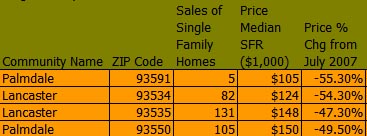
Lowest priced homes in Los Angeles County in July 2008:

bottom41.jpg

Palmdale and Lancaster are in the high desert about 60-75 miles north of downtown LA. Home prices were cut in half there from 2007 to 2008.

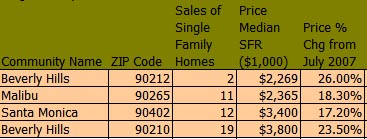
Let us now take a look at these top 4 zip codes in median home price in LA County, where prices were still rising as of July 2008:

top41.jpg

These three million dollar homes are likely to collapse in price, too, at some point. Still, think about the ratio between the top and bottom in LA County zip codes at the end of the housing bubble in July 2007: $2.5 million median prices in the 99th percentile zip codes vs. $250,000 to $300,00 prices in the 1st percentile zip codes. A ten to one ratio of home prices between the 99th and 1st percentile in LA County, one of the most unequal places in America, is not very much at all. It's a much narrower gap than in non-home wealth.

Also, note that the most expensive zip codes aren't turning over as fast as the least expensive, so mortgages originated during the carcinogenic years of the bubble don't make up as large a proportion in the high end zip codes as they do in the low end zip codes. There were a lot of people furiously flipping houses in Lancaster to put them on the road to one day moving up to Beverly Hills. But the folks in Beverly Hills already were living in Beverly Hills, so the urge to speculate wildly on their houses wasn't as pressing for them.

Buying a house in Beverly Hills for millions of dollars is a bet that there will always be stars and other rich people with lots of money who'd like to live in Beverly Hills with the other celebrities. That proved to be a fairly good bet during the Great Depression, and a great bet ever since. Buying a home in Lancaster-Palmdale for hundreds of thousands of dollars, however, was a bet that people who work in big box retail store will somehow make dramatically more money in the next decade or two.

Personally, like most red-blooded Americans, I'd love to Blame It on Beverly Hills, but that's not what the evidence says. (Of course, rich people speculated in investment properties, which had disastrous effects on some neighborhoods when they rented out nice houses to lowlifes to bring in a little cash flow while they were waiting to cash in.)

To bring it home, to help you get a palpable feel for what the financial assets that the U.S. Senate wants to use $700 billion of your money to buy, let's look at Dr. Housing Bubble's continuing series on California's Real Homes of Genius, modeled on the old Bud Light commercials:

ANNOUNCER: Bud Light presents real men of genius. Real men of genius. Today, we salute you, Mr. Giant Taco Salad Inventor.

UNIDENTIFIED MALE: Mr. Giant Taco Salad Inventor.

ANNOUNCER: Ground beef, refried beans, guacamole, cheese, sour cream, and if there's any room left, a few shreds of lettuce. A culinary creation that baffles the human mind. A 12,000-calorie salad. Ay carramba. Some may ask, is your taco salad healthy? Of course it is, it's a salad, isn't it? [If you're still hungry] you can eat that deep fried crunchy bowl.

There are 88 different cities in LA County, which is home to over 3% of the country's residents, and nobody can be expected to know, say, Bellflower from Bell Gardens. So, I'll stick to Real Homes of Genius from one low-end municipality that you might have heard of, Compton, home of the Crips gang. This is where the original West Coast gangsta rappers, NWA, were straight outta. Although world-famous as a black ghetto, already by the time of the 2000 Census, it was 56% Hispanic and no doubt was increasingly Latino all through the Housing Bubble.

(When you're looking at these prices below, add a one or two or three hundred thousand to get prices for comparable homes in cruddy nearby neighborhoods that didn't have a nationally notorious brand name.)

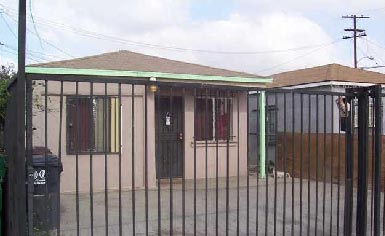
Here, for example, is an 828 square foot manse on a 5,000 square foot Compton lot, with one bathroom, built in 1954. (The average size of a new house in the U.S. is 2,349 s.f.) Maybe it doesn't look like much, but you do get a high rise security fence and it probably would only cost a few thousand to top your fence with the now fashionable lethal finials.

With the inherent value of this kind of asset, is it any surprise that this 828 square foot Compton home's selling price went up, up, up:

On 11/05/2003, it sold for $110,000.

On 9/30/2004, it sold for $235,000.

On 12/22/2005, it sold for $310,000.

Of course it would appreciate $100,000 per year. Just look at it. The median household income in Compton was $31,819, so you could make three times as much money per year just by living in your house as you could by going outside and working for a living.

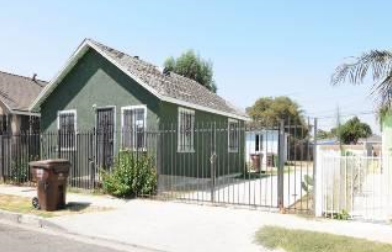
But that's nothing. Here's a 500 sq. ft. one bedroom - one bath Compton house built in 1939.

It sold on 9/27/2007 for $340,000.

Think about that. That's $680 per square foot of 68-year-old wood frame construction. In Compton.

By August 2008, less than a year later, it was on sale for $97,900, a 71% price cut in less than a year.

If 500 square feet isn't quite enough to fulfill your lifestyle needs, there is always this 1,089 square foot Compton home. Dr. Housing Bubble explains:
This 1,089 square foot home includes four bedrooms and two “full” baths. Nestled in the majestic resort town of Compton, you will entertain your friends and family behind U.S. Steel reinforced gates, such as those guarding the Rockefeller Estate. This home uses transcendent features of the 1950s including a patented aqua green color to ward off nuclear attacks from Soviet warships. This moderately priced dream crib is all yours for the rock bottom price of $375,999. This is actually less than the sale price of 2006:

Sale History
06/23/2006: $412,000
10/01/1981: $58,500
What happened to all the money that people in Compton made selling these Real Homes of Genius to each other? A few wise oldtimers presumably bailed out and retired to the South with the profits from selling their Compton homes to Hispanic newcomers. A few clever youngsters probably sold out at the peak and rented homes for $900 per month. A lot of the money, of course, went into buying new Real Homes of Genius. But, I suspect the worst problem is that a lot of people wound up spending the money on consumer goods. In fact, plenty of people probably spent money they assumed they'd make eventually off selling their homes to support a lifestyle that can't be supported. And that's going to require a nasty contraction of the real economy to work out.

Beyond that, the global financial markets concocted vast leveraged contraptions on top of these absurdly leveraged no money down Compton mortgages.

My published articles are archived at iSteve.com -- Steve Sailer

Dear Mr. Buffett: I will sell you my share of the bailout

In the LA Times today, Warren Buffett endorsed the bailout plan as "a rescue plan for America." He went on to say:

"If we could do the deal that is available to the United States government and have its staying power, and its borrowing costs, we would make significant money. I would love to have, if they buy the assets at market price, I would love to have 1% of the profit or loss that results from buying these assets from troubled financial institutions."

Okay, well, that suggests a second deal:

I hereby offer to sell, straight up, my family's share of the bailout, both payouts and subsequent profits, to Mr. Warren Buffett. If he'll write me a check for what it will cost me in taxes, I'll sign over to him my share of the profits, if any.

Seriously, if Buffett really "would love to have 1% of the profit or loss that results from buying these assets from troubled financial institutions," then I am all in favor of him ponying up $7 billion for 1% of the action.

Indeed, I would be feeling a lot better about this deal if Buffett, his buddy Bill Gates, and the rest of the Forbes 400 put together a syndicate to, say, buy 2/7th of the bailout for $200 billion dollars. I'd love for them to have a say in how it's spent as long as they had substantial skin in the game. Buffett has been investing billions in Goldman Sachs and GE in return for 10% interest and warrants to buy stock at certain prices. I'd trust Buffett to come up with a better bailout plan than Paulson or Congress ... but only if Buffett had billions riding on it himself.

By the way, Buffett offers a caveat on his prediction:

"If they buy them at market, they will realize a significant profit over time . . . but the key is buying at market prices."

Indeed. But if they buy them at market prices, how do insolvent banks get bailed out?

I'm guessing about $2 to $2.5 trillion in paper wealth has evaporated in California houses alone, with similarly scaled losses in the other 49 states' houses.

On top of that, there's a possibility that those losses in wealth would be much bigger if the entire financial system comes tottering down because of the mortgage meltdown and we go back to an economy based on trading salt for rifle cartridges.

But, preventing that general collapse isn't going to make those 4 to 5 trillion in paper losses go away. That wealth isn't coming back in the real world because that wealth never really existed.

Now, the big question that I haven't seen answered is: How much of the 4 to 5 trillion was wasted on consumer crap during the bubble as if it were real? I don't know. Personally, I didn't spend more during the Bubble because I never believed in the Bubble price for my home. But, I'm driving a 1998 Accord with 105,000 miles on it, while a lot of other people on the freeway are driving 2008 Lexuses with $4,000 rims, so it seems as if other people took the market price of their homes more on faith.

So, I'm left wondering whether $700 billion (or, I guess, $810 billion in the Senate's version) is going to be enough to prevent a collapse of the financial system?

UPDATE: So, how do you price financial assets if the market has locked up? I have no idea what to do with all the derivatives and other financial black magic, but the underlying mortgages aren't that complicated. The good news is that rents weren't much affected by the bubble. Rents tend to trend upward at a fairly stable rate over the years. In California, house purchase prices got wildly out of wack with house rents. We also have readily available on the Internet a vast amount of information on rental properties comparable to each mortgaged house -- Dr. Housing Bubble typically looks at a half dozen comparable rental units for each of his Real Homes of Genius awards.

So, it wouldn't be that hard to come up with a relatively simple spreadsheet to value homes based on rents in that area. From that, the government could value mortgages. One big technical problem might be reassembling sliced and diced mortgages. But the biggest problem is that 4 or 5 trillion in wealth just vanished and some unknown fraction of that has already been spent.

My published articles are archived at iSteve.com -- Steve Sailer

October 1, 2008

The French see Palin as Annie Oakley

Steven Erlanger writes in the NYT:

They value sophistication above almost anything, and so they regard their own hyperactive president, Nicolas Sarkozy, with his messy romantic life and model-singer wife, as “Sarko the American.”

But this year has been difficult for the French. Mr. Sarkozy has generally supported American foreign policy and has praised the United States’ openness and entrepreneurial verve. And the sudden emergence of Senator Barack Obama — black, and seen as elegant and engaged with the larger world — has sent many French into a swoon.

But the combination of two recent surprises — Gov. Sarah Palin and America’s terrifying financial meltdown — has brought older, nearly instinctual anti-American responses back to the surface.

These two surprises, one after the other, have refreshed clichés retailed under President Bush, confirming the deeply held belief of the French that the United States remains the frontier, led by impenetrably smug and incurious upstarts who have little history, experience or wisdom.

Even worse, from the French perspective, Americans are reckless optimists, incurably blind to the tragedy of life, to the weary convolutions of history and thus to the need for lengthy August vacations and financial regulations.

While the French see themselves as the heirs of urban revolutionaries, with a strong distaste for politicized religion, the American revolutionary spirit seems to them these days to come like a hurricane from the uncosmopolitan right — from the dry, dull flatlands of Texas ranch country or the emptiness of Vice President Dick Cheney’s Wyoming, and now from the odd sunset communities of Arizona and the bizarre bars, churches and hockey rinks of Alaska.

The financial meltdown also seems inevitably American, a product of the reckless audacity that the French pretend to abhor, but often secretly admire. But however careful France’s own banks may have been, the United States is so large and so dominant that the French are afraid of being hit with what one economist, Daniel Cohen, called the “toxic waste” of the scandal.

This year, mocking the candidates has become an industry, with the satirical puppet show “Les Guignols de l’Info” recently adding a squeaky-voiced Senator John McCain puppet to the jug-eared Obama model. In general, though, Americans are portrayed as Sylvester Stallone, lunky and thick-headed. Ms. Palin has been a kind of godsend.

The French know exactly what to make of her, said Frédéric Rouvillois, and that is the problem. Ms. Palin may be an American dream but she is a French nightmare, said Mr. Rouvillois, a lawyer and social historian who has just written a book titled “The History of Snobbery.”

“She’s a caricature of a certain America that hasn’t parted with its boorish ‘Wild West’ side,” said the impish Mr. Rouvillois, who has also written a history of good manners. “For the French snob, the only admissible American is from the East Coast, knows Henry James, is comfortable in French, a sort of European on the other side of the Atlantic.”

A little, yes, like Senator John Kerry. ...

France, like most of Europe, is quite taken with the Democratic candidate, whom the French regard as a “métis,” politely translated as someone of mixed race, usually used for those of African colonial ancestry. Mr. Obama is seen uniquely as an American métis with global experience and antecedents in Africa, through his Kenyan father, not in slavery.

Bernard-Henri Lévy wrote in the magazine Le Point of Mr. Obama as a new type of American black politician.

“Obama is, certainly, black,” Mr. Lévy wrote. “But not black like Jesse Jackson; not black like Al Sharpton; not black like the blacks born in Alabama or in Tennessee and who, when they appear, bring out in Americans the memories of slavery, lynchings and the Ku Klux Klan — no; a black from Africa; a black descending not from a slave but from a Kenyan; a black who, consequently, has the incomparable merit of not reminding middle America of the shameful pages of its history.”

He goes on for a while, but you get the idea.

My published articles are archived at iSteve.com -- Steve Sailer
"Appaloosa"

Here's an excerpt from my review in The American Conservative:
The bald and square-jawed Ed Harris has played American heroes and psycho killers since first drawing notice as astronaut John Glenn in 1983's "The Right Stuff." He's now written and directed "Appaloosa," an amiable Western about masculine camaraderie and honor adapted from the book by Robert B. Parker, the genre novelist who created Spenser, the Boston private eye. "Appaloosa" furnishes Harris and Viggo Mortensen (the King in "The Return of the King") with plenty of wry lines for their portrayals of itinerant lawmen in the New Mexico of the 1880s.

Fish do not feel wet, we are told (although on what authority, I cannot say), and cowboys and Indians movies once felt no more awkward than cops and robbers films do today. Westerns were then less a genre than a natural, default mode.

In the early 1970s, however, urban crime dramas, such as "The French Connection" and "The Godfather" replaced Westerns as the norm. The Western has since become a highly self-conscious genre, one almost immobilized by the weight of its pre-1970 cinema history.

As an actor, however, Harris appears unburdened by all the film school baggage the Western has accumulated. The straightforward "Appaloosa" provides two outstanding roles and sundry old-fashioned pleasures.

My published articles are archived at iSteve.com -- Steve Sailer
Another secret reader

A couple of weeks back, I suggested that Obama mention that he plays poker while McCain likes to roll the dice, poker being a game of skill while craps is, well, a crapshoot. Earlier this week,

I read the other day that Senator McCain likes to gamble. He likes to roll those dice. And that's okay. I enjoy a little friendly game of poker myself every now and then.

But one thing I know is this -- we can't afford to gamble on four more years of the same disastrous economic policies we've had for the last eight.

I know that when Senator McCain says he wants to bring the same kind of deregulation to our health care system that he helped bring to our banking system -- his words -- well, that's a bet we can't afford. We can't afford to roll the dice by privatizing Social Security, and wagering the nest egg of millions of Americans on Wall Street. We can't afford to gamble on more of the same trickle down philosophy that showers tax breaks on big corporations and the wealthiest few. We've tried that. It doesn't work.

Sen. Barack Obama

My published articles are archived at iSteve.com -- Steve Sailer