Showing posts sorted by relevance for query richard III. Sort by date Show all posts

February 12, 2013

Richard III: Kingship and Kinship, Nepotism and Neposchism

Olivier as Richard III
My new Taki's column looks at Richard III, both the real king recently dug up from a parking lot in England, and Shakespeare's hunchback Machiavel:
As Richard’s supporters, the Ricardians, like to complain, history is written by the victors. And the victorious Tudors had the best writer ever, William Shakespeare, whose patroness, Queen Elizabeth I, was Henry VII’s granddaughter.

What was so bad about Richard III? I offer an explanation calling upon the Darwinian insights of William D. Hamilton and Robert Trivers.

Read the whole thing there.

February 14, 2013

More King Richard III Mania

From the NYT:
Tracing a Royal Y Chromosome 
By NICHOLAS WADE 
Researchers last week developed DNA evidence to help identify the remains of a skeleton found under a parking lot in Leicester, England, as those of Richard III, the last English king to die in battle, in 1485. But the researchers’ work is only half-done. They have made a strong but not conclusive link through the female line, and are now turning to the male side for corroboration.
... Chris Tyler-Smith, a geneticist at the Wellcome Trust Sanger Institute near Cambridge, said the mitochondrial DNA type identified by Dr. King was “rare enough to be interesting, but not rare enough to be conclusive.”

Tyler-Smith is the Genghis Khan's Y chromosome guy. I scooped Wade on Tyler-Smith's discovery because Wade was tied up with the exploding space shuttle.
The Leicester team plans to investigate the paternal DNA of the remains. Kevin Schürer, a historian at the university, has already found four living descendants of John of Gaunt, the son of Edward III, who was Richard III’s great-great-grandfather. Dr. King has found that their Y chromosome, which is carried only by men, match, establishing that they are all true descendants of John of Gaunt. 
The Y chromosome DNA from the skeleton is very degraded, but Dr. King said she had found that she could amplify it and hopes to get enough to make a match with the living descendants.

September 2, 2008

Tribal Fertility Totem Elicits Strong Emotions

Over at The American Scene, the always sensible Noah Millman returns from the Labor Day Weekend to make some sensible comments about Sarah Palin: e.g., she might have made a better Keynote speaker, like Obama in 2004, than VP candidate. (By the way, though, how often do you think Democrats have kicked themselves since 2004 that they didn't let themselves get carried away at that convention and nominate Obama for Veep by acclamation back then, instead of what's his name, that loser with the hair? John Kerry might be President today.)

But Noah then added this postscript, after he realized that we're in the middle of a full-blown national freak-out over the various Palin Pregnancy stories, true and false, that have obsessed attention since he left for the weekend.

UPDATE: You know, I wrote this post, and made my little points, and then I started working back through some of the comments (not on my posts, actually – I haven’t gotten back that far, and I’m not sure I will). People are seriously losing their minds here, in a way that I’ve never seen before on this site. And not just people who have obviously wandered over here for the first time: regular readers are going off their rockers. I’m really not sure what we all ought to do about this. I wrote a little sermonette but I just deleted it because I can’t imagine anyone who’s gone off their rocker reading it and doing anything but getting angrier. I’m open to suggestions on what to do. Myself, I swear my next post will about Canadian theater.

Right.

And here’s the fundamental reason underlying all the rage on one side and amusement on the other over Sarah Palin: it’s all about … female fertility.

Human beings have extremely strong emotions on the topic of fertility. It’s an obsession — look at the celebrity gossip columns these days. The who is sleeping with whom stuff bores people now compared to the pregnancy news. Thus, celebrities auction off rights to pictures of their new babies for millions, even though all newborns look alike. The top breeding stock parents — Angelina Jolie and Brad Pitt — were looking to snag something like $6 million for the exclusive rights to the first photos of their twins.

Now, the Breeding Wars have moved into the political arena. Barack Obama launched his Presidential run at the 2004 Democratic convention by devoting the first 380 words of his speech to describing in great detail the two stocks from which he was crossbred. His message is that by uniting in his DNA the two races, he will end the racial conflict that has long plagued this land. (Noah should take a look at Henry VII’s speech ending Shakespeare's “Richard III” for the classic expression of the logic of dynastic merger, in this case between the Lancasters and the Yorks.) Obama left out the part about his mom being 17 when she got pregnant and his father already being married with a kid and another on the way.

Palin has horned in on all that subliminal symbolism with her own. She’s had five kids while shooting caribou (a picture of her and a daughter standing over a huge beast she shot is the LA Times most emailed article of the day even though it's not an article, just a picture) and throwing the crooks out, and now she has a 17-year-old daughter who is pregnant and will marry a handsome hockey player.

The Blue Whites are alarmed and outraged to be reminded that the Red Whites can afford to outbreed them and are outbreeding them. Modern people tell themselves they don't care about stuff like that, but they do, oh, they do.

My published articles are archived at iSteve.com -- Steve Sailer

September 21, 2009

Cuckoos Eggs

According to the rating system of Chessmetrics.com, for a brief period in the early 1970s, Bobby Fischer was the greatest chess player of the last 170 year.

Peter Nicholas in the LA Times has a long article, Chasing the king of chess, documenting his theory that Bobby's true father wasn't German gentile biophysicist Gerhardt Fischer, whom his mother Regina Wender, a Jewish-American, had married in Moscow in 1933. Instead, Nicholas argues that the biological father was Paul Nemenyi, a Hungarian Jewish physicist. Nicholas has pictures of the two men, Gerhardt Fischer and Paul Semenyi, for you to compare to the chess legend's looks. I guess I'd lean toward his theory, but neither man looks implausible for the role of Fischer's father.

That reminds me of John D. Gartner's theory in In Search of Bill Clinton: A Psychological Biography that the former President wasn't actually the posthumous son of the bigamous marriage of his mother Virginia (the first of her five marriages) to traveling salesman Bill Blythe (the last of his five marriages). Bill Blythe, a high school dropout, was in the Army in Italy nine months before Bill Clinton was born. In 1993, when the Washington Post revealed that the President had an unknown half-brother in California, Clinton shrugged it off.

Gartner feels that having one charming tramp for a parent, his mother is enough to account for the ex-President's charming trampiness, while having another charming tramp, his putative father, as a parent is genetic overkill and leaves open the question where Clinton got his more serious genes.

Gartner theorizes that a doctor in Hope (where Virginia was a nurse) named George Wright was the real father. Later, Dr. Wright had young Bill Clinton vacation with his family every summer at a lakeside house. Apparently, lots of people in Hope believe Clinton was Dr. Wright's natural son.

Wright was a dirt-poor farmboy who graduated from high school at 16, worked in his brother's cotton-field for four years to save up money for college, graduated in 2.5 years, and then graduated from LSU medical school, where a classmate recalled him as "the poorest person I met im medical school." He was a bright workaholic and a voracious reader of medical literature. Of Wright's three legitimate sons, one is a doctor, another a lawyer, and a third is a car salesman.

It sounds plausible that Clinton is the product of his mother and the bright, hard-working doctor. But, of course, that's not proof. One of the doctor's sons is willing to provide a DNA sample if the ex-President is ever willing.

This reminds me that the bane of the uneasy reign of King Henry VII, the Lancastrian founder of the Tudor dynasty, were the impostors, Lambert Simnel and Perkin Warbeck, who pretended to be the rightful heirs to the late King Edward IV, whose daughter Elizabeth of York Henry had married to end the War of the Roses after killing her uncle, Richard III at Bosworth Field. The impostors were handsome youths whom Yorkist malcontents seized upon to lead sizable military uprisings. Warbeck, who looked much like the famously handsome King Edward IV, might possibly have been an illegitimate offspring of that lusty monarch.

My published articles are archived at iSteve.com -- Steve Sailer

December 27, 2009

Am I going deaf?

Or was much of Robert Downey's English-accented dialogue in Sherlock Holmes close to inaudible?

I started to understand more of what the star was saying after about an hour. I think I could follow the diction of Jude Law's Dr. Watson a little better. In contrast, when I was 13 and first saw Laurence Olivier's Richard III on TV, it took me about five minutes to get the hang of the accent, the blank verse, and Shakespeare's 16th Century vocabulary.

Am I deafer now, or was there something wrong with the sound system in the theatre, or is Sherlock Holmes not worth watching until it comes out with on subtitles? (Of course, that raises the issue of whether it's worth watching on DVD.)

In contrast, Englishman Hugh Laurie has been doing Holmes with an American accent to perfection on House on TV for most of the decade. (In general, I don't mind the movie turning Sherlock Holmes into bare knuckle brawler -- Laurie has been doing a brilliant riff on Sherlock Holmes as a purely cerebral force 22 times a year.)

Part of the problem is no doubt using overlapping dialogue like in a 1930s screwball comedy. But audiences could follow His Girl Friday or Bringing Up Baby because Cary Grant and Katharine Hepburn didn't actually step on each other's lines. Instead, they generally started each line with an unnecessary syllable like "Ohhhhhhh" while the other finished.

Visually, Guy Ritchie did a bunch of useful hand-holding exercises to keep the audience from losing the thread of the plot, which was much appreciated. But it's frustrating when dialogue is inaudible. Later in the movie I could understand better, but then the witticisms didn't seem very funny. That I will never understand -- why spend years and 9 figures mounting a movie and then not spend a few weeks and six figures for a script doctoring to make sure there are enough jokes? Downey is really funny, so why not give him some jokes?

Also, is it really a good idea to make Robert Downey Jr. an action star? Despite what they tell you in the making-of documentaries, the insurance companies that provide the business-interruption insurance for film productions won't let expensive stars do their own stunts. What action stars are supposed to do is fake the hard landing after the stunt man flies through the air.

The worst job I've ever seen a leading man do in regard was Matthew Perry (Chandler Bing on Friends) in a 2002 turkey called Serving Sara. In the middle of production, he'd disappeared into rehab for a vicodin painkiller addiction. So, when he got back, the crew treated him like he was as fragile as Christmas tree bulb. They couldn't let him get hurt because he was on the wagon for painkillers, and if he slipped off the film would never have gotten finished (which wouldn't necessarily have been a bad thing for the history of cinema). So, the stuntman would fly through the air and then the director would cut to Chandler lying inertly on the ground.

Now, which major current 44-year-old star would you guess would be most vulnerable to a Vicodin addiction if he, say, dislocated his shoulder taking a tumble and then gallantly soldiered on to keep the production on track?

Right.

Sherlock Holmes wasn't nearly as bad as Serving Sara, but the interplay between the star and his stunt double was a lot less seamless than is the norm these days. Guy Ritchie's Vegematic editing distracts from this problem, but it's still there.

And is it really the best use of Downey's verbal skills to have him sitting around endlessly on giant productions waiting for the crew to get ready for his next shot?

And maybe Downey got all ripped for his shirtless boxing scene purely through natural weightlifting, but, don't forget, Downey's director was married for years to Madonna, a notorious performance enhancing drug abuser. So, if the middle-aged Downey's workout regimen wasn't producing the results Ritchie had in mind, how much pressure would he put on Downey to try some chemical shortcuts? But is Downey the right guy to be putting weird chemicals in his body?

My published articles are archived at iSteve.com -- Steve Sailer

June 15, 2008

The dynastic appeal of Barack Obama

In my new VDARE.com column, I respond to Kenan Malik's criticism in Prospect of my definition of race. His assumption that it's absurd to call the British royal family a racial group got me thinking about dynasticism again, and I finally figured out something about the essence of Barack Obama's appeal that should have been obvious to me a year ago.

It's absurd that in a huge country like America that a Bush or a Clinton has been on every national ticket since 1980. I viewed Obama's victory over the Clinton dynasty as a defeat for the forces of dynasticism, but now I realize I was being naive, that has brilliantly tapped into the public's dynastic logic, just on a larger and subtler scale.

Here's an excerpt, but you'll have to read the whole article to see how.

How to Think About Race — and Barack Obama

By Steve Sailer

A new but characteristically confused debate over whether race is a biological reality reminds me of the value of having a simple definition of "race" in mind.

Left-leaning British-Indian science journalist Kenan Malik's latest book, Strange Fruit: Why Both Sides are Wrong in the Race Debate, has so far only gone on sale in the U.K. But he argues online: "Race is not a real biological entity."

In a hostile review of Malik's book in Prospect, the fine British intellectual magazine, Mark Pagel, a British evolutionary biologist, lands a flurry of blows:

"Malik knows these facts about our genetics, but wants to insist that, unless 'race' corresponds to absolute boundaries, it is a useless and damaging concept. But to deny what everybody knows and to swap the word race for something less politically charged like ‘group’ is just an act of self-denial and certainly no more accurate than the dreaded ‘r’ word. It is also patronising—I would like to think we are all grown up enough to accept the facts and ready ourselves for the deluge to come. I say deluge because the more we measure, the more genetic differences we find among populations …"

Unfortunately, Pagel doesn't deliver a knockout punch because he lacks a definition of race. Like Supreme Court justice Potter Stewart wrote in his famous opinion in a pornography case, Pagel can't define race, but he knows it when he sees it.

Malik responded in Prospect by noting, with some justice, "The debate over race has moved on. To judge from his review of my book, Mark Pagel hasn't noticed."

To illustrate the state of the art thinking among the race realists he opposes, Malik writes:

"In the 19th and early 20th centuries, races were viewed as fixed groups, each with its own distinct behaviour patterns and physical characteristics. They could be ranked on an evolutionary hierarchy, with whites at the top and blacks at the bottom. Today, with a few exceptions, race realists reject the idea that there are essential, unbridgeable differences between human populations, or that differences signify inferiority or superiority. So how do they define a race? Usually as 'an extended family that is inbred to some degree' in the words of Steve Sailer of the Human Biodiversity Institute. ... But once everything from the British royal family to the entire human population can be considered a race (because each is an "extended family inbred to some degree"), then the category has little value."

[More]

Along these lines, here's an update of an update of Richmond's speech concluding Shakespeare's Richard III about the dynastic marriage to end the War of the Roses between the Yorks and Lancasters:

We will unite the white rose and the black:
Smile heaven upon this fair conjunction,
That long have frown'd upon their enmity!
What extremist hears me, and says not amen?
America hath long been mad, and scarr'd herself;
The rev'rend shouted his congregation's ire,
The consultant plotteth Will Horton ads
The undiverse fleeeth to the exurbs
All this divided White and Black
Divided in their dire division,

But then Barack Sr. and Stanley Ann
The true succeeders of each racial house,
By God's fair ordinance conjoin together!
And let their heir, God, if thy will be so.
Enrich the time to come with smooth-faced peace,
With smiling plenty and fair prosperous days!
Abate the edge of racists, gracious Lord,
That would demand both parties make borders secure,
And make America less inclusive
Let them not live to taste this land's increase
That would with insensitivity wound this fair land's peace!
Now civil wounds are stopp'd, peace lives again:
That she may long live here, God say amen!

My published articles are archived at iSteve.com -- Steve Sailer

January 21, 2014

Richard Sherman

Seattle Seahawks' cornerback Richard Sherman is getting a lot of attention for a postgame interview on Sunday that's more WWE than NFL.

I saw him play in high school in 2005. His team, Compton Dominguez, was so loaded with talent that they crushed my old high school, Notre Dame of Sherman Oaks, in the Southern California Division III finals without this future Super Bowl cornerback standing out in the game as a wide receiver (a position he played well for a couple of years at Stanford).

Compton's fast black backs just ran the ball over and over (19 times on the opening drive for a touchdown) behind an offensive line of giant Pacific Islanders, including a 319 pound tight end.

Compton Dominguez had gotten some major personal foul penalties in earlier playoff games, of the kind Sherman got at the end of the NFC championship game, but their conduct was exemplary in this one. Slum schools tend to blow up in high school playoffs, but Compton was very disciplined and didn't start celebrating after tackles until the last couple of minutes of the game.

Compton dominated so dominated on the ground, that NDHS only got one offensive play off in the first quarter, although it was a good one: Quarterback Garrett Green ran a draw 75 yards for a touchdown, pulling away from all four Compton defensive backs, including Sherman. Green was a remarkable athlete, a white guy faster than Richard Sherman, an excellent defensive back, and a quarterback with more or less a Division I passing arm, although not the NFL passing arm required by USC during those years at the top of the heap. So at USC Green just played quarterback on the practice squad, imitating the opponents' quarterback for the USC defense to tee off on, then went into the real estate business, which is a good business to go into if your years of service to the Trojans are appreciated by USC alums.
  

October 20, 2005

The ultimate logic of the present moment

If front-runner Hillary Clinton wins the 2008 election and is re-elected, then two families will rule America for 28 straight years. The next step in this grand historical evolution seems obvious.

Thinking along similar lines, Norm Ornstein writes today:

"Americans all have to consider the implications now of a worst case scenario-- the problems of scandal and polarization result in a meltdown of the W. Administration and a collapse of governance in Washington. No Doubt some hard core partisans and ideologues would exult. But with the domestic and foreign policy challenges the country faces, it would be a disaster for all of us.

"We are in the same boat, and if it is rudderless, we all sink. So how can we deal with the consequences if that worst case scenario occurs? Here is one simple three steop roadmap:


"1. Vice President Cheney resigns-- and President Bush replaces him not with Condoleezza Rice, as the rumors in Washington speculate, but with his father, George H.W. Bush.

"2. President Bush resigns, allowing his father to move up to the presidency.

"3. Bush 41/44 chooses his best buddy and surrogate son Bill Clinton (42, that is) to be Vice President. Talk about a fusion White House. Talk about bringing us together. Talk about compassionate triangulation.


C'mon, Norm, you can do better. Why stop there? How about ...

4. Jeb Bush's politically ambitious son George P. Bush gets his marriage to that blonde annulled on the grounds of non-dynasticism and marries Chelsea Clinton.

5. George P. and Chelsea succeed to the White House as co-Presidents in the mode of England's King William and Queen Mary (fulfilling her mother's deepest wish).

6. Chelsea gives birth to a son and daughter, who, in the fullness of time, follow their parents on the throne.

7. The royal siblings marry and produce a son and a daughter.

8. Repeat forever... or at least until inbreeding depression reduces the co-Presidents to drooling cretins and the Secret Service auctions off the Presidency to the highest bidder.

Hey, it worked for the ancient Egyptians.

A reader updated Richmond's speech concluding Shakespeare's Richard III about the marriage to end the War of the Roses:


We will unite the blue rose and the red:
Smile heaven upon this fair conjunction,
That long have frown'd upon their enmity!
What extremist hears me, and says not amen?
America hath long been mad, and scarr'd herself;
The doctor blindly spinned his client's gaffe,
The consultant plotteth revenge in ye War Room
The leader useth his aide as a cigar
All this divided Red and Blue
Divided in their dire division,

O, now, let George P and Chelsea
The true succeeders of each royal house,
By God's fair ordinance conjoin together!
And let their heirs, God, if thy will be so.
Enrich the time to come with smooth-faced peace,
With smiling plenty and fair prosperous days!
Abate the edge of racists, gracious Lord,
That would demand both parties make borders secure,
And make America less inclusive
Let them not live to taste this land's increase
That would with insensitivity wound this fair land's peace!
Now civil wounds are stopp'd, peace lives again:
That she may long live here, God say amen!


My published articles are archived at iSteve.com -- Steve Sailer

June 1, 2005

Laura Bush vs. Hillary Clinton in 2008? With talk mounting of the two First Ladies running against each other for President in 2008, one reader was inspired by my suggestion that an arranged marriage between dynastic heirs George P. Bush and Chelsea Clinton could meld our discordant red and blue into a royal purple. He updated Richmond's speech in Shakespeare's Richard III about the marriage to end the War of the Roses:

Inter their bodies as becomes their births:
Proclaim a pardon to the soldiers fled
That in submission will return to us:
And then, as we have ta'en the sacrament,
We will unite the blue rose and the red:
Smile heaven upon this fair conjunction
onjunction,
That long have frown'd upon their enmity!
What extremist hears me, and says not amen?
America hath long been mad, and scarr'd herself;
The doctor blindly spinned his client's gaffe,
The consultant plotteth revenge in ye War Room
The leader useth his aide as a cigar
All this divided Red and Blue
Divided in their dire division,


O, now, let George P and Chelsea

The true succeeders of each royal house,

By God's fair ordinance conjoin together!
And let their heirs, God, if thy will be so.
Enrich the time to come with smooth-faced peace,
With smiling plenty and fair prosperous days!
Abate the edge of traitors, gracious Lord,
That would demand both parties make borders secure,
And make America less inclusive
Let them not live to taste this land's increase
That would with insensitivity wound this fair land's peace!
Now civil wounds are stopp'd, peace lives again:
That she may long live here, God say amen!


My published articles are archived at iSteve.com -- Steve Sailer

February 26, 2007

Chicago's Election

Mayor Richard M. Daley will likely tie the late Mayor Richard J. Daley's municipal mark by winning his sixth straight mayoral election on Tuesday. (Illinois Senator Barack Obama has jumped on the bandwagon, endorsing Daley despite previously expressing concern about the corruption of Daley's regime.)

When Richie Daley was first elected in 1989, nobody (including, I'm sure, the candidate himself) imagined that aesthetics would be his foremost concern. And, yet, Daley, of all people, has proven the most artistically important politician in America. Chicago's lakefront is now a gleaming wonderland, and Daley is going all out to get the 2016 Olympics to show it off to the world.

As a politician, Daley is strangely similar to one of his inspirations, the Emperor Napoleon III, the renovator of Paris. Fortunately, lacking an army, Daley hasn't gotten into similar entanglements abroad, such as attempting to put a puppet king on the throne of New Mexico or declaring war on the insolent Teutons of Wisconsin.


My published articles are archived at iSteve.com -- Steve Sailer

May 13, 2006

Great article: The genetics of nepotism and neposchism in Shakespeare's history plays

William D. Hamilton's kin selection calculus strikes again!

Study: Royal Executions Followed Pattern

By Jennifer Viegas, Discovery News

A study of British royal executions has determined that the killings followed consistent patterns that correspond to Charles Darwin's "survival of the fittest" theory.

The study helps to explain why so many British royals killed family members, particularly over a 200-year period called The Cousins' Wars that spanned the 14th to the 16th centuries.

It also suggests that human behavior, even family murders, can be consistent with patterns of survival under circumstances in which resources are scarce, yet highly valued, life-supporting and gained only through inheritance.

According to the researchers, such conditions existed after Edward III's death in 1377. The king and his wife produced five sons and three daughters who survived to adulthood and who all had their eyes on the crown.

Richard II, Edward's successor and eldest son, proved to be a weak, despised leader. Richard's cousin, Henry IV, executed the king and began the apparently Darwinian Cousins' Wars.

"Darwin's major contribution to science was selection -- natural and sexual, which depend upon competition between individuals and their choices," explained Kathleen Heath, who worked on the study, which has been selected for publication in The History of the Family journal.

Heath, an associate professor of anthropology at Indiana State University, added, "Those who adapt best -- better than his/her competitor -- in a particular environment are favored by natural selection, that is, live longer and have a better chance of passing on their genes to the next generation."

Heath and her colleagues determined that the murdering royals never sacrificed lineal relatives. Of the 47 killed, only five were not cousins. These included one brother, two uncles and two nephews.

The researchers assigned genetic relatedness values to each individual, so that a parent, for example, is 50 percent, or .5, related to a child, while a full first cousin is .125.

Using these values, the scientists found that executioners never killed in excess of their own nuclear relatedness, meaning the total value assigned to the individual and his or her children.

If they had killed in excess of this amount, it "would have been the equivalent of evolutionary suicide," according to the researchers, since the killers would have been eliminating, instead of furthering, their genetic family line.

Finally, the study found that the longer an individual lived and served as monarch, the more people he or she killed. Elizabeth I, whose long, stable reign ended the Cousins' Wars, wound up killing five cousins, all of which were perceived threats to her life and throne.

"Some royals killed as a simple insurance policy -- the poster boy for this is Henry VIII, who would not allow anyone to come close to his son's claim to the throne," Heath told Discovery News. "As a mother is violent when her children are in danger, there is an inherent drive to protect one's offspring/lineage by whatever means -- love or murder."

She said non-royal wealthy families had to devise other means for reducing inter-family competition for resources. These tactics included sending relatives off to military service, on quests, to the priesthood or to a nunnery.

David Zeanah, graduate coordinator of archaeology at California State University, Sacramento, and graduate student Henry Lyle told Discovery News that the researchers were "ingenious" in "finding a source of data where the consequences of human behaviors for reproductive success can be evaluated."

Zeanah and Lyle added, "This not only offers tremendous potential benefits for Darwinian approaches to studying human behavior, but promises new insights into the ultimate, Darwinian causes of historical events that have previously been understood in terms of proximate causation alone."

Not surprisingly, Dr. Heath got her Ph.D. in Anthropology at the U. of Utah, the department that is home to Henry Harpending and many other independent minds.

By the way, awhile ago I asked readers to coin a term for exactly this flip side of nepotism, this tendency to struggle most with one's own kin for resources, what I'd been calling "sibling rivalry writ large." Ideally, the terms would form a handy pair like Galton's "nature and nurture."

I particularly liked one suggestion: nepotism vs. "neposchism".


My published articles are archived at iSteve.com -- Steve Sailer

September 26, 2013

A $1,185.00 book on "The Philosophy of Race"

Tyler Cowen pointed out this book reprinting 73 academics papers on the Philosophy of Race for the low, low price of $1,185. How much of it sounds of value? 

I looked over the 73 titles and then read with interest the Philip Kitcher article from 2007, "Does Race Have a Future?" [link improved] in which this very bright guy, the John Dewey Professor of Philosophy at Columbia, offers his mea culpa for previously proposing a definition of race rather like mine, because everybody -- except what Kitcher calls "ogre naturalists" such as JP Rushton -- knows that race doesn't exist. But Kitcher also slips in a few Eppur si muoves. In that kind of intellectual atmosphere, where even a heavyweight like Kitcher gets browbeaten, how much good work can get done?
The Philosophy of Race 
Edited by Paul Taylor 
Routledge – 2012 – 1,584 pages 
Series: Critical Concepts in Philosophy 
Hardback: $1,185.00 
December 14th 2011 
Volume I: HISTORY 
Part 1: Philosophical Historiography 
1. Cornel West, ‘A Genealogy of Modern Racism’, Prophesy Deliverance! Towards an Afro-American Revolutionary Christianity (Westminster Press, 1982), pp. 47–68. 
2. Robert Bernasconi, ‘Race, Culture, History’ (plenary lecture at Sodertorn University, 28 May 2009), pp. 11–46. 
3. David Theo Goldberg, ‘The End(s) of Race’, Postcolonial Studies, 2004, 7, 2, 211–30. 
Part 2: Early Figures and Moments 
4. Harry Bracken, ‘Philosophy and Racism’, Philosophia, 1978, 8, 2–3, 241–60.
5. Richard Popkin, ‘Hume’s Racism Reconsidered’, The Third Force in Seventeenth-Century Thought (Brill, 1992), pp. 64–75. 
6. Meg Armstrong, ‘"The Effects of Blackness": Gender, Race, and the Sublime in Aesthetic Theories of Burke and Kant’, Journal of Aesthetics and Art Criticism, 1996, 54, 3, 213–36. 

June 29, 2010

Missing the Point

Christopher Hitchens writes in Slate:
Reviewing the sudden spasm of violence between the Uzbek minority and the Kyrgyz majority in Kyrgyzstan recently, many commentators were at a loss to explain why the two peoples should so abruptly have turned upon one another. Explanations range from official pandering to Kyrgyz nationalism, to sheer police and army brutality, to provocations from Taliban-style militias hoping to create another Afghanistan, but none go very far in analyzing why intercommunal relations became so vicious so fast. As if to make the question still more opaque, several reports stressed the essential similarity—ethnic, linguistic, cultural—between the Kyrgyz and Uzbek populations.

But that in itself could well be the explanation. In numerous cases of apparently ethno-nationalist conflict, the deepest hatreds are manifested between people who—to most outward appearances—exhibit very few significant distinctions. It is one of the great contradictions of civilization and one of the great sources of its discontents, and Sigmund Freud even found a term for it: "the narcissism of the small difference." As he wrote, "It is precisely the minor differences in people who are otherwise alike that form the basis of feelings of hostility between them."

Not necessarily. In general, people who are vastly different don't live near each other so they don't have much to fight over. And, if they do, they learn not to compete all that much for the same resources. For example, Pygmies are better adapted to life in the forest than Bantu, so they tend to stick to forests the Bantu find unprofitable. When they emerge into deforested agricultural land, they subordinate themselves to Bantu farmers as laborers.

When highly different people do compete, however, the competition can be so nasty that pretty soon they aren't competing much anymore: see the story of Ishi, for example, to understand why there aren't any wild Indians left in Northern California to compete with white men for land.
The partition of India and Pakistan, for example, which gives us one of the longest-standing and most toxic confrontations extant, involved most of all the partition of the Punjab. Visit Punjab and see if you can detect the remotest difference in people on either side of the border. Language, literature, ethnic heritage, physical appearance—virtually indistinguishable. Here it is mainly religion that symbolizes the narcissism and makes the most of the least discrepancy.

I used to work in Northern Ireland, where religion is by no means a minor business either, and at first couldn't tell by looking whether someone was Catholic or Protestant. After a while, I thought I could guess with a fair degree of accuracy, but most of the inhabitants of Belfast seemed able to do it by some kind of instinct. There is a small underlay of ethnic difference there, with the original Gaels being a little darker and smaller than the blonder Scots who were imported as settlers, but to the outsider it is impalpable. It's just that it's the dominant question locally.

Hitchens is an acute observer to notice physical difference on average in Northern Ireland.
Likewise in Cyprus, it is extremely hard to tell a Greek from a Turk. The two peoples have been on the same island for so long that they even suffer from a common sickle-cell blood disease called thalassemia. I once interviewed a doctor who specialized in the malady, and he solemnly told me that, from a blood sample, it was not possible to tell if the donor was Greek or Turkish. I had to stop myself from asking him if he had hitherto thought that different nationalities were made out of different genetic material. There have been almost no recorded cases of intermarriage between Greek and Turkish Cypriots, and the island remains sternly partitioned. 

Hitchens should reread this last sentence of his and he might start to get a clue about the forest that he can't see for the trees.
In his book The Warrior's Honor, Michael Ignatieff spent some time trying to elucidate what it was that made soldiers in the Balkan Wars—physically indistinguishable from one another—so eager to inflict cruelty and contempt upon Serb or Croat or Bosnian, as the case might be. Very often, the expressed hatred took the form of extremely provincial and local rivalries, inflamed by jealousies over supposed small advantages possessed by the other. Of course, here again there are latent nationalist and confessional differences to act as a force multiplier once the nasty business gets started, but the main thing to strike the outsider would be the question of "How can they tell?" In Rwanda and Burundi, even if it is true, as some colonial anthropologists used to claim, that Hutu and Tutsi vary in height and also in the delimitation of their hairlines, it still doesn't seem enough of a difference upon which to base a genocide.

In Sri Lanka, where again it takes a long time to notice that Tamils are prone to be slightly smaller and slightly darker than the Sinhala majority, it is somehow the most important information that either population possesses. And it doesn't take long for one population to start saying that the other one has too many children, takes too much leisure, is too casual about hygiene. Every time he heard a Shiites or Sunni Iraqi saying that religion didn't really count, said my friend Patrick Cockburn in his book on Baghdad, he noticed that every single one of them knew the exact faith allegiance of everybody else in the room. And if you want to see an expression of sheer racial disdain, try giving to an Iranian Shiites the impression that you think he and his Iraqi co-religionists are brothers under the skin.

The next example of this phenomenon will be among the most serious as well as the least dramatic. One of the most unobtrusive differences in the world—the line that separates French from Flemish-speaking Belgians—is about to be forcefully reasserted in a bid to split Belgium in two. If this secession occurs, then the headquarters country of NATO and the European Union will rather narcissistically cease to exist, undone by one of the smallest distinctions of all.

So pity the Uzbeks and Kyrgyz as they peer suspiciously at one another during a sudden time of scarcity and insecurity. Their mutual miseries may be just beginning. And all this contains the true ingredients of tragedy—and of irony. One of the great advantages possessed by Homo sapiens is the amazing lack of variation between its different "branches." Since we left Africa, we have diverged as a species hardly at all. If we were dogs, we would all be the same breed.

Dogs have been genetically engineered into more varieties than any other species. Human beings differ in looks roughly about as much as do house cats, another species to which people have devoted a lot of effort to differentiate.

But, all this is just barking up the wrong tree ...
We do not suffer from the enormous differences that separate other primates, let alone other mammals. As if to spite this huge natural gift, and to disfigure what could be our overwhelming solidarity, we manage to find excuses for chauvinism and racism on the most minor of occasions and then to make the most of them. This is why condemnation of bigotry and superstition is not just a moral question but a matter of survival.

Well, why do Montagues and Capulets fight in Romeo and Juliet? The Hatfields and McCoys? The Corleones and Barzinis in The Godfather? The Lancasters and Yorks? The children of Jacob and the children of Esau? Is it because of their differences in looks? In language? In religion?

No, it's because they are different extended families. They contend with each other to gain advantages and to prevent themselves from being subjected to disadvantages.

The other differences enumerated by Hitchens serve to help keep them different extended families through less than random levels of intermarriage and other forms of alliance. And, reduced intermarriage causes the various markers of genealogical difference (looks, language, religion, cuisine, customs, dress, etc.) to become more obvious over the generations.

Hitchens, like 99% of current intellectuals, gets all this backwards, starting from the top down of observable difference, rather than building solidly from the ground up of genealogy.

Hitchens writes "but the main thing to strike the outsider would be the question of 'How can they tell?'" But there is a more fundamental question than how do you tell what group some other person belongs to. Instead, how do you tell what group you belong to? But nobody asks that question because the answer is so obvious most of the time: you belong to the racial group that your relatives belong to. (When it's not obvious to an individual, he sometimes writes a 150,000 word book, such as Dreams from My Father, to justify his answer).

Similarly, you can tell what group somebody else belongs to generally by whom their relatives are.

And that's what different racial groups are: large extended families that possess more coherence and continuity over time than typical extended families due to higher than random levels of in-marriage. A racial group is merely a partly inbred extended family.

It's not very complicated to figure this out. All you have to do is to read a little history. The modern fashion is simply historically obtuse. The Old Testament, for example, goes to great lengths to explain the genealogical basis of various conflicts.

Similarly, the Sunni-Shi-ite split started as a family feud among the Prophet's relations over leadership after Mohammed's death. The Sunnis go back to the followers of Abu Bakr, Mohammed's father-in-law, while the Shi'ites go back to the followers of Ali, Mohammed's cousin and son-in-law.

Moreover, how did the Lancasters and Yorks of the War of Roses stop warring? Shakespeare explains in the last speech of Richard III, in which the victorious Richmond (Henry Tudor of the Lancaster clan) announces he will marry Elizabeth of the York clan:
O, now, let Richmond and Elizabeth,
The true succeeders of each royal house,
By God's fair ordinance conjoin together!
And let their heirs, God, if thy will be so.
Enrich the time to come with smooth-faced peace,
With smiling plenty and fair prosperous days!

It's frustrating to me that I've been explaining since the 1990s that there is a simple, Occam's Razor explanation for much of the group conflict in the world that's staring everybody right in the face and but the current worldview works to keep people, even ones as generally sharp as Hitchens, unperceptive and ignorant.

October 30, 2008

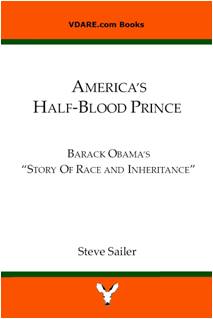
The Introduction to my book: "America's Half-Blood Prince: Barack Obama's Story of Race and Inheritance"

We've posted online my entire 264 page book, America's Half-Blood Prince: Barack Obama's Story of Race and Inheritance. You'll be able soon to order a paperback copy for $29.95, but in the meantime, you can start reading it online here:


To give you a taste, here's the first chapter. (The killer chapter, though, is the second, which tells why Obama's mother indoctrinated him in the dreams from his father.)

1. Introduction

I am new enough on the national political scene that I serve as a blank screen on which people of vastly different political stripes project their own views. As such, I am bound to disappoint some, if not all, of them. Which perhaps indicates a second, more intimate theme to this book–namely, how I, or anybody in public office, can avoid the pitfalls of fame, the hunger to please, the fear of loss, and thereby retain that kernel of truth, that singular voice within each of us that reminds us of our deepest commitments.

Barack Obama
The Audacity of Hope, 2006


The fundamental irony of Sen. Barack Obama’s Presidential candidacy is that no nominee in living memory has been so misunderstood by the press and public, and yet no other candidate has ever written so intimately or eloquently (or, to be frank, endlessly) about his “deepest commitments.”

While journalists have swarmed to Alaska with admirable alacrity to ferret out every detail of Sarah Palin‘s energetic life, the media have drawn a curtain of admiring incomprehension in front of Obama’s own exquisitely written autobiography, Dreams from My Father. Because few have taken the trouble to appreciate Obama on his own terms, the politician functions as our national blank slate upon which we sketch out our social fantasies.

Although many have supported Obama in 2008 because he seems to them better than the alternatives, he has also famously electrified throngs of voters. Yet, the reasons for their enthusiasm are often contradictory.

For example, many Americans, whether for Obama, McCain, or None of the Above, appreciate the patriotic, anti-racialist sentiment in the most famous sentence of Obama’s keynote address to the 2004 Democratic Convention: “There is not a Black America and a White America and Latino America and Asian America—there’s the United States of America.”

Yet, Obama’s white enthusiasts are often excited by the candidate’s race, and for diverse motivations. More than a few white people, for instance, wish to demonstrate their moral and cultural superiority over more backward members of their own race. As Christian Lander’s popular website Stuff White People Like acerbically documents, white people strive endlessly for prestige relative to other whites, scanning constantly for methods to claw their way to the top of the heap. In this status struggle, nonwhites seldom register on white people’s radar screens as rivals. Instead, white people see minorities more as useful props in the eternal scuffle to gain the upper hand over other whites. High on Lander’s list of stuff white people like is:

#8 Barack Obama
Because white people are afraid that if they don’t like him that they will be called racist.

As one of Hillary Clinton’s advisers explained to The Guardian:

If you have a social need, you’re with Hillary. If you want Obama to be your imaginary hip black friend and you’re young and you have no social needs, then he’s cool.

Other white Obama devotees have very different rationales in mind. Some are eager to put white guilt behind them, assuming that Obama’s election will prove there is no more need for affirmative action. Stuart Taylor Jr. exulted in The Atlantic in an article called “The Great Black-White Hope:”

The ascent of Obama is the best hope for focusing the attention of black Americans on the opportunities that await them instead of on the oppression of their ancestors.

And some white Obamaniacs wish to enthrone the princely Obama to serve as a more suitable exemplar for young African-Americans than the gangsta rappers they presently idolize. (Don't be so black. Act more Ba-rack!) Jonathan Alter rhapsodized in Newsweek:

[Obama’s] most exciting potential for moral leadership could be in the African-American community. Remember the 1998 movie Bulworth, where Warren Beatty … tells astonished black Democrats that it’s time for them to “put down the chicken and the malt liquor…”

That the candidate is black offers the country a potential advantage: it makes his intellectual facility and verbal adeptness more acceptable to the bulk of voters, many of whom found Al Gore and his 1355 SAT score too inhumanly cerebral to trust. If Obama, a superb prose stylist, were white, he’d be written off as an effete intellectual. But white voters are hungry for a well-educated role model for blacks. And blacks hope that his wife Michelle and his long membership in Rev. Dr. Jeremiah A. Wright, Jr.’s Trinity United Church of Christ are evidence that he is, as Michelle says, keeping it real.

Whatever their reasons, conscious or unconscious, white Obama zealots are prone to assume that Obama is the Tiger Woods of politics: as the postracial product of a happy mixed race family, he must be the anti-Jesse Jackson. His election will enable America to put all that tiresome tumult over ethnicity behind us.

Since 2004, Obama has himself stoked the popular hope among whites that his admixture of black and white genes means that “trying to promote mutual understanding” is “in my DNA,” as he asserted at the April 29, 2008 press conference in which he finally disowned his longtime pastor.

Obama’s 2004 keynote address tapped into an omnipresent theme in our popular culture, which is currently dominated by fantasy and science fiction epics largely about orphans predestined by their unique heredity and/or upbringing to save the world, such as Harry Potter, Star Wars, Superman, Terminator, Lord of the Rings, and Batman.

Likewise, in politics, a fascination with breeding is both very old (going back to the days of hereditary monarchy) and very contemporary. The main qualifications for the Presidency of the current Chief Executive, Mr. Bush, and the Democratic runner-up in 2008, Mrs. Clinton, consist of being, respectively, the scion and consort of ex-Presidents.

More subtly, Obama launched himself on the national stage at the 2004 convention by devoting the first 380 words of his speech to detailing the two stocks, black and white, from which he was crossbred. He implied that, like the mutual heir to a dynastic merger of yore—think of England’s King Henry VIII, offspring of the Lancaster-York marriage that ended the War of the Roses—he is the one we’ve been waiting for to end the War of the Races.

In Richard III, Shakespeare concludes his cycle of history plays with the victorious Lancastrian Richmond (Henry Tudor, now to become King Henry VII) proclaiming his dynastic marriage to Elizabeth of York:

We will unite the white rose and the red …
All this divided York and Lancaster,
Divided in their dire division,
O, now, let Richmond and Elizabeth,
The true succeeders of each royal house,
By God’s fair ordinance conjoin together!
And let their heirs—God, if Thy will be so—
Enrich the time to come with smooth-faced peace,
With smiling plenty and fair prosperous days!

Correspondingly, America’s half-blood prince reassures us that, as the son of what he called his parents' “improbable love,” he will unite the white race and the black.

In contrast, many African Americans, after an initial period of uncertainty about a man sequestered throughout his childhood thousands of miles from any black community, have come to view Obama as their racial champion. They hope he will do in the White House what he tried to accomplish in his earlier careers on the left margin of Chicago‘s one-party Democratic political system as a community organizer, discrimination lawyer, foundation grant dispenser, and inner city politician: namely (to put it crassly), to get money for blacks from whites. That Senator and Mrs. Obama donated $53,770 to Rev. Wright‘s church as recently as 2005 through 2007 suggests that this hope is not wholly delusionary.

Nonetheless, judging by his predominantly white campaign staff, the circumspect Obama would likely field an Administration in which minority appointees would not hold all that much more power than in the Bush Administration of Condoleezza Rice, Colin Powell, and Albert Gonzales.

Which one is the real Barack Obama? How can we decipher The Obama Code? What is the Rosebud that reveals the inner Obama?

The overarching thesis of my book is extremely simple: that there’s no secret about Obama’s big secret. He spelled out exactly what he considers the central mandates of his existence in the subtitle of his graceful 1995 memoir Dreams from My Father. To Obama, his autobiography is most definitely not a postracial parable. Instead, it is A Story of Race and Inheritance.

The then 33-year-old Obama who wrote Dreams from My Father is obsessed with ethnicity and ancestry, as he relentlessly documents across nearly each of the book’s 460 pages. For 150,000 words, nothing diverts Obama from the subject of his racial identity.

What is the precise concern about race and inheritance that galvanizes Obama’s innermost emotions?

Once again, it’s not exactly a mystery.

Obama’s 1995 memoir reveals a genetically biracial young man raised by his white relatives who incessantly interrogates himself with the same question that the 139,000 mostly turgid articles and web postings catalogued by Google have asked about him: Is he black enough?

In particular, is Obama black enough to fulfill the dreams from his father and become a leader of the black race? Or will his half-blood nature and nonblack nurture leave him forever outside the racial community he treasures?

Doubts over whether he is black enough have tormented Obama since his youth. His psychological trauma helps make him a more captivating personality to contemplate than, say, his vanquished rival for the Democratic nomination, Bill Richardson, the New Mexico governor. Richardson‘s unusual life story (raised among the elite of Mexico City, the descendent of one WASP and three Mexican grandparents) would seem at least as relevant to contemporary American politics as Obama’s famously exotic background. Yet, nobody paid Richardson any attention. That’s partly because Americans evidently find Hispanics less interesting than blacks, even though Latinos now significantly outnumber African Americans—and partly because Richardson is a hack, while Obama is something more refined and intriguing.

Despite Obama’s aesthetic talents, his actual politics aren't terribly innovative. As conservative literary critic Shelby Steele, who is also the son of a black father and white mother, points out in A Bound Man, “For Obama, liberalism is blackness.” To be black enough is tied up in Obama’s mind with being left enough. As someone brought up by whites far from the black mainstream, Obama lacks the freedom to be politically unorthodox enjoyed by men of such iconic blackness as boxing promoter Don King, or funk singer James Brown and basketball giant Wilt Chamberlain, both of whom endorsed Richard Nixon in 1972.

(Why Obama being “black enough” would be in the interest of the 7/8ths of the electorate that isn't black has never been answered. That’s hardly surprising, because the press has barely even thought to ask why Obama’s 460 pages about his feelings of race loyalty might concern any nonblack. It’s a question that wouldn't occur to the typical 21st Century reporter. That’s the kind of thing that just isn't written about in polite society.)

Remarkably, much of Obama’s campaign image—the transcender of race, the redeemed Christian, the bipartisan moderate, etc.—is debunked in Obama’s own 1995 memoir. Obama’s potential Achilles heel has always been that he has such a gift for self-expression combined with so much introspective self-absorption that he can't help revealing himself to the few who invest the effort to read carefully his polished and subtle (but fussy and enervating) prose.

For example, Obama has spent millions in 2008 to advertise his mother’s race in order to ingratiate himself to whites. Obama supporter Matthew Yglesias blogged that one of the candidate’s June 2008 TV spots laden with pictures of the white side of his family should have been entitled “My Mom’s White! And I‘m from America!” Yet, Obama boasted in the Introduction to Dreams (p. xv) that he had “ceased to advertise my mother’s race at the age of twelve or thirteen, when I began to suspect that by doing so I was ingratiating myself to whites.”

Similarly, around Obama’s 27th birthday in 1988, between his three years as a racial activist in Chicago and his three years at Harvard Law School, he traveled to his father’s Kenya for the first time. On his way to Africa, he spent three weeks touring Europe. But his racial resentments made his European vacation a nightmare. He found sightseeing amidst the beautiful ancestral monuments of the white race to be wounding to his racial team pride:

And by the end of the first week or so, I realized that I‘d made a mistake. It wasn’t that Europe wasn’t beautiful; everything was just as I‘d imagined it. It just wasn’t mine. [pp. 301-302]

Obama in Europe was like a Boston Red Sox fan in Yankee Stadium in New York. Sure, the House that Ruth Built was magnificently large and echoing with glorious baseball history, but that just makes it more hateful to a Red Sox rooter. In Europe,

I felt as if I were living out someone else’s romance; the incompleteness of my own history stood between me and the sites I saw like a hard pane of glass. I began to suspect that my European stop was just one more means of delay, one more attempt to avoid coming to terms with the Old Man. Stripped of language, stripped of work and routine—stripped even of the racial obsessions to which I‘d become so accustomed and which I had taken (perversely) as a sign of my own maturation—I had been forced to look inside myself and had found only a great emptiness there. [pp. 301-302]

On the other hand, Obama may be home free, because it can take a lot of effort to follow his Story of Race and Inheritance.

The main happy ending in Dreams, for instance, occurs in Kenya when a friend of his father points out to him that even Kenyan culture isn’t purely authentically black African (the tea they love to drink was introduced by the British, and so forth). That even Africans aren’t wholly black by culture means to Obama, that, despite his background, he can be black enough to be a leader of the black race. He summarizes this revelation in his memoir’s brief but almost impenetrable Introduction.

So far, I‘ve minimized the number of lengthy quotes from Dreams from My Father because large dollops of Obama’s calculatedly perplexing prose can be daunting and disconcerting to the unprepared reader. Obama, who was already planning his Chicago political career when he published Dreams, eschews any sentence that could be turned into a soundbite. He has little desire to assist those readers and voters with merely normal attention spans grasp who he feels he is.

In his Introduction, Obama uncoils two serpentine sentences of importance. The first explains what his book is about, while the second reveals a primary lesson learned.

At some point, then, in spite of a stubborn desire to protect myself from scrutiny, in spite of the periodic impulse to abandon the entire project, what has found its way onto these pages is a record of a personal, interior journey—a boy’s search for his father, and through that search a workable meaning for his life as a black American. [p. xvi]

Okay, that sentence wasn't too hard to follow: Obama, like one of those questing orphan-heroes elucidated by Joseph Campbell (the professor of comparative mythology who influenced George Lucas’s Star Wars), goes on a semi-metaphorical journey in which he learns how to be “a black American.” Not, bear in mind, “a postracial American” or “a mixed race American” or “a black and white American” or just “an American American.” He wasn't looking for “a workable meaning” for any of the identities that a citizen whose knowledge of Obama doesn't go back farther than the reinvented image debuted during his first statewide campaign in 2004 might assume. No, Obama’s accomplishment was becoming “a black American.”

Next, after some literary pedantry about whether or not Dreams could be considered an autobiography, Obama delivers this doozy of a sentence in which he unveils, wedged between dashes and obscured by lawyerly stipulations, something crucial he’s discovered about himself:

I can’t even hold up my experience as being somehow representative of the black American experience (“After all, you don’t come from an underprivileged background,” a Manhattan publisher helpfully points out to me); indeed, learning to accept that particular truth—that I can embrace my black brothers and sisters, whether in this country or in Africa, and affirm a common destiny without pretending to speak to, or for, all our various struggles—is part of what this book’s about. [p. xvi]

That’s the kind of sentence that Sister Elizabeth, my 8th grade English grammar teacher, would force kids who shot spitballs in class to diagram on the blackboard.

Let’s unpack it slowly. Obama says that “part of what this book’s about” is “learning to accept that particular truth.” And what’s that truth? That, even though his life is not at all “representative of the black American experience,” he still “can embrace my black brothers and sisters, whether in this country or in Africa.”

What then does he want to do with his racial brethren and sistren in America and Africa? “Affirm a common destiny.” And what does our Nietzsche-reading Man of Destiny mean by that? That’s where Sister Elizabeth can't help us anymore. With Sen. Obama leading in the polls as I write this in mid-October 2008, it looks like we'll just have to wait and see.

Obama’s most primal emotions are stirred by race and inheritance, as this overwrought paragraph from Dreams’ Introduction about how the “tragedy” of his life is also the tragedy of us all illustrates:

Privately, they guess at my troubled heart, I suppose—the mixed blood, the divided soul, the ghostly image of the tragic mulatto trapped between two worlds. And if I were to explain that no, the tragedy is not mine, or at least not mine alone, it is yours, sons and daughters of Plymouth Rock and Ellis Island, it is yours, children of Africa, it is the tragedy of both my wife’s six-year-old cousin and his white first grade classmates, so that you need not guess at what troubles me, it’s on the nightly news for all to see, and that if we could acknowledge at least that much then the tragic cycle begins to break down…well, I suspect that I sound incurably naive, wedded to lost hopes, like those Communists who peddle their newspapers on the fringes of various college towns. [p. xv]

Of course, it is possible that since Obama published Dreams while preparing to run for the State Senate in 1996, he has transformed himself ideologically and shed his racialism.

After all, he suffered a soul-crushing rejection by black voters in his early 2000 primary challenge against Rep. Bobby Rush (who had been trounced by Mayor Richard M. Daley in 1999). In emulation of Obama’s hero, the late Harold Washington, the first black mayor of Washington, who had progressed from the Illinois state senate to the U.S. House to the mayor’s office, Obama tried to wrestle the Democratic nomination from the aging Rush, a former Black Panther, in a district that was 65 percent black.

Rush scoffed at Obama in the Chicago Reader, “He went to Harvard and became an educated fool. …Barack is a person who read about the civil-rights protests and thinks he knows all about it.” The third candidate in that race, state senator Donne Trotter, laughed, “Barack is viewed in part to be the white man in blackface in our community.”

Obama carried the white minority, but the Panther thumped the Professor among blacks. Overall, Obama lost 61 percent to 30 percent.

Obama reacted to this racial rejection with “denial, anger, bargaining, despair,” as he described his long post-defeat grief in The Audacity of Hope. Obama apparently realized then that he would never have quite the right pedigree to appeal more to black voters than other black politicians do. (Moreover, Obama’s dream of using a House seat as a stepping stone to reclaiming for the black race Harold Washington‘s old post as mayor of Chicago seemed increasingly implausible for a second reason. It was becoming evident that local voters considered Richie Daley to be the trueborn rightful heir to his famous father’s throne of Mayor-for-Life.)

Eventually, Obama snapped out of his depression. He seems to have decided that even if he weren’t black enough to best Bobby Rush in the hearts of black voters, he is white enough to be the black candidate whom white voters love to like. In 2001, Obama gerrymandered his South Side state senate district to make it, as Ryan Lizza wrote in The New Yorker, “wealthier, whiter, more Jewish, less blue-collar, and better educated,” snaking it all the way up from his base in Hyde Park to include the affluent whites of Chicago‘s North Side Gold Coast.

So, maybe Obama has changed what he called in Audacity his “deepest commitments.”

Or maybe he’s just learned to keep quiet about them …

In his 2004 Preface to the reissue of Dreams, the older Obama denies that he has gained much wisdom in subsequent years:

I cannot honestly say, however, that the voice in this book is not mine—that I would tell the story much differently today than I did ten years ago, even if certain passages have proven to be inconvenient politically, the grist for pundit commentary and opposition research. [p. ix]

Perhaps one of the hundreds of journalists who have followed Obama around for the last two years should have asked the Presidential candidate about the gaping discrepancy in worldview between his two books. When there’s a dispute between a man and his memoir, shouldn’t the burden of proof be on the man who wants to become the most powerful in the world?

Why hasn't Dreams proven “inconvenient politically?” Why have so few in public life noticed that Dreams from My Father is (as it says right there in the subtitle) A Story of Race and Inheritance?

Besides the sheer intricacy of the prose style, racial condescension plays a major role in the conventional misinterpretations of Dreams. Middle-aged white liberals in the media tend to assume that being an authentic black male is a terrible burden for which nobody would aspire. Yet, around the world, hundreds of millions of young hip-hop and basketball fans struggle to reach African-American levels of coolness.

In 2000, without much insight into the real George W. Bush, America elected a pig in a poke to be President. How has that worked out for us? Putting partisan divisions aside, wouldn’t it seem like a good idea, on general principles, to try to understand clearly what a Presidential nominee has written about his innermost identity?

Obama spent the first four decades of his life trying to prove to blacks that he’s black enough. If the public were finally to become well-enough informed about Obama’s own autobiography to compel him to spend the four or eight years of his Presidency trying to prove to the nation as a whole that his “deepest commitments” are to his country rather than to his race, America would be better off.

This book serves as a reader’s guide to Obama’s Dreams from My Father. The would-be President has written a long, luxuriant, and almost incomprehensible book, so I have penned a (relatively) short and brusque book that explains who Obama thinks he is. I mostly follow his life as it unfolds in Dreams, up through his marriage to Michelle in 1992. I especially emphasize the little-understood but critical four years he spent in Indonesia from age six to ten, during which his white mother, for surprising reasons of her own, set about systematically inculcating in him the racial grievances, insecurities, and ambitions that make up the pages of Dreams.

I had once thought of tracking Obama all the way to the present, but I finally realized that book would wind up even longer than Dreams. Like Zeno’s arrow, it would never arrive at its destination. I respect Obama’s 2006 bestseller The Audacity of Hope as an above-average example of the traditional testing-the-waters campaign book. The test-marketed themes he ran by his strategist David Axelrod and dozens of others in the draft stage of the unaudacious Audacity, however, don't hold my attention the way his lonelier first book does.

You may be wondering by what authority I presume to challenge the Presidential candidate. Yet, this isn’t a debate between Barack Obama and some guy named Steve. Fundamentally, this book consists of a debate between Obama and Obama’s own autobiography. I’m emceeing that debate.

In what follows, I‘ve included big slabs of Obama’s prose for two reasons. First, if I just summarized what he wrote in my own words, you wouldn't believe me. You'd think I was making it up.

Second, I enjoy Obama’s writing style. As a professional writer, I envy the sonorous flow of his prose and his eye for novelistic details. I can't write that mellifluously.

Of course, I don't want to, either. By personality, I‘m a reductionist, constantly trying to state complex truths as bluntly as possible. Dreams, in contrast, is allusive, elusive, and inconclusive. Together, between my predilection for Occam’s Razor and Obama’s for Occam’s Butterknife, we make a pretty good team at explaining who Obama is.

(I justify borrowing thousands of words of Obama’s copyrighted prose under the legal doctrine of “fair use.” If he doesn't like it, he can sue me. Just make sure to spell my name right—it’s “Sailer,” with an “e,” not an “o.” I do urge you to buy your own copy of Dreams from My Father to read along with this book, so you can see if I‘m leading you astray. It’s quite lovely in its own self-absorbed artiste way.)

Moreover, both Obama and I have written for many years on the knotty questions of race and ethnicity, of nature and nurture. Most people just think and talk about them, whereas Obama and I have written about them at vast length. Nevertheless, as Obama’s rise, jet-propelled by his race and inheritance, in four years from the Illinois legislature to the threshold of the White House suggests, everybody, deep down, is engrossed by these matters.

I spent many years in the market research industry, to which I was attracted because I have a certain knack for pattern recognition. During a sick leave for chemotherapy in the 1990s, I realized that I wanted to spend the rest of my life, however long that might be, as a writer. Looking around for a market niche to specialize in, I noticed that among topics of great importance, the weakest journalism, in terms of quality of evidence and logic, was found in discussions of race. I set out to become the most intellectually sophisticated writer in that field. (I soon learned, however, why there is so little competition at writing honestly about race: it doesn't pay.)

My approach is that of an empirical realist. I suspect that that by this point in our lives, Obama and I wouldn't disagree much on the facts about race. We would likely differ on what to do about them. Unlike Obama, I advocate colorblind government policies. Of course, ever since he left community organizing in the slums of Chicago for Harvard Law School, Obama’s solution to his failing to solve racial challenges he has set himself has been to get himself promoted.

I don't spend much time banging the drum for my political philosophy because factual matters are so much more engaging, but in case you are wondering, I advocate what I call “citizenism“ as a functional, yet idealistic, alternative to the special-interest abuses of multiculturalism.

Citizenism calls upon Americans to favor the well-being, even at some cost to ourselves, of our current fellow citizens over that of foreigners and internal factions. Among American citizens, it calls for individuals to be treated equally by the state, no matter what their race.

The citizenist sees little need for politically correct browbeating. Today’s omnipresent demand to lie about social realities in the name of “celebrating diversity” becomes ethically irrelevant under citizenism, where the duty toward patriotic solidarity means that the old saying “he’s a son of a bitch, but he’s our son of a bitch” turns into a moral precept.

As I finish my portrait of the politician as a young artist, it’s a few weeks before the election and the financial markets are tottering, likely ensuring Obama’s election. John McCain doesn't seem to have noticed that the Grand Strategy of the Bush Administration—Invade the World, Invite the World, In Hock to the World (or as blogger Daniel Larison put it, “Imperialism, Immigration, and Insolvency")—has driven us into the ditch.

In the event that Obama manages to lose the 2008 election, rendering this book less immediately relevant, I can console my bank account with the knowledge that Obama will be younger on Election Day in 2032, six elections from now, than McCain is in 2008. So, I suspect this book will remain electorally pertinent. Moreover, if Obama somehow loses in 2008, we will hear forever that white racism was the reason, so it would be helpful to have a handy record of Obama’s own feelings on race.

This is not a book about who to vote for in 2008. In case you are wondering, in 2004, I couldn't bring myself to vote for either George W. Bush or John Kerry, so I wrote in the name of my friend Ward Connerly, the campaigner against racial preferences.

In any event, the significance of Obama extends far beyond politics. Win or lose, Obama’s life will continue to illuminate much about modern America.

Nonetheless, the question remains. Would he make a good President?

There is still one secret about Obama. We know how cautious and capacious his head is. Those of us who have read him faithfully know how fervent and unreasoning his heart can be. What we don't know is which will win: head or heart.

Obama may not know that yet, either.

Fortunately, politics never ends. Much to the disappointment of Obama cultists, January 20, 2009 would not mark Day One of the Year Zero. Obama’s inauguration honeymoon would merely provide a brief lull before mundane struggles begin over seeming minutia such as appointments to federal agencies, maneuvers in which Obama’s more racial and radical impulses can be tied up … if enough of the public understands his story of race and inheritance.

You can find my whole 264-page book at:

My published articles are archived at iSteve.com -- Steve Sailer

September 27, 2007

Cochran, Brecher, et al in The American Conservative

Here's the table of contents:

September 24, 2007 Issue

Easy Out
By Gregory Cochran
Don’t overestimate the logistical impediments to a quick withdrawal.

A Separate Peace
By Leon Hadar
Iraq will move forward when America leaves it behind.

Open Fire
By Paul W. Schroeder
Americans still don’t understand that the Iraq War didn’t go wrong. The war was wrong.

Once More into the Breach
By Justin Logan
Will the neocons’ Iranian PR campaign bomb?

After Tocqueville
By Chilton Williamson Jr.
Can democracy expand across the globe when it’s dying at its source?

Run for the Border
By W. James Antle III
Rudy and Romney pose as Minutemen.

Breaking Planks
by Michael Brendan Dougherty
Giuliani wins, social conservatives lose?

In the Shadow of the Valley
By Steve Sailer
Paul Haggis’s “In the Valley of Elah”

The School for Scandal
By Richard B. Spencer
Until Proven Innocent: Political Correctness and the Shameful Injustices of the Duke Lacrosse Case by Stuart Taylor Jr. and K.C. Johnson

Sneak Preview
October 8, 2007 Issue

Sycophant Savior
General Petraeus protects official Washington from its greatest fear: admitting it was wrong.
by Andrew J. Bacevich

For some reason, this isn't the whole table of contents. For example, the new biography of Dick Cheney by Stephen Hayes is reviewed by Gary Brecher.

My published articles are archived at iSteve.com -- Steve Sailer