Showing posts sorted by relevance for query weasel. Sort by date Show all posts

May 8, 2013

Gang of Eight's well-oiled push becoming a ClusterZuck

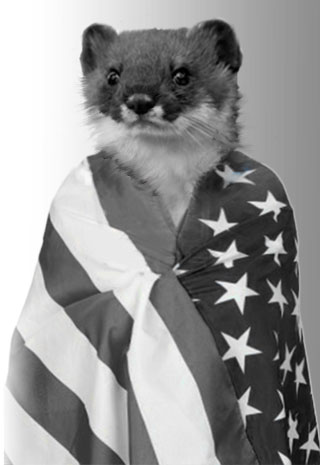
A weasel
Repeat after me: The Gang of Eight and Mark Zuckerberg, Mark Zuckerberg and the Gang of Eight. 

It's a meme. Spread it.

A long time ago I wrote that much of modern journalism has become a form of marketing criticism. Just like movie reviews consist of critiques of how well the movie was made, the news increasingly consists of critiques of how skillfully the special interests are pushing their interests. For months, most of the "news" about immigration has consisted of admiring puff pieces about how seamlessly the amnesty pushers had gotten all their ducks in a row, marketing-wise. Americans, especially journalists, love a winner, and the Gang of Eight had checked all the boxes in setting up their marketing to make themselves look like winners.

Now, though, the Gang of Eight's once-smooth running promotional hotrod is starting to look instead like a circus jalopy bursting with clowns. The focus of the push is supposed to be the inoffensive face of Marco Rubio, not Marco Zuckerberg, who was the subject of a hit movie about what a weasel he is.

From the New York Times just now:
Silicon Valley Group’s Political Effort Raises Uproar 
By SOMINI SENGUPTA and ERIC LIPTON 
Published: May 8, 2013

“Move fast and break things” has been the motto at Mark Zuckerberg’s Facebook, embodying the Silicon Valley ethos of unapologetically finding new ways to solve old problems. His latest foray into politics in Washington, however, might be characterized as “Move fast, play hardball and be prepared for blowback.”

Fwd.Us, the new nonprofit advocacy group created by Mr. Zuckerberg and several technology executives and investors to push for an overhaul of immigration law, has bankrolled television ads endorsing the conservative stands taken by three lawmakers, prompting an outcry from liberal groups and a call to withhold advertisements from Facebook. 

The liberal attacks on Zuckerberg are pretty boring:
... Vinod Khosla, a venture capitalist who finances some of the same clean energy companies as Mr. Doerr’s firm and who was once a major partner at Mr. Doerr’s investment firm, said on Twitter over the weekend: “Will Fwd.us prostitute climate destruction & other values to get a few engineers hired & get immigration reform?” ...

But the point is this: You know how, these days, the worst thing you can hold on a political issue currently up for consideration is a "divisive opinion"? There is nothing worse in 2013 than a divisive individual, like you controversial creeps who aren't all on board with the Gang of Eight.

But, now, Mark Zuckerberg is on board with the Gang of Eight, and he is, by nature, divisive and controversial, thus spreading his contagion of divisiveness via guilt by association to the immigration "reformers."
Still, others say the ads signal a calculated pragmatism. Fwd.Us is led by experienced political operatives, including Joe Lockhart, a former Clinton Administration official, and Rob Jesmer, a former Republican Senate political adviser. One executive involved in the effort said the advertisements were vetted with executives backing it — and that the executives realized before they were shown that they might alienate certain liberal audiences.... 
“We did not just fall off the turnip truck,” the executive said. 

This could get fun.

By the way, did I ever mention the Spring iSteve fundraising drive is going on?

Thanks to everybody who has contributed so far. And for those who haven't gotten around to it:

First: you can make a non-tax deductible contribution to me by credit card via WePay by clicking here.

Second: you can make a tax deductible contribution to me via VDARE by clicking here.

Third: You can mail a non-tax deductible donation to:

Steve Sailer
P.O Box 4142
Valley Village, CA 91607-4142

Thanks.

May 4, 2013

NAABP (National Association for Advancement of Billionaire People) buys Gang of Eight

From the New York Times:
Tech Firms Take Lead in Lobbying on Immigration 
By ERIC LIPTON and SOMINI SENGUPTA 
WASHINGTON — The television advertisement that hit the airwaves in Florida last month featured the Republican Party’s rising star, Senator Marco Rubio, boasting about his get-tough plan for border security. 
But most who watched the commercial, sponsored by a new group that calls itself Americans for a Conservative Direction, may be surprised to learn who bankrolled it: senior executives from Silicon Valley, like Mark Zuckerberg of Facebook and Reid Hoffman of LinkedIn, who run companies where the top employees donate mostly to Democrats. 
The advertising blitz reflects the sophisticated lobbying campaign being waged by technology companies and their executives.

You know, having one red-blue sock puppet website for Republicans and one almost identical blue-red sock puppet website for Democrats isn't really that sophisticated. I've defended Zuckerberg in the past, but he just exudes weaseliness. Sophisticated he ain't.

Granted, Aaron Sorkin's and David Fincher's reasons offered in The Social Network for depicting the Zuck as a weasel weren't that convincing, but still, you've got to admit that there's something going on if two extremely talented middle-aged filmmakers feel inspired to make a fine movie about what a weasel you are when you are only 26-years-old.

There's something about Zuckerberg that inspires animus, so the more he becomes the face of Immigration Deform, the more trouble it's in. (By the way, the comments on the NYT article are ferocious, and they aren't even very ad hominem yet.)
They have managed to secure much of what they want in the landmark immigration bill now pending in Congress, provisions that would allow them to fill thousands of vacant jobs with foreign engineers. At the same time, they have openly encouraged lawmakers to make it harder for consulting companies in India and elsewhere to provide foreign workers temporarily to this country. 
Those deals were worked out through what Senate negotiators acknowledged was extraordinary access by American technology companies to staff members who drafted the bill. The companies often learned about detailed provisions even before all the members of the so-called Gang of Eight senators who worked out the package were informed. ...
Now, along with other industry heavyweights, including the U.S. Chamber of Commerce, the technology companies are trying to make sure the law gets passed — which explains the political-style television advertising campaign, sponsored by a group that has revealed no details about how much money it gets from its individual supporters.

What are the laws regarding obvious quid pro quos like these TV ads for Rubio and Lindsey Graham?
The industry also hopes to get more from the deal by working to remove some regulatory restrictions in the proposal, including on hiring foreign workers and firing Americans.

That should be FWD.us's motto: "Firing Americans since 2013."
... Rob Jesmer, a former top Republican Senate strategist who helps run the new Zuckerberg-backed nonprofit group that sponsored the Rubio ad, insisted that his organization’s push is based on the personal convictions of the executives who donated to the cause and who believe immigration laws need to be changed. Those convictions just happen to line up with what their corporations are lobbying for as well, he said. 
“It will give a lot of people who are educated in this country who are already here a chance to remain in the United States,” Mr. Jesmer said, “and encourage entrepreneurs from all over the world to come to the United States and create jobs.”

No. It's a myth that these billionaire entrepreneurs are magnanimously bringing poor Asians to America to start companies to compete with them.

The reality is that billionaires just want code-fodder. The number of H-1B visa workers who will prove competition for the Zuckerbergs is negligible. You can see the evidence for that in a different NYT article this weekend:

From "Silicon Valley's Start-Up Machine" by Nathaniel Rich in the NYT Magazine about essayist Paul Graham's Y Combinator boot camp for entrepreneurs:
Several years ago, Paul Graham — whom everybody calls P.G. — began to film the interviews he and his partners held with prospective Y.C. inductees. When reviewing the footage, he focused on the interviews with start-ups that ultimately failed. Like any savvy marketing executive, he wanted to isolate patterns that portended ill, which he called “negative predictors.” He was already aware of a few — investors tended to be biased against older founders, for instance. “The cutoff in investors’ heads is 32,” Graham says. “After 32, they start to be a little skeptical.” And Graham knew that he had his own biases. “I can be tricked by anyone who looks like Mark Zuckerberg. There was a guy once who we funded who was terrible. I said: ‘How could he be bad? He looks like Zuckerberg!’ ” 
... But after ranking every Y.C. company by its valuation, Graham discovered a more significant correlation. “You have to go far down the list to find a C.E.O. with a strong foreign accent,” Graham told me. “Alarmingly far down — like 100th place.” I asked him to clarify. “You can sound like you’re from Russia,” he said, in the voice of an evil Soviet henchman. “It’s just fine, as long as everyone can understand you.”
This was bad news for Strikingly’s David Chen, who moved in 2005 from Guangzhou to the United States to attend high school at Houghton Academy, in upstate New York. He spoke English fluently but struggled to pronounce words like “build,” “mobile” and, most ominously, “strikingly.” Yet Chen had clearly established himself as the fledgling company’s impresario and spokesman. ... 
One week before Demo Day, Graham told the Strikingly founders that Chen’s accent was too strong. The quiet, reserved Bao — who spoke less frequently than either of his partners despite being the group’s only native English speaker — would have to deliver the pitch instead. Bao denied that he was anxious, but as he tried to memorize the pitch, he grew even quieter than usual. “I haven’t gotten to the point where I’m comfortable with public speaking,” he admitted. 

December 29, 2012

Classic from the files: Why do car salesmen dress like that?

About a decade ago, Edmunds.com paid journalist Chandler Phillips to get sales jobs at a couple of L.A.-area new car dealerships and then write "Confessions of a Car Salesman" about what he'd learned. I stumbled upon this during the long debate initiated by Malcolm Gladwell when he responded incredulously to Judge Richard Posner and me objecting to his contention in his bestseller Blink about why car salesmen charge blacks and women more. Gladwell contended that car salesman discriminated against blacks and women in price negotiations only because they didn't realize they were unconsciously discriminating even though it was costing them money. Posner in The New Republic and I in VDARE argued in negative reviews of Blink that car salesmen tend to be jerks who have a pretty good idea of how to weasel more money out of people. 

In defense of Gladwell's position, you have to admit that car salesmen don't dress in a manner calculated to inspire trust. Phillips writes:
What [car salesmen] think is cool is viewed by the public as tacky and obvious. For example, why do they insist on wearing white shirts and silk ties? Or what about gold watches, rings and chains? Who wears that stuff anymore? Don't they realize they are turning themselves into walking cliches? The only answer I came up with was that, as a salesman, I spent all my time with other salesmen. They were my friends. Believe it or not, I tried to fit in, to belong. So I began to develop an interest in gold ties, white shirts and dress shoes. I even grew a goatee because a lot of the guys had beards. And I put gel on my hair and combed it straight back.

On the other hand, Phillips hints at car salesman lore that fits the Informed Jerk model better:
Since I was still a "green pea" the other salesmen tried to push me to wait on undesirable ups — the undesirable customers who the salesmen thought wouldn't or couldn't qualify to buy a car. My manager had, at one point, described the different races and nationalities and what they were like as customers. It would be too inflammatory to repeat what he said here. But the gist of it was that the people of such-and-such nationality were "lie downs" (people who buy without negotiating), while the people of another race were "roaches" (they had bad credit), and people from that country were "mooches" (they tried to buy the car for invoice price). 
I'll repeat what Michael, my ASM, told me about Caucasians . He said white people never come into the dealership. "They're all on the Internet trying to find out what our invoice price is. We never even get a shot at them. I hate it. I mean, would they go (to a mall) and say, 'What's your invoice price on that beautiful suit?' No. So why are they doing it here?"

Presumably "lie downs" are African-Americans. The study by Ian Ayers of Yale Law School that Gladwell brought up as evidence that salesmen were unintentionally discriminating showed that black law students couldn't negotiate as low a price as white law students. 

The rest of the sentence is a little ambiguous, but I'm guessing that "roaches" are Mexican-Americans (although Mexicans could be the bad negotiators and blacks the bad credit). I suspect that "mooches" "from that country" does not mean from Mexico, but is more likely referring to hard-nosed Asian immigrants such as Koreans.

In Phillips' experience, the American brand dealership he worked at second was less obnoxious, while the popular Japanese dealership was pretty much plain evil. That's been my experience over the years with a certain gigantic T-y-t- dealership in the San Fernando Valley. They ripped my deaf octogenarian father off for a ridiculous interest rate when he could have paid cash for his Corolla. Mostly, though, they seem to exist to psychologically intimidate Mexicans into paying too much.

May 10, 2013

More of the right kind of headlines

Sad weasel
From Reuters:
Exclusive: Elon Musk quits Zuckerberg's immigration advocacy group

Immigration Reform is Mark Zuckerberg. Mark Zuckerberg is Immigration Reform.

Meme it.

May 15, 2013

Joel Kotkin does a number on Mark Zuckerberg

And without resorting to weasel jokes.

Joel is seriously unhappy about media glorification of winner-take-all-ism. Here are the Zuckerbergian parts, but there is lots more about other Silicon Valley superstars:
America's New Oligarchs -- FWD.US and Silicon Valley's Shady 1 Percenters 
by Joel Kotkin 05/14/2013 
... A new, and potentially dominant, ruling class is rising. Today’s tech moguls don’t employ many Americans, they don’t pay very much in taxes or tend to share much of their wealth, and they live in a separate world that few of us could ever hope to enter. But while spending millions bending the political process to pad their bottom lines, they’ve remained far more popular than past plutocrats, with 72 percent of Americans expressing positive feelings for the industry, compared to 30 percent for banking and 20 percent for oil and gas.  
Outsource Manufacturing, Import Engineers 
Perversely, the small number of jobs—mostly clustered in Silicon Valley—created by tech companies has helped its moguls avoid public scrutiny. ...
This is an equation that defines inequality: more and more wealth concentrated in fewer hands and benefiting fewer workers. 
Not so much anti-union as post-union, the tech elite has avoided issues with labor by having so few laborers who could be organized.  ...
But Americans with those skills shouldn’t rest easy, either. These same companies are always looking to cut down their domestic labor costs. Mark Zuckerberg, in particular, is pouring money into a new advocacy group, Fwd.us, with a board consisting of big-name Valley luminaries, to push “comprehensive immigration reform” (read: letting Facebook bring in a cheaper labor force). In a remarkably cynical move, Fwd.us has separate left- and right-leaning subgroups to prod politicians across the political spectrum to sign on to the bill that would pad the company’s bottom line. 
Ostensibly, the increase in visas for high-skilled computer workers is a needed response to the critical shortage of such workers here—a notion that has been repeatedly dismissed, including in a recent report from the Obama-aligned Economic Policy Institute, which found that the country is producing 50 percent more IT professionals each year than are being employed in the field. The real appeal of the H1B visas for “guest workers”—who already take between a third and half of all new IT jobs in the States—is that they are usually paid less than their pricy American counterparts, and are less likely to jump ship since they need to remain employed to stay in the country. Facebook’s lobbyists, reports the Washington Post, have pressed lawmakers to remove a requirement from the bill that companies make a “good faith” effort to hire Americans first. 
The Valley of the Oligarchs 
Even as market caps rise, the number of Americans collecting any cut of that new wealth has scarcely moved. Since 2008, while IPOs have generated hundreds of billions of dollars of paper worth, Silicon Valley added just 30,000 new tech–related jobs—leaving the region with 40,000 fewer jobs than in 2001, when decades of rapid job growth came to an end. ... 
But little of the Valley’s wealth reaches surrounding communities. ...
But past the conspicuous consumption, the most outstanding characteristic of the new oligarchs may be how quickly they have made their fortunes—and how much of the vast wealth they’ve held on to, rather than paid out to shareholders or in taxes. ... 
Tech oligarchs control portions of their companies that would turn oilmen or auto executives green with envy. ... In contrast, Mark Zuckerberg’s 29.3 percent stake in Facebook is worth $9.8 billion. ...
The concentration of such vast wealth in so few hands mirrors the market dominance of some of the companies generating it. ... Even the oil-and-gas business, associated with oligopoly from the days of John Rockefeller, is more competitive; the world’s top 10 oil companies collectively account for just 40 percent of the world’s production. 
Greater Representation with Minimal Taxation 
Despite this vast wealth, and their newfound interest in lobbying Washington, the tech firms are notorious for paying as little as possible to the taxman. 
Facebook paid no taxes last year, while making a profit of over $1 billion. ... 
And now, these 1 percenters—who invested heavily in Obama—are looking to help shape the “public good” in Washington and, as with Fwd.us, what they’re selling as good for us all is what aligns with their interests. 
... The oligarchs believe their control of the information network itself gives them a potential influence greater than more conventional lobbies. The prospectus for Fwd.us—headed up by one of Zuckerberg’s old Harvard roommates—suggests tech should become “one of the most powerful political forces,” noting “we control massive distribution channels, both as companies and individuals.” 
One traditional way the wealthy attain influence is purchasing their own news and media companies. Facebook billionaire and former Obama tech guru Chris Hughes (who owes his fortune to having been another of Zuckerberg’s college roommates) has already started on this road by buying the New Republic. (His husband, perhaps not incidentally, is running for the New York State Assembly.) ... 
If You're the Customer, You're the Product
Perhaps an even bigger danger stems from the ability of “the sovereigns of cyberspace” to collect and market our most intimate details. ... Apple is being hauled in front of the courts for its own alleged violations while Consumer Reports recently detailed Facebook’s pervasive privacy breaches—culling information from users as detailed as health conditions, details an insurer could use against you, when one is going out of town (convenient for burglars), as well as information pertaining to everything from sexual orientation to religious affiliation to ethnic identity. ...
But while Facebook and Google have been repeatedly cited both in the United States and Europe for violating users’ privacy, the punishments have been puny compared to the money they’ve made by snatching first and accepting a slap on the wrist later. ... 

Lots more here.

October 23, 2007

NYT on neo-nepotism and JPod

The New York Times has an interesting article on Jpod taking over as editor of Commentary, cleverly tying it to the 2003 book by Adam Bellow, In Praise of Nepotism:

New Commentary Editor Denies Neo-Nepotism

By Patricia Cohen

The new appointment puts three generations of Podhoretzes at the magazine, with Norman holding the title of editor at large and his grandson Sam Munson as online editor. Of course, the ancestral streak is not exactly surprising. The Podhoretz, Kagan (Fred, Donald, Robert and Kimberly) and Kristol clans have dominated the movement for 40 years.

“There’s a family business aspect to the neoconservative enterprise,” said Mr. Bellow, whose book “In Praise of Nepotism” was published in 2003. Such kinship ties are part of “a very broad phenomenon across American society; it’s not really right to single out neoconservatives."

(Here's my review-essay on Bellow's "In Praise of Nepotism" in The National Interest.)

The NYT reporter had asked me:
"How is he [JPod] thought of in conservative circles?"
I replied:
Among conservative intellectuals, John Podhoretz is widely considered proof of the statistical tendency toward regression beneath the mean. The only reason he has a career is because he is, as they say in Little Italy, connected.

As blogger Larry Auster has been pointing out, only one of his many colleagues at National Review Online's group blog, The Corner, has congratulated him on his ascension. On Tuesday morning, Kathryn Jean Lopez ("K-Lo") offered this minimalist salute:
Congrats Are in Order [Kathryn Jean Lopez]

My published articles are archived at iSteve.com -- Steve Sailer

May 14, 2013

The Axis of Weasel: All iSteve obsessions are harmonically converging

From Fox News Latino:
Bloomberg, Republicans Join Obama Backers In Support Of Immigration Reform 
Published May 14, 2013 
From left, News Corporation CEO Rupert Murdoch, looks on as New York Mayor Michael Bloomberg speaks during a forum on The Economics and Politics of Immigration in Boston on Tuesday. (AP2012)
WASHINGTON –  A grassroots political support group backing President Barack Obama is joining a Republican pro-immigration organization and an effort run by New York Mayor Michael Bloomberg to push for a comprehensive immigration bill using social media platforms.

Like, say, Mark Zuckerberg's Facebook?
Organizing for Action, a grassroots group run by Obama loyalists that grew out of his 2012 re-election campaign, will co-sponsor a "virtual march on Washington" planned for next week aimed at getting people to use social media platforms to register their support for the immigration legislation. 
Bloomberg's Partnership for a New American Economy is behind the effort. 

Featured members of Bloomberg's group include Michael Nutter (the anti-First Amendment Philadelphia mayor who looks like an R. Crumb cartoon character), Steve Ballmer, Antonio Villaraigosa, Julian Castro, Bob Iger, and J.W. Marriott.
Republicans for Immigration Reform, a group headed by former Bush administration Commerce Secretary Carlos Gutierrez, also is co-chairing the endeavor. 

Carlo Gutierrez is the most exquisite example of the Hidalgo-American yet identified.
"By bringing together leaders from both parties and Americans across the country, we hope to send Congress a clear message that there is broad support for smart reform — and the time for action is now," Bloomberg said in a statement. 
The virtual "March for Innovation," planned for May 22-23, is designed to get people to use Twitter, Reddit, Facebook and other social media platforms to push Congress to pass the immigration bill, which may come to a vote next week in the Senate Judiciary Committee. 
It's another sign of engagement by business and high-tech leaders and officials across the political spectrum to support the immigration legislation.

So, all we have to do is stop the open conspiracy of Barack Obama, Michael Bloomberg, Rupert Murdoch, Mark Zuckerberg, John McCain, and Bill Gates from having their way with us. (Am I leaving out any names of those allied against us? Karl Rove? The Bushes?)

As Henry Kissinger might have said (at a Bilderberg Conference, no doubt): "Just because you are a paranoid doesn't mean you don't have real enemies, real enemies who are publicly conspiring against you, real enemies with billions of dollars, media empires, covert electronic surveillance capabilities, and nuclear weapons."

This could get fun.

I'm reminded of the famous passage in Evelyn Waugh's Sword of Honour about Guy Crouchback reading the newspaper in 1939:
Just seven days earlier he had opened his morning newspaper on the headlines announcing the Russian-German alliance. ... But now, splendidly, everything had become clear. The enemy at last was plain in view, huge and hateful, all disguise cast off. It was the Modern Age in arms. Whatever the outcome there was a place for him in that battle.

By the way, unlike Bloomberg, Gates, and Zuckerberg, I've neglected to acquire a giant monopoly, so did I ever mention the Spring iSteve fundraising drive is still rattling on?

My thanks to all who have contributed so far. And for those who haven't gotten around to it:

First: you can make a non-tax deductible contribution to me by credit card via WePay by clicking here.

Second: you can make a tax deductible contribution to me via VDARE by clicking here.

Third: You can mail a non-tax deductible donation to:

Steve Sailer
P.O Box 4142
Valley Village, CA 91607-4142

May 16, 2013

The weasels are winning: Software pay falls 2% in 2012

Happy weasel
From Computerworld, an IT trade publication:
Software developer wages fall 2% as workforce expands 
Less costly young, and long unemployed older developers may be expanding the workforce at less cost to employers 
By Patrick Thibodeau 
Computerworld - WASHINGTON -- The U.S. tech industry added nearly 64,000 software related jobs last year, but as the workforce expanded, the average size of workers' pay checks declined by nearly 2%. 
There are multiple theories for the decline in pay, but a common one cited by analysts is simply that the new people being hired are paid less than those already on the job. 
The average annual wage of all workers in the software services sector was $99,000 in 2012, about $2,000 less than the prior year, reported TechAmerica Foundation in its annual Cyberstates report. 
The foundation is an affiliate of the industry trade group TechAmerca. It uses Labor Dept. data to assemble its report. ...
The Cyberstates report puts the tech labor force at 5.95 million in 2012, an increase of 1.1% from the prior year. Of that, 1.87 million workers are in software services jobs. 
Software services, which includes government defined labor categories software publishers, custom programmers, computer facilities management and other computer related services, are the best paid and the largest segment of the tech work force. 
The next largest, engineering and tech services, employs 1.62 million. Wages for workers in this segment increased by $1,500 to $92,500. But unlike software services, job growth was modest, increasing by only 11,300 last year. 
David Foote, the CEO of Foote Associates, which analyzes IT hiring trends and wages, said the supply of workers in the software services segment "is plentiful. Of course, there are many unemployed workers who want to get back to work."
Employers, consequently, did not need to offer generous wage packages to fill many of their jobs. "In fact, [employers] could get workers pretty cheap," said Foote. 
Foote said the IT industry-specific Cyberstates study doesn't include all tech workers. Working against the wage decline is high demand for certain software skill sets, which puts upward pay pressure on certain jobs that are harder to fill, he said. 
Victor Janulaitis, CEO of Janco Associates, a research firm that also analyzes IT wage and employment trends, cited a number of reason for the decline in wages for software professionals. First, technology is becoming easier to implement without having an IT professional, he said. Also, the option of turning to outsourcing creates less pressure to increase wages. 

But, as Mark Zuckerberg tells us, this is just a start: the United States government must help him drive down wages even farther. Zuck getting even richer at the expense of his workers is Good for the Economy.

October 3, 2007

Robert De Niro in "15 Minutes"

Here's yet another one of my 2001 movie reviews for UPI that had disappeared, like the movies themselves, down the old memory hole

Mar. 8, 2001 (UPI) -- A brutally violent crime movie that accuses tabloid TV of encouraging crime by showing brutal violence obviously has a bit of a credibility problem. The only way such a film can escape blatant hypocrisy is to play the whole thing as a cynical, self-condemning satire. Unfortunately, "15 Minutes" (from New Line Cinema and rightfully rated "R" for foul language, toplessness, and way too much violence), while less repulsive than Oliver Stone's similar "Natural Born Killers," is drenched in both blood and sanctimony.

Director John Herzfeld's script also seems dated. It portrays a crime spree in which a Czech thug slices up New Yorkers while his movie-mad Russian sidekick videotapes him. The bad guys then sell their snuff film to a despicable trash TV host played by Kelsey Grammar, who delivers a convincing portrayal of a weasel in heat.

Upon his arrest, the killer Czech points out that you'd have to be crazy to let your buddy videotape your murders. So, a judge declares him incompetent to stand trial and dispatches him to a country club mental home. Fortunately, in the climactic gun battle, the vengeful good guy shoots straighter. So, this reality series starring the bad Czech is cancelled.

Herzfeld's scenario was clearly influenced by criminals who beat the rap by claiming to be victims, such as John Hinckley, OJ, Lorena Bobbit, and the Menendez Brothers. In 1987, this theme would have been prophetic. In 1994, it would have been timely enough to justify its populist pretensions of being a vigilante fantasy in the tradition of "Dirty Harry" and "Death Wish." In 2001, though, we've heard it all before.

Yet, before Herzfeld begins slathering on the sermons and clichés, "15 Minutes" starts out promisingly. Amusing scenes introduce us to the fine cast.

"15 Minutes" begins at JFK airport. An immigration officer questions two European tourists played by Karel Roden and Oleg Taktarov. You don't have to be Pat Buchanan to sense that the Statue of Liberty wasn't meant to welcome these two to America.

Roden, a Czech stage actor, has the kind of Central European face that Hollywood loves to hate. He looks like a U-Boat captain gone bad.

Taktarov, who was a former Ultimate Fight Champion, has the perfect mug for the role of the Hollywood-loving Russian criminal who really wants to direct. He's handsome in a rather endearing, almost childishly innocent way. Yet, the left half of his face is alarmingly out of whack with the right half.

Meanwhile, square-jawed Edward Burns, the triple-threat star/director/writer of the 1995 low-budget surprise "The Brothers McMullen," appears as a straight-arrow New York City arson investigator. He's accosted in Central Park by a mugger played by David Alan Grier, the entertainingly prissy black comic from TV's "DAG" and "In Living Color." You would think that any movie that casts Grier as a knife-wielding street criminal couldn't take itself too seriously, right?

Burns quickly disarms Grier and, in order to rush off to a fire, handcuffs him to a tree. Before Burns can get back, a predatory bag lady steals Grier's trousers. Later, the mugger appears on TV pompously accusing the Boy Scout-pure Burns of violating his civil rights.

Burns makes a perfectly adequate action hero, although the script doesn't let him do much besides display his natural knack for Irish glumness. If more proven talents such as Brad Pitt, currently floundering in "The Mexican," continue to turn down traditional good guy roles, Burns may have a solid career ahead of him as a leading man.

To catch the Eurotrash killers, Burns teams up with Robert De Niro's media savvy homicide detective. De Niro frequently appears on Grammar's tabloid show. We later discover, however, that he uses his celebrity for the honorable purpose of helping him get the cooperation he needs to catch crooks. This undermines the moral of the movie, but at least it allows De Niro to give young Burns some avuncular mentoring.

Herzfeld introduces De Niro in a bravura scene. An underwater camera peers up through a basin full of ice cubes. Suddenly, the great man's head plunges into the frigid bath as he struggles to sober up. It's a funny homage to De Niro's celebrated scene pounding his head against the prison wall in 1980's "Raging Bull."

Later, De Niro spends a lot of time talking to himself in a mirror, rather like Travis Bickle, anti-hero of "Taxi Driver," another film that certainly influenced "15 Minutes." Here, though, De Niro is merely getting ready to propose to his girlfriend in a touching episode. (She's played by the lovely star of the "Providence" TV series, Melina Kanakaredes, who is the Platonic ideal of a Greek beauty.)

Although critics generally consider De Niro the greatest acting artist of his generation, he's always struck me as John Wayne for Guys Who Went to Grad School. Of course, since most reviewers are males with post-grad educations, while most viewers are not, De Niro's critical acclaim has always exceeded his box office clout.

De Niro seldom disappears into a role like Alec Guinness or Gary Oldman. Instead, like The Duke, he brings tremendous craftsmanship to the old-fashioned movie star's job of playing endless variations on himself.

The pleasure of watching De Niro is largely that of seeing a truly superior individual try out different occupations that no doubt he would have been a success at if he hadn't gone into acting. The premise of practically any De Niro movie is: What if fate had made Bobby De Niro a detective? Or a boxer? Gangster? Psycho killer?

Dr. Samuel Johnson defended this idea that a first-rate man could have been a winner in any one of many different fields by saying, "Sir, the man who has vigor may walk to the North as well as to the South, to the East as well as to the West." De Niro's vigor, intelligence, work ethic, charisma, and force of will allows him to persuade us that he would have made one hell of a detective, boxer, gangster, or psycho killer.

Director Herzfeld's best film was "Don King: Only in America," an ironic HBO biopic about boxing's grandiloquent promoter and lovable con man. If Herzfeld had made "15 Minutes" similarly sardonic, rather than pseudo-solemn and self-righteous, this movie wouldn't have ended up being so much less than the sum of its considerable parts.

My published articles are archived at iSteve.com -- Steve Sailer

July 24, 2006

The Word of the Decade: "Elites"

The first time I can recall anybody using the plural form of "elite" was at a December 1999 Hudson Institute conference. Since then, it has become omnipresent.

I've used it a lot myself, but I must confess that I have never been sure exactly what it means. It has two possible meanings: as a collective noun for collective nouns (e.g., elite groups) or as a collective noun for individuals who are elite.

The former is the more traditional use of the term, since "an elite" has normally designated a group of individuals: e.g., "Navy SEALs are an elite." In the past, you wouldn't have said, "A Navy SEAL is an elite." You would have said "A Navy SEAL belongs to an elite." Or you would have used "elite" as an adjective when referring to an individual: "A Navy SEAL is an elite fighting man." But, now, it appears that "elites" can mean the plural: "Navy SEALs are elites." Yet, you still don't see "elite" used very often to refer to a single individual: "A Navy SEAL is an elite."

I tend to weasel-word my sentences so "elites" could mean either. For example, if I write "Elites favor mass immigration," I could be referring to various elite organizations and groups, such as, say, the Business Roundtable, the United States Conference of Catholic Bishops, and the like. This would be the more traditional use of the term.

But I could also mean individuals who have elite status in some fashion. That would be a more novel use of the word.

So, what exactly is the meaning and status of the Word of the Decade?

My published articles are archived at iSteve.com -- Steve Sailer

May 30, 2006

A reader asks:


I wonder what the effects of the ethos of romantic love are on human evolution. My guess would be that coupled with a technologically advanced society and an ethos of individualism it tends to be eugenic, because smart women are not forced by their families into marrying some dolt at 12. Obviously "tends to" is the necessary weasel word because there's the countervailing trend of smart women choosing dolts on their own. It's worth study because romantic love is a huge Western cultural import, and one that is most threatening to the powerful in undeveloped countries -- a big fear of traditional non-Western men is that once their women wise up and get Westernized they won't want them any more.


My published articles are archived at iSteve.com -- Steve Sailer

October 7, 2005

Levitt complains he's not getting enough love from the NYT

On his Freakonomics.com blog, Steven D. Levitt complains about a New York Times article entitled "New York's Falling Crime Rate Is a Potent Weapon for the Mayor," which lists the following reasons for crime being down:

"Academic experts cite several plausible contributors to the nationwide trend, including an aging population (young men are responsible for most crimes), the end of the crack cocaine epidemic, an improving economy and rising rates of homeownership in urban areas."

Not satisfied with the NYT giving him two rave book reviews, a rave op-ed column, and a job writing his own column, Levitt whines:

Anybody notice any factors missing from that list? Like, maybe, the increase in the prison population or legalized abortion, which I claim are the two most important drivers of the decline in crime?

I replied in the the comments:

Let's face it. Your abortion-cut-crime theory is now tainted in the media's mind by the Bill Bennett Brouhaha and they would just as soon not deal with it.

Perhaps you could have headed off this fate if last week you had issued a ringing endorsement of free thought, quoted Voltaire, and in general used your media glamour to defend Bennett from the smear jobs. Instead, though, you chose to weasel and waffle to protect yourself by claiming, disingenuously, that what he said wasn't implied by your theory. By letting Bennett be trashed, though, you've let your trademark theory be tainted by association with his disgrace.

As you sow, so shall you reap.


By the way, if anybody really wants to understand fully why crime has fallen so fast in New York City, I would point to this statistic from the article by Jonathan Tilove, the Newhouse New Service's ace race and immigration reporter, called "Where Have All the Black Men Gone?" "There are 36 percent more black women than men in New York City..." Tilove wrote:


There are nearly two million more black adult women than men in America, stark testimony to how often black men die before their time. With nearly another million black men in prison or the military, the real imbalance is even greater -- a gap of 2.8 million, according to U.S. Census data for 2002. On average, then, there are 26 percent more black women than black men; among whites, women outnumber men by just 8 percent.

Perhaps no single statistic so precisely measures the fateful, often fatal, price of being a black man in America, or so powerfully conveys how beset black communities are by the violence and disease that leaves them bereft of brothers, fathers, husbands and sons, and leaves whole communities reeling. ...

In the March/April issue of Health Affairs, Dr. David Satcher, surgeon general under former President Bill Clinton and now the interim president of the Morehouse School of Medicine in Atlanta, exposes the core of the problem: Between 1960 and 2000, the disparity between mortality rates for black and white women narrowed while the disparity between the rates for black and white men grew wider.

Exponentially higher homicide and AIDS rates play their part, especially among younger black men. Even more deadly through middle age and beyond are higher rates of cardiovascular disease and cancer.

The imbalance between the numbers of black men and women does not exist everywhere. There is no gap to speak of in places with relatively small black populations like Minneapolis, Minn.; Portland, Ore.; San Francisco and San Diego. And Seattle actually has more black men than women.

But it is the rule in communities with large concentrated black populations. There are, for instance, more than 30 percent more black women than men in Baltimore, New Orleans, Chicago and Cleveland, and in smaller cities like Harrisburg, Pa. There are 36 percent more black women than men in New York City...


Levitt's favorite explanation, abortion, can't account for any of the huge sex difference among blacks today.

It's absurd for Levitt to focus on prenatal culling as a crime-reducer when the postnatal culling of black males in places New York City (and nearby East Orange, where the gender gap is a similar 37%), became so ferocious during the late 1980s and early 1990s. If there are 29 percent fewer black men in their 20s than black women in East Orange today, and a few percent of the black women are in jail or dead due to their being involved in criminal activities, then roughly 25 percent of the black male population gets culled by age 30, and those 25 percent tend to be the most violent members of that cohort. If the most dangerous 25% of a cohort disappears, that's going to have a much bigger impact than randomly aborting some of the cohort, prenatally.

However, not all the decline in crime came just from culling criminals. The 14-17 year old murder rate for black male youths born in the early 1980s was only about one third as high as for black male youths born in the late 1970s. (Abortion can't explain that because the non-white abortion rate peaked in 1977.) I like to think that a lot of little brothers learned tragic but valuable lessons from the fates of their older brothers during the abattoir years of 1990-1994.


My published articles are archived at iSteve.com -- Steve Sailer

March 2, 2005

Democracy No Cure-All

Robert Conquest on "Downloading Democracy" in the National Interest:

The common addiction to general words or concepts tends to produce mind blockers or reality distorters. As Clive James has put it, "verbal cleverness, unless its limitations are clearly and continuously seen by its possessors, is an unbeatable way of blurring reality until nothing can be seen at all."

Mark Steyn should get that tattooed on the back of his hand.

"Democracy" is high on the list of blur-begetters--not a weasel word so much as a huge rampaging Kodiak bear of a word. The conception is, of course, Greek. It was a matter of the free vote by the public (though confined to males and citizens). Pericles, praising the Athenian system, is especially proud of the fact that policies are argued about and debated before being put into action, thus, he says, "avoiding the worst thing in the world", which is to rush into action without considering the consequences. And, indeed, the Athenians did discuss and debate, often sensibly.

Its faults are almost as obvious as its virtues. And examples are many--for instance, the sentencing of Socrates, who lost votes because of his politically incorrect speech in his own defense. Or the Athenian assembly voting for the death of all the adult males and the enslavement of all the women and children of Mytilene, then regretting the decision and sending a second boat to intercept, just in time, the boat carrying the order. Democracy had the even more grievous result of procuring the ruin of Athens, by voting for the disastrous and pointless expedition to Syracuse against the advice of the more sensible, on being bamboozled by the attractive promises of the destructive demagogue Alcibiades.

It's bizarre how neocons are so obsessed with the Peloponnesian War and Thucydides' account of it, yet stumble repeatedly into the same mistakes the Athenians made.

Even in failure, the thought-fires it set off went on burning. But the views it posed did not really return to Europe and elsewhere until a quarter of a millennium ago. Thus it was not its example but its theory that hit the inexperienced thinkers of the European Enlightenment. Unfortunately, the inheritance was less about the Periclean need for debate than about the need to harness the people (to a succession of rulers). And though the broader forces of real consensual rule began to penetrate, from England and elsewhere (such as the early New England town meetings or those of Swiss rural cantons), they had to compete in the struggle for the vote with inexperienced populations and "philosophical" elites.

The revival of the concept of democracy on the European continent saw this huge stress on the demos, the people. They could not in fact match the direct participation of the Athenian demos, but they could be "represented" by any revolutionary regime claiming to do so--often concerned, above all, to repress "enemies of the people." Also, the people, or those of military age, could be conscripted in bulk--the levŽe en masse that long defeated more conventional armies.

Burke said, "The Revolution was made, not to make France free, but to make her formidable; ... not to make her more observant of laws, but to put her in a condition to impose them." Of course, no true conservative pays attention to that old fuddy-duddy Burke anymore.


My homepage and blog is iSteve.com

July 13, 2010

The philosophical significance of the Belly Button Theory

From Slate:
Can a black-white performance gap be hereditary but not racial?
By William Saletan
Uh-oh. Another study is suggesting a biological ability gap between blacks and whites.

The study, just published in the International Journal of Design and Nature and Ecodynamics, starts with a puzzle about racing sports: "More and more, the winning runners are black athletes, particularly of West African origin, and the winning swimmers are white. More and more, the world finalists in sprint are black and in swimming are white."

Swimming is a white herring in this discussion. I saw a black guy, Anthony Nesty, beat the great Matt Biondi for a gold medal in the 1988 Olympics, so blacks have been modestly competitive in swimming in proportion to the numbers who take it up seriously for a generation.

There are lots of obvious reasons blacks don't do all that well in swimming -- access to pools, fear of sinking and drowning that keeps them away from water (which is a reasonable fear for low body-fat young black males, who drown in motel pools in tragic numbers), opportunities in other sports, etc. -- and morphological differences is only one of them. Sure, there are very few blacks shaped like Michael Phelps, but then there aren't all that many whites shaped like him, either.

What we have a huge amount of data about is running (and not just sprinting).
The authors—Edward Jones of Howard University and Adrian Bejan and Jordan Charles of Duke University—attribute the two trends to a common factor: center of gravity. They explain:
Anthropometric measurements of large populations show that systematic differences exist among blacks, whites and Asians. The published evidence is massive: blacks have longer limbs than whites, and because blacks have longer legs and smaller circumferences (e.g. calves and arms), their center of mass is higher than that in other individuals of the same height. Asians and whites have longer torsos, therefore their centers of mass are lower.

These structural differences, they argue, generate differences in performance. Using equations about the physics of locomotion, they analyze racing as a process of falling forward. Based on this analysis, they conclude that having a higher center of body mass in a standing position is advantageous in running but disadvantageous in swimming.

Drawing on data from 17 groups of soldiers around the world, the authors note that in terms of upper body length, "the measurements of the group of blacks fall well below those of the other groups. Their average sitting height (87.5 cm) is 3 cm shorter than the average sitting height of the group of men with the same average height (172 cm)." From this, they calculate that "the dimension that dictates the speed in running (L1) is 3.7 percent greater in blacks than in whites. At the same time, the dimension that governs speed in swimming is 3.5 percent greater in whites than in blacks."

Measurements of women suggest a similar pattern:
[U]pper- and lower-extremity bone lengths are significantly longer in adult black females than in white females. For the lower-extremity bone lengths, the difference is between 80.3 ± 10.4 cm (black females) and 78.1 ± 6.2 cm (white females). This difference of 2.2 cm represents 2.7 percent of the lower-extremity length, and it is of the same order as the 3.7 percent difference between the sitting heights of whites and blacks.

The paper calculates that a 3 percent difference in center of mass—the average difference between blacks and whites—produces for the athlete with the higher center of mass
a 1.5 percent increase in the winning speed for the 100 [meter] dash. This represents a 1.5 percent decrease in the winning time, for example, a drop from 10 to 9.85 [seconds]. This change is enormous in comparison with the incremental decreases that differentiate between world records from year to year. In fact, the 0.15[-second] decrease corresponds to the evolution of the speed records ... from 1960 (Armin Hary) to 1991 (Carl Lewis). The 3 percent difference in L1 between groups represents an enormous advantage for black athletes.
For swimming, the conclusion is quantitatively the same, but in favor of white athletes. The 3 percent increase in [lower-body length] means a 1.5 percent increase in winning speed, and a 1.5 percent decrease in winning time. Because the winning times for 100[-meter] freestyle are of the order of 50 [seconds], this represents a decrease of the order of 0.75 [seconds] in the winning time. This is a significant advantage for white swimmers, because it corresponds to evolution of the records over 10 years, for example, from 1976 (James Montgomery) to 1985 (Matt Biondi).

Sure, but there are all sorts of other morphological reasons blacks tend to be faster at running, such as narrow pelvises on average, plus non-skeletal reasons involving thinner calves, higher muscle to fat ratio, biochemistry, etc.
Despite these caveats, the authors fear the consequences of acknowledging that heredity can produce differences in group averages. (I've wrestled with the same problem here, here, here, here, here, here, here, here, here, and here.) To avoid fueling bigotry, they've come up with a creative maneuver: removing the word race from theories of black/white group biology. At the outset of their paper, they write:
Our approach is to study phenotypic (somatotypic) differences … which we consider to have been historically misclassified as racial characteristics. These differences represent consequences of still not well-understood variable environmental stimuli for survival fitness in different parts of the globe during thousands of years of habitation. Our study does not advance the notion of race, now recognized as a social construct, as opposed to a biological construct. We acknowledge the wide phenotypic and genotypic diversity among the so-called racial types.

Duke's press release about the study draws the same distinction: The black/white performance gap stems from "athletes' centers of gravity," which "tends to be located higher on the body of blacks than whites. The researchers believe that these differences are not racial, but rather biological." [Emphasis added]

So, these racial differences aren't racial, they are biological.

Got it! As T.H. Huxley said upon reading The Origin of Species, "How stupid of me not to have thought of that."
This is a fascinating bit of finesse. There's nothing unusual about dismissing race as social construct. Racism watchdogs do it all the time. But they do it precisely to deny hereditary differences between blacks and whites. Bejan, Jones, and Charles are affirming hereditary differences. That's what they mean by "survival fitness in different parts of the globe during thousands of years." Evolution in Europe and evolution in Africa produced different results.

Taking "race" out of the equation makes a substantive difference: It focuses the conversation about heredity on populations, a more precise and scientifically accepted way of categorizing people. 

No, it's not. The word "population" is almost never used in this sense in, say, the newspaper. "Population" is only used to mean "racial group" when somebody is looking for a weasel-word to talk about race without mentioning race. Usually, the word "population" is used in contexts like, "World population is 6.7 billion" or "The population off the U.S. is 310 million" when it's intended to denote everybody. The great majority of people won't know what you are talking about when you use "population" in this tortured way. When people talk about "the population problem" they don't mean the same thing as when they talk about "the racial problem."

Look, the fundamental problem is that the upper crust of the public has been lied to by the "Race is only a social construct meme" and they fell for it. (I suspect the crucial moment in the propagation of this lie was Bill Clinton's announcement of the wrapping up of the Human Genome Project a decade ago.) So, rather than try to finesse our way out of this intellectual dead end with every more complicated euphemisms, why don't we start by not lying anymore? As a wise man once told me, "Always tell the truth. It's easier to remember."
In the press release, for example, Jones explains, "There is a whole body of evidence showing that there are distinct differences in body types among blacks and whites. These are real patterns being described here—whether the fastest sprinters are Jamaican, African or Canadian—most of them can be traced back generally to Western Africa." Western African ancestry differs genetically from Eastern African ancestry. Population, unlike race, captures that difference.

The common term "racial group" is superior to either. Anyway, it's not as if the Belly Button Theory doesn't also work to help explain the superiority of Kenyan distance runners, too. Sprinting is a subgroup of running, just as West Africans are a subgroup of sub-Saharan Africans.
The authors also help the conversation by pointing out that "environmental stimuli" caused differential evolution in different parts of the world. There's nothing inherently good or bad about being West African or Eastern European. All of us are evolving all the time. As environmental conditions change in each part of the world, they change the course of natural selection. Ten thousand years from now, the average center of body mass might be higher in Europe than in Africa.

But the authors' most intriguing contribution isn't in biology or physics. It's in linguistics. By removing the word race, they're trying to make the world safe for clearheaded consideration of theories about inherited group differences. What they've done is more than a series of engineering calculations. It's a political experiment. Let's hope it works.

Wouldn't it be simpler and more helpful for clear thinking overall if everybody just adopted my definition of a racial group: "a partly inbred extended family?"

September 3, 2013

Gladwell on human biological diversity in sports

Shaquille O'Neal and
comic Kevin Hart
In The New Yorker, Malcolm Gladwell reviews The Sports Gene by David Epstein. 

Epstein's book is structured around an attack on Gladwell's 10,000 Hour Rule, so Gladwell's irate initial response last month was to imply that his fans who are true believers in his 10,000 Hour Rule are deluded. They just didn't read Outliers closely enough to notice the fragments of sentences where he admits that innate gifts matter as well as training.

Now, Gladwell is back to say, well of course human biodiversity, including racial differences, matters hugely in sports. Who can't see that? Then, Gladwell focuses in on the weak spot in The Sports Gene: the impact of performance-enhancing genes. 

Gladwell goes on to say that sports should allow doping to make up for hereditary inequality. Why should Kenyans win most of the distance races just because they are born with advantages at running?

But he doesn't explain how that would make much difference. For example, since the fall of the Berlin Wall, PEDs mostly seem to augment racial differences. Up to 1989, East German chemistry wizardry made East German women competitive in the shorter races with women of West African descent. 

But since the end of communism freed Eastern European sports chemists to wander the world looking for work, it mostly seems to exaggerate previous racial differences. For example, EPO got to East African distance runners in the mid-1990s, making them even more dominant than they were since the 1960s.
MAN AND SUPERMAN 
In athletic competitions, what qualifies as a sporting chance? 
by Malcolm Gladwell 
SEPTEMBER 9, 2013

Élite sports is a contest among athletes with an uneven set of genetic endowments and natural advantages.  
Toward the end of “The Sports Gene” (Penguin/Current), David Epstein makes his way to a remote corner of Finland to visit a man named Eero Mäntyranta. ... What’s most remarkable is the color of his face. It is a “shade of cardinal, mottled in places with purple,” ... 

Judging from pictures of the Finn online, Epstein's description is a little over-the-top. [Update, now that I look at the picture from a different angle on screen, wow, that is red.]
Mäntyranta carries a rare genetic mutation. His DNA has an anomaly that causes his bone marrow to overproduce red blood cells. That accounts for the color of his skin, and also for his extraordinary career as a competitive cross-country skier. ... Mäntyranta, by virtue of his unique physiology, had something like sixty-five per cent more red blood cells than the normal adult male. In the 1960, 1964, and 1968 Winter Olympic Games, he won a total of seven medals—three golds, two silvers, and two bronzes ...
In “The Sports Gene,” there are countless tales like this, examples of all the ways that the greatest athletes are different from the rest of us. They respond more effectively to training. The shape of their bodies is optimized for certain kinds of athletic activities. They carry genes that put them far ahead of ordinary athletes.
Epstein tells the story of Donald Thomas, who on the seventh high jump of his life cleared 7' 3.25"—practically a world-class height. The next year, after a grand total of eight months of training, Thomas won the world championships. How did he do it? He was blessed, among other things, with unusually long legs and a strikingly long Achilles tendon—ten and a quarter inches in length—which acted as a kind of spring, catapulting him high into the air when he planted his foot for a jump. ... 
Why do so many of the world’s best distance runners come from Kenya and Ethiopia? The answer, Epstein explains, begins with weight. A runner needs not just to be skinny but—more specifically—to have skinny calves and ankles, because every extra pound carried on your extremities costs more than a pound carried on your torso. That’s why shaving even a few ounces off a pair of running shoes can have a significant effect. Runners from the Kalenjin tribe, in Kenya—where the majority of the country’s best runners come from—turn out to be skinny in exactly this way. Epstein cites a study comparing Kalenjins with Danes; the Kalenjins were shorter and had longer legs, and their lower legs were nearly a pound lighter. That translates to eight per cent less energy consumed per kilometre.

Thin calves was part of O.J. Simpson's explanation back in the 1977:
“We are built a little differently, built for speed—skinny calves, long legs, high asses are all characteristics of blacks.”

Gladwell continues:
... According to Epstein, there’s an evolutionary explanation for all this: hot and dry environments favor very thin, long-limbed frames, which are easy to cool, just as cold climates favor thick, squat bodies, which are better at conserving heat. 
Distance runners also get a big advantage from living at high altitudes... When Kenyans compete against Europeans or North Americans, the Kenyans come to the track with an enormous head start.
What we are watching when we watch élite sports, then, is a contest among wildly disparate groups of people, who approach the starting line with an uneven set of genetic endowments and natural advantages. There will be Donald Thomases who barely have to train, and there will be Eero Mäntyrantas, who carry around in their blood, by dumb genetic luck, the ability to finish forty seconds ahead of their competitors. Élite sports supply, as Epstein puts it, a “splendid stage for the fantastic menagerie that is human biological diversity.” 
The menagerie is what makes sports fascinating. But it has also burdened high-level competition with a contradiction. We want sports to be fair and we take elaborate measures to make sure that no one competitor has an advantage over any other. But how can a fantastic menagerie ever be a contest among equals? 

Games aren't really supposed to be a contest among equals since the idea is to find the best, not the most average. Almost all games have rules that inevitably make some animals more equal than other animals: disparate impact. The most egalitarian games, like state lotteries and slot machines, games where nobody has a natural edge, where hard work doesn't pay off, where strategies don't avail, are the most boring to people with three digit IQs and most exploitative of people with two digit IQs.

All games have to trade off various aspects against others. For example, most sports have separate divisions for juniors, seniors and women, as well as some kind of open division in which young men compete. Is it fair to the 128th best men's tennis player that he's not allowed to win the sizable women's first prize in the U.S. Open? Sure, just as male golfers get to make some more money when they hit 50 and can compete in senior tournaments. It may or may not be fair, but it's more interesting.

Successful games have rules that make the game sporting enough to be interesting. For example, basketball is immensely biased in favor of the tall. On the other hand, it's not simply a test of tallness.

Now, we could have a game consisting solely of players being measured for height and the tallest team wins (kind of like a State Fair contest to see who grew the biggest rutabaga).

In fact, in the 18th Century, King Frederick William I of Prussia saw himself as competing with the other kings of Europe to assemble the tallest soldiers, often having his agents kidnap tall men. His Potsdam Giants were the reigning champs at his chosen sport of being tall.

Large men make large targets, and Frederick William was content to obsessively drill his Giants on the parade ground rather than to risk them in battle. His son, Frederick the Great, didn't see much point in his father's game, preferring to play a more serious game on the battlefields of Europe, and let his father's Giants dissipate.

In interest, basketball falls in-between the father's hobby and the son's. The disparate impact of height on basketball is profound, but there's more to the game than just height.

Or, consider the America's Cup sailboat race (currently going on in San Francisco Bay), which has a rule that the winner of the last America's Cup gets to set the rules for this one. So, zillionaire Larry Ellison wrote the current rules to require new high tech catamarans so lively that they sometimes fly almost completely above the water for long distances. But Ellison's Rules are so expensive that few countries showed up for the 2013 competition. And one sailor has been killed so far.

Is this fair? Well, the America's Cup has always been a rich man's race, sacrificing access for a celebration of the extreme in big money sailing. But there is much concern that Ellison pushed the envelope too far this time. Will the exciting footage of boats skimming the waves in front of the Golden Gate Bridge make up for the thinness of the field? We'll see. No doubt, there will be intense arguments after this America's Cup is over concerning the rules for the next one.
During the First World War, the U.S. Army noticed a puzzling pattern among the young men drafted into military service. Soldiers from some parts of the country had a high incidence of goitre—a lump on their neck caused by the swelling of the thyroid gland. Thousands of recruits could not button the collar of their uniform. The average I.Q. of draftees, we now suspect, also varied according to the same pattern. Soldiers from coastal regions seemed more “normal” than soldiers from other parts of the country. 
The culprit turned out to be a lack of iodine. Iodine is an essential micronutrient. Without it, the human brain does not develop normally and the thyroid begins to enlarge.  ...
After the First World War, the U.S. War Department published a report called “Defects Found in Drafted Men,” which detailed how the incidence of goitre varied from state to state, with rates forty to fifty times as high in places like Idaho, Michigan, and Montana as in coastal areas. 
The story is not dissimilar from Epstein’s account of Kenyan distance runners, in whom accidents of climate and geography combine to create dramatic differences in abilities. In the early years of the twentieth century, the physiological development of American children was an example of the “fantastic menagerie that is human biological diversity.” 
In this case, of course, we didn’t like the fantastic menagerie. In 1924, the Morton Salt Company, at the urging of public-health officials, began adding iodine to its salt, and initiated an advertising campaign touting its benefits. That practice has been applied successfully in many developing countries in the world: iodine supplementation has raised I.Q. scores by as much as thirteen points—an extraordinary increase. The iodized salt in your cupboard is an intervention in the natural order of things. When a student from the iodine-poor mountains of Idaho was called upon to compete against a student from iodine-rich coastal Maine, we thought of it as our moral obligation to redress their natural inequality. The reason debates over élite performance have become so contentious in recent years, however, is that in the world of sport there is little of that clarity. What if those two students were competing in a race? Should we still be able to give the naturally disadvantaged one the equivalent of iodine? We can’t decide. 

While perfect clarity is impossible, it's not that hard to logically distinguish between curing goiters by iodine supplementation and shooting up with steroids or EPO. The first involves rectifying a clear problem. There are major benefits in going from a sub-normal level of dietary iodine to a normal level, and few if any disadvantages. Moreover, there are no known benefits to risking your health by taking massively extra levels of iodine, so few do. Mainlining iodine right before you go on Jeopardy won't boost your IQ enough to win. So, iodine in salt is the textbook example of a health intervention without troubling tradeoffs, which is why I've been endorsing its spread since 2004.

In contrast, screwing around with your level of red blood cells, as endurance athletes are wont to do, can kill you. EPO doping needs to be regulated to keep cyclists from killing themselves in death or glory bids: Geoffrey Wheatcroft wrote in the NYT in 2004:
In hindsight we can date the clandestine arrival of EPO with grim accuracy. ... Between 1987 and 1990, no fewer than 20 Belgian and Dutch cyclists died from otherwise inexplicable nocturnal heart attacks. 

Gladwell continues:
Epstein tells us that baseball players have, as a group, remarkable eyesight. ... 
Eyesight can be improved—in some cases dramatically—through laser surgery or implantable lenses. Should a promising young baseball player cursed with normal vision be allowed to get that kind of corrective surgery? In this instance, Major League Baseball says yes.

Laser surgery on your eyes sounds pretty crazy, except that millions of people have had this operation by now. So, the negative tradeoffs are well-understood and fairly limited. On the other hand, at some point some mad surgeon might develop a technique that, say, offers a 95% chance of getting 20/5 eyesight at the risk of a 5% chance of permanent blindness. Would some jocks jump at this? Yes, so therefore we shouldn't assume that any and all eye surgeries will be okay for the rest of baseball history.
... Baseball is in the middle of one of its periodic doping scandals, centering on one of the game’s best players, Alex Rodriguez. ...
The other great doping pariah is Lance Armstrong. He apparently removed large quantities of his own blood and then re-infused himself before competition, in order to boost the number of oxygen-carrying red blood cells in his system. Armstrong wanted to be like Eero Mäntyranta. He wanted to match, through his own efforts, what some very lucky people already do naturally and legally. Before we condemn him, though, shouldn’t we have to come up with a good reason that one man is allowed to have lots of red blood cells and another man is not? ... 

Perhaps because arms races in boosting the chance of sudden death should make us think twice?

Now, it could be that thanks to volunteer lab rats like professional cyclists, the medical profession will slowly learn more about safe dosing levels for various substances, which will generate advances in the general welfare.

Of course, secrecy in sports doping gets in the way of doctors learning from these maniacs. So, Gladwell endorses legalizing everything but requiring complete transparency. The New Yorker summarizes:
He argues that we should legalize performance-enhancing drugs and then regulate them, and imagines a world where athletes make their biological passports public: “What I really would like is to have complete liberalization and complete transparency. I would like to know about every single baseball player, track-and-field athlete, basketball player, precisely what they are on. And then I’d like to reach my own conclusions as a fan about how to evaluate their performance.”

But, the point of doping is not to advance medical science, but to get a leg up over the competition. So, secrecy is a competitive weapon, meaning that if cheating were legalized when it comes to taking drugs, athletes would continue to cheat when it comes to reporting drugs because they don't want competitors to know their secrets (nor would they want their mothers to be able to find out what hellish potions they are ingesting).

The testing system would quickly collapse if the goal was only to get the paperwork right. Imagine being the poor bastard who had to collect slugger Ryan Braun's urine, only to get publicly lambasted by Braun for purported incompetence in Braun's successful bid to weasel out of his first positive drug test. If the goal is not to catch the guy with the $100 million contract but instead simply to document whatever devil's brew he is imbibing, well, screw it. Life's too short.

Furthermore, the often suggested solution -- let the athletes cheat a little -- doesn't work. They already do get to cheat some because the sports' organizations incentives are more to avoid false positives than false negatives. Telling athletes they can now have X parts per million of MongoDynaRoid 9000Z in their urine but not X+1 parts just makes the testing process even shakier.

So, we'll stumble onward much like we do now.