December 18, 2012

2011 NAEP vocabulary results by state

The feds' National Assessment of Educational Progress has a table of 4th and 8th grade vocabulary and reading comprehension scores by state. Sample size issues are of concern for smaller states which tend to bounce around, but we can state with a high degree of statistical confidence that the future of the state of California, the traditional State of the Future, looks dumb. Out of the 50 states, the Golden State ranks 48th, 47th, 48th, and 49th on various measures. Here's the bottom six of 52 in the four different tests:
In contrast, Massachusetts is 1st, 1st, 1st, and 1st, while the District of Columbia was 52nd, 52nd, 52nd, and 52nd (in case you are wondering why D.C. is the 52nd state, Department of Defense schools rank 2nd, 5th, 2nd, 6th). Obviously, the problem is all those Republicans in California and D.C. If only D.C. would develop enlightened political opinions like Massachusetts, its test scores would soar.

Perhaps more relevantly, Texas is 37th, 36th, 37th, and 36th. Texas always beats California on the NAEP. Has anybody studied this to make sure this is not just a test artifact (e.g., Texas cares about the NAEP and California doesn't)? If it isn't, why the consistent difference? Texas is pretty bad, but it's not as bad as California, and beggars can't be choosers, so somebody ought to be investigating why Texas beats California.

One obvious objection is that the future isn't as bad as it looks because Hispanics, as new immigrants, are just being held back by the inevitable biases of testing skills in English. 

Indeed, this effect does exist, but how big is it? Here's national 8th grade vocabulary. The first number is score at the 10th percentile, then 25th, 50th, 75th and 90th. 

Let's first compare whites and Asians. At the 10th percentile, Asians lag whites by 8 points. Presumably, a fair number of these Asian 8th graders just got off the plane from China, so their English vocabulary is limited. At the 25th percentile, the White-Asian gap is down to 5 points. At the median, it's 3, at the 75th percentile it's 0, and at the 90th percentile, Asians are out in the lead by a point. 

Now, compare Hispanics to blacks, most of whom grow up speaking English, but as we all know from hundreds of articles, African-Americans grow up in conditions that would drive a Trappist Monk crazy for lack of speech. In black homes, nobody every talks, watches TV, or listens to rap music. So, black scores on language are bad, with unfortunate long-term consequences. 

At the 10th percentile, where many of the Hispanics are newcomers, blacks lead by 2 points. At the 25th percentile, however, Hispanics are out in front by 1 point, by 2 at the median, 3 at the 75 percentile, and 4 at the 90th. 

So, clearly, Hispanics who have all the advantages are, on average, a little smarter than blacks who have all the advantages. In other words, if immigration were shut off for a generation or two, Mexicans would appear, on average, perceptibly more on the ball academically than blacks. Indeed, that was my perception back in the 1970s in L.A., where the Chicanos had mostly been a stable population since WWII.

But, nationally, Hispanics only pick up 6 points on blacks going from the 10th to the 90th percentiles, while Asians pick up 9 points on whites, who are, to be frank, a lot more competition.

Being a little smarter than blacks is, well, good. Or, you could say with equal justice, less bad. On the other hand, Hispanics at the 90th percentile among Hispanics, typically those with all the advantages, are simply not playing in the same league as Asians and whites with all the advantages. They're down there beating out blacks for third place, not being nationally competitive. There's not a lot of high end in the Hispanic population. 

However you look at it, it's still not very encouraging considering that our leadership kind of bet the country on Hispanics.

December 17, 2012

The Sixties: Wilderness v. recreation, educated v. affluent

Continuing to consider the Sixties ... let's take a look at the Sixties through the lens of class, using the long battle in the 1960s over Mt. San Gorgonio in Southern California, which was a harbinger of the coming class wars between the educated elite, the prosperous upper middle class, and, mostly as bystanders, the masses.

The single best place to downhill ski in Southern California would be the north slope of Mt. San Gorgonio, near Big Bear Lake, 80 miles east of Los Angeles in the San Bernardino Mountains. It's 11,500 feet high, and, due to the extreme elevation, about 3,000 vertical feet of skiing would be usable well into spring each year. (Most SoCal ski mountains top out at around 8600 feet, which is about where a San Gorgonio ski complex would start.) And Old Greyback is a more rounded mountain, more like volcanic Mammoth in the Sierras, better suited for non-lethal skiing than most of the alarmingly steep SoCal mountains. 

But, it also has a lovely alpine wilderness below the peak that's well-watered and not too steep, especially around the two natural lakes at about 9000 feet. (Despite the name of Los Angeles's main NBA team, natural lakes are extremely rare in Southern California.) Here's Dry Lake, which actually isn't dry most of the time:

I found this 47-year-old Sports Illustrated article written just before the Ecology Age kicked fully into gear in the late 1960s that discusses the political struggle between skiers and wilderness enthusiasts in the early 1960s. Obviously, this isn't terribly relevant to the latest breaking news out of wherever, but it offers an insight into educated American opinion just before the Sixties broke over everything.
February 01, 1965 
The Battle For A Mountain 
Sportsmen are fighting sportsmen in the conflict over beautiful, rugged Mt. San Gorgonio, a lofty wilderness near Los Angeles which conservationists want to keep wild and skiers long to penetrate 
Coles Phinizy

In southern California, east of Los Angeles, where yellow tongues of smog lick the dusty feet of brown mountains, there is a rocky giant called Mt. San Gorgonio. It is 11,502 feet tall—a half a head higher than the other peaks flanking it in the San Bernardino range. By early spring, when most of the range and the crests of the adjacent San Gabriel range have lost their kiss of snow, big San Gorgonio often still shines white—the one true jewel of the lot. It is also the least spoiled today, because 34,718 acres of it above the 7,000-foot contour have been set aside by Congress as a wilderness area where there can be no road or building, or any use of land vehicles or planes. 
San Gorgonio is a product of dramatic geologic faulting; in its upper faces there are vast cirques that were gored out long ago by glaciers. Although it is today, by law, supposedly a place of emptiness and little noise, for the past quarter century it has been a critical battleground. On and off since the late 1930s skiers have been trying to open up the San Gorgonio wilderness so that tows and lifts for downhill skiing might be built on its hoary upper slopes. As anyone might guess, all manner of conservationists and outdoorsmen have rallied to defend the wilderness against the ambitions of the skiers. It has been a peculiar battle. Both sides feel strongly on the matter, but even in the most crucial moments, there has been little uncontained anger. Indeed, the only thing that has been expended at all recklessly in the long fight has been talk. 
The battle is, in fact, only worth considering at this time because, sooner or later, similar fights will break out in other areas.

That turned out to be true, and in a hurry after 1965.
In the U.S. there have been many quarrels over land before, the miners, railroaders, loggers, cattlemen, sheepmen, farmers, industrialists, sportsmen all scrambling for a proper share. Now for the first time, on the high ground of San Gorgonio, we have sportsmen against sportsmen in a major fight. 

Skiers v. backpackers was something of a class battle of the upper realms, with skiers tending to be affluent and wilderness enthusiasts extremely well-educated Thoreau quoters. The family snow play crowd (see below), in contrast, is mass-market and wasn't much represented in these debates as the 1960s went along. Their interests generally sided with the skiers in terms of making use of roads and other facilities.
The one real reason such a battle is taking place and that others will follow is that the U.S. population is becoming a burden.

Boy, that's something you seldom read anymore.
We are fast running out of room for working, decent living and playing. By present, crowded standards, almost all outdoor sports require an exorbitant amount of space—a large factory and housing enough for all its workers can be built in the same space needed by 18 men to play a game of baseball. In the U.S., east and west, there are wilderness tracts far larger and more precious than San Gorgonio, and there are other snowy mountains better for downhill skiing. San Gorgonio has become the first battleground of sportsmen simply because it is located near greater Los Angeles. In municipal Los Angeles and in the tangle of contiguous cities that lie with it under a blanket of smog, there are now more than 10 million people. The air they breathe on inversion days is only slightly better than the old foul breath of Pittsburgh. The particular virtue of the megalopolis is the complex of freeways by which ordinary men escape in their off time, some of them heading for the water, some for the deserts, some for the mountains, some for the ball parks and horse tracks, and many simply leaving home to find a louder jukebox playing a different tune. 

This passage reflects the Era of the Common Man thinking that would die out as the Sixties went on. Within five to ten years, you'd be hard-pressed to find anybody in the fashionable sporting press extolling freeways for providing freedom to average guys.
... In winter many "go to the snow," as they say, even when there is no snow. They often go to bare ski slopes simply to ride the chair lifts, to hike about, to breathe clean air and to gaze across at Palos Verdes and Catalina Island floating on the distant horizon. 
Any New Englander reared in a cold, nubbly land where belly-flopping, ice-ball fights, tobogganing and bundling were taken for granted would be amazed to see the use southern Californians get out of a ski slope. If the slopes have any meager snow cover at all, the desperate Californians engage in what they call "snow play." For the benefit of old Down Easters who are not hep to modern recreational terms, by "snow play" a southern Californian means all the usual trivial, thrilling and dangerous pleasures of winter. For example, three weekends ago on the Mt. Baldy ski slopes, the highest in southern California, there were about four inches of intermittent glaze and slush on the upper reaches. Although all slopes were closed to skiers, the main chair lift still carried 1,800 snow players and sightseers to the 7,800-foot level. ... at the base of the lift Greg Zemenek, 9, Steve Madison, 9, Ricky Traynor, 9, Dale Traynor, 8, and Darrell Traynor, 7—all of El Monte, Calif.—were battling with brown snowballs. It was not altogether clear who was siding with whom, but all five participants were carefully mixing one part mud to one part snow in their ammunition so that the sparse patches of slush would last for the duration of their small war. 
While these small boys battled, in the main parking lot Darlene Bryan, age 10, of Santa Monica was weeping because her uncle would not let her put a three-foot snowman in the back seat of the car. Some families came to the slopes carrying garbage can tops, inner tubes, crate tops and air mattresses, and when denied access to the lift with such dangerous vehicles, they climbed part way up on foot and slid down tree-studded, rock-rubbled slopes that would have scared any sensible belly-flopper out of his wits. ... 

Not a lot has changed at the Mt. Baldy parking lot other than the ethnicity of the snowball fighters.
On the January weekend when people were having such snowy fun around Mt. Baldy, only six of the 13 ski areas within 100 miles of Los Angeles were open for skiing, and all of these six were using artificial snow to supplement the meager natural fall. ... During the same period, above the 8,400-foot contour on San Gorgonio there was a foot of snow, and the conditions on the fiats and north slopes were good for recreational skiing. 
Quite obviously, for skiing or for any kind of "snow play," Los Angeles needs more room and more reliable snow, and that is why the pressure is on the prize acreage atop San Gorgonio. After a number of smoldering years, the battle for San Gorgonio broke out again about three years ago when a group of southern California ski-lift operators petitioned the Forest Service to open up 3,500 acres between 8,000 and 11,000 feet (see map).

My impression is that in Switzerland, developers typically won most of these battles, so the Alps are covered with gondola lifts, cog railways, tunnels inside the Eiger, hotels, hostels, and so forth. In the U.S., the exclusionary wilderness ethic turned out to be quite a bit stronger than in Switzerland, perhaps because the Alps were always inhabited by the Swiss, so there was a natural alliance between developers for the wealthy and the rural masses.
Although the operators and skiers will argue the point forever, the 10% of the area that they want for trails, lifts, parking lots, restaurants and so forth is an important ecological part, used by cougar, bobcat, deer, bear and bighorn sheep. It is also, from the human point of view, the esthetic heart of the area. ...
Some skiers claim they are ardent conservationists; some of the wilderness defenders claim they are ardent downhill skiers. In their nobler moments, the skiers lean heavily on the late President Kennedy's old pitch of vim and vigor.  In their nobler moments the wilderness defenders fetch up the wisdom of old Henry Thoreau, pleading that city people need the tonic of wilderness to clear their addled heads and fortify their souls. ...

By 1970, Thoreau, the spokesman for New England post-Puritan near-misanthropic elitism, was huge.
While both houses of Congress were weighing a number of different wilderness measures during the past two years, both sides in the San Gorgonio fight took their causes before congressional committees, and ever since there has been a great outpouring of emotion, needless words and confusing figures. No one can surely say how many skiers there are in southern California, but one statistician opposing them claimed that there were 61,010 in 1963. The skiers variously estimate their own strength at somewhere between 100,000 and 300,000. In any case, this means that there are still somewhere around 10 million people in the area who do not ski. According to the Forest Service, last year there were 53,900 visitors who rode horses or hiked into the wilderness (this total includes one lady pushing a perambulator and another carrying a straight-backed chair). 
This means that, despite the publicity the battle for the mountain has received in the local press, there were around 10 million people in the area who did not bother to visit the wild battleground. 
... There is no doubt that if the high ground of San Gorgonio were opened up to skiing, the area would get far greater use than it does now. The sport of skiing flourishes in the U.S. wherever there are slopes, lifts and reliable snow close to heavily populated areas. On their side the skiers have the old and often valid doctrine of the greatest good for the greatest number. But weighed against this are two equally logical considerations. First, the American wilderness is disappearing, and we grieve already at its passing. Second, as soberly put in a committee hearing by a geologist named Barclay Kamb, "It is argued that the principle of the greatest good for the greatest number compels development because the downhill skiing facilities would attract so many more people than presently visit the area in its wilderness state. This claim takes us back to the basic question of values at the heart of wilderness preservation. It is like arguing that we should convert our churches to roller-skating rinks because that would get the attendance up." 
The battle for San Gorgonio will continue—that is the only thing certain about its future. As long as the mountain is wild, it will have defenders, and as long as it shines with snow in winter, there will be skiers wanting it.

It's interesting to see that back in early 1965 a writer felt he had to explicitly argue against majoritarianist utilitarianism -- "the greatest good for the greatest number" as the moral default. One of the key changes of the Sixties was that the default assumption of who was in the moral right flipped from the majority to just about any organized minority.

Since then, the wilderness advocates won completely at San Gorgonio. There has been no development at all of the high country. Backpacking became highly fashionable around 1970, as part of the anti-materialism ethos of the hippie era, although its popularity would seem to have receded much in recent years, perhaps in part because it's hard to get started in it.

A big change since then is the emergence of small but well-networked extreme sport enthusiasts. Individuals will climb San Gorgonio in the dead of winter to ski down once. (My dad would go skiing in the Sierras that way back before WWII, but was quite happy when somebody finally got an old Model T up to the top of the run, flipped it over and attached a rope tow to the engine.

Whereas at one time, if you thought spending 6 hours climbing a mountain to get 15 minutes of skiing was a good idea, you'd pretty much have to be a Caltech student to know similar individuals. (The Caltech Alpine Club has been around for decades.) But, now the Internet helps individuals with unusual tastes get together.

In fact, besides implementing a wilderness permit quota system to manage crowds, wilderness activists succeeded in closing the last three miles of road to the trailhead to make the region less accessible. Back in the 1970s when I hiked to the top of San Gorgonio three times, it was only a six mile roundtrip to Dry Lake with 1200 feet of elevation, which made it an ideal weekend backpacking trip. Now it's a 12 mile roundtrip with 2400 feet of gain. At that altitude, it sounds daunting for a decayed physique like mine.

My guess is that the result at San Gorgonio is fairly representative of the developments of the 1960s: the tastes of the highest class won the legal war over those of the next highest class. 

Meanwhile, the masses get fatter.

December 16, 2012

December in SoCal

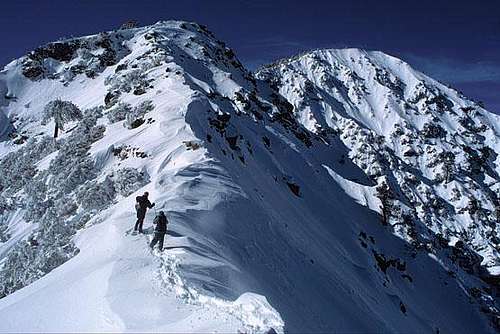
One of the weirder things about Los Angeles is that it's edged by some rather imposing peaks, such Mt. Baldy (10,064 feet), the high point of the San Gabriel Mountains that run west to east north of the city. 

The San Gabriels are actually mostly too steep for conventional skiing. There's one successful conventional ski slope on the north side, Mountain High, but the other ski slopes are scratch affairs. Back at the turn of the century, a guy who was on my high school debate team bought one, Mt. Waterman, scraped through some dry years, and then in the big snow year of 2005, he was happily skiing down his mountain while getting it ready to open, when he hit a tree and was killed.

Mt. Baldy is remarkably close to L.A. You take the 210 freeway to about 20 miles east of Pasadena, get off at the Claremont Colleges, then it's about 15 miles straight up into the mountains. Well, not exactly straight up. What's less straight than a hairpin curve? A bobbypin curve? There's a tiny ski resort 6,500 feet up Mt. Baldy that makes the dilapidated one in Hot Tub Time Machine look like Aspen, with a 39-year-old chairlift up to 7800' elevation, where there's a restaurant. 

I first rode up it in June 1977. I recall that the restaurant back then made a big deal about having a live rock band weekend nights. A dude who worked there explained it was a good deal because at that altitude you got wasted faster, which made a lot of sense in 1977. How that was good for driving later back down to the city was not a topic that came up, because it was 1977.

We then hiked to the top of Mt. Baldy up the Devil's Backbone trail (above, in Michael Gordon's winter photo). We came down the face of the Baldy Bowl, a vast 35 degree slope of ping-pong ball sized pebbles. You basically ran down in this kind of moon-walking style, flying about 15 feet with each step, then skidding for about 10 feet in a mini-avalanche before another big step. 

Nobody seems to run down anymore. As far as I can tell from the Internet, these days people either stick to the trail in summer, which seems boring, or ski down the couloirs in winter (such as Girlyman), which seems like a manifestation of mental illness.

Thirty-five years later, in October, my wife bought a $29 Groupon deal for two to ride up plus $20 off lunch, expiring Saturday, December 15, 2012. (Groupon is basically a sort of legal loanshark serving small businesses. Groupon keeps half the $29, but pays out fast. If you are a ski hill that was barely open last year due to a lack of snow, you could really use that $14.50 in October.)

Being terrified of chairlift rides since I fell off getting onto one when I was 7 and had to ride down alone, I of course procrastinated. But she prudently didn't tell me she'd only spent $29, so, me being a true believer in the Sunk Cost Fallacy, off we finally went. 

The guy working at the lift looked kind of like the guy I had talked to 35 years ago, and the music in the restaurant hadn't changed -- heavy on Foreigner. (Maybe they were his 8-tracks?) There was about a foot of new snow, covering all the trees, very Winter Wonderlandy. The hamburgers at the restaurant were surprisingly delicious and $20 bucks covered the majority of the cost. The chairlift ride down, however, turned out to be exactly as terrifying as I'd assumed it would be.

Dueling Morgan Freemans

From Key and Peele on Comedy Central.

Keegan-Michael Key and Jordan Peele have to be the most confusing pair of names ever to team up in the history of comedy. (Besides all the long E sounds, the redunant Kee syllables, and the former's strangely front-loaded name, you've even got Michael Jordan buried in there.).

December 15, 2012

Women's media

Glenn "Instapundit" Reynolds has a suggestion in the New York Post on what rich Republican donors can do with their money:
In her 2004 book, “Spin Sisters: How the Women of The Media Sell Unhappiness — and Liberalism — to the Women of America,” Myrna Blyth (a former Ladies Home Journal editor) explained in considerable detail the variety of “Mean Girls” feminism that the women’s media aim at their readers with every issue. 
The message: There’s one way that women should think; people who don’t think that way are bad and stupid — and if you think the wrong way, women won’t like you. 
For $150 million, you could buy or start a lot of women’s Web sites. And I’d hardly change a thing in the formula. The nine articles on sex, shopping and exercise could stay the same. The 10th would just be the reverse of what’s there now. 
For the pro-Republican stuff, well, just visit the “Real Mitt Romney” page at snopes.com, or look up the time Mitt Romney rescued a 14-year-old kidnap victim, to see the kind of feel-good stories that could have been running. For the others, well, it would run articles on whether Bill Clinton should get a pass on his affairs, whether it’s right that the Obama White House pays women less than men, and reports on how the tax system punishes women. 
This stuff writes itself, probably more easily than the Spin Sisters’ pabulum. And opening up a major beachhead in this section of the media is probably a lot cheaper than challenging major newspapers and TV networks head on. 
The only losers will be the political consultants who ate up so much of the GOP’s cash this time around.

Not a bad idea, although a problem that is growing for the Right is that the Left is getting really good at policing advertisers, and the Internet gives a big edge to advertising-supported media over subscription-supported media. Women's publications are particularly advertiser-supported because women spend more money than men do (because men give more money to women to spend than women give to men).

I haven't looked at a paper copy of The Nation magazine recently, but the last time I did, it was crammed with ads. People on the Right tend to sympathize with advertisers, like the idea that "It's just business" and that there should be depoliticized areas of life, so they wouldn't dream of organizing a boycott of, say, Sears (the banner pops up when I went to TheNation.com) for advertising on The Nation. 

People on the Left, in contrast, like getting worked up in a moral dudgeon and demanding that advertisers not advertise on the Right. This leads to the few ads on Right sites being pretty non-mainstream, which makes it look like conservatives are non-mainstream fringe folks, which makes them less appealing to mainstream non-fringe folks, whereas, obviously, The Nation is totally mainstream and non-fringe -- I mean, Sears advertises on it!

December 14, 2012

Myers-Briggs: Sensing v. Intuition

The Myers-Briggs personality test is popular with Human Resources departments in the U.S. Extrapolated from the thinking of Swiss psychoanalyst Carl Jung, everybody gets lumped into one of 16 personalities based on four dichotomies:
Dichotomies
Extraversion (E) –(I) Introversion
Sensing (S) –(N) Intuition
Thinking (T) –(F) Feeling
Judging (J) –(P) Perception
I never really got the Sensing v. Intuition dichotomy, but now I've finally understood why. Here's Wikipedia's explanation:
Sensing and intuition are the information-gathering (perceiving) functions. They describe how new information is understood and interpreted. Individuals who prefer sensing are more likely to trust information that is in the present, tangible, and concrete: that is, information that can be understood by the five senses. They tend to distrust hunches, which seem to come "out of nowhere".[1]:2 They prefer to look for details and facts. For them, the meaning is in the data. On the other hand, those who prefer intuition tend to trust information that is more abstract or theoretical, that can be associated with other information (either remembered or discovered by seeking a wider context or pattern). They may be more interested in future possibilities. For them, the meaning is in the underlying theory and principles which are manifested in the data.

It finally occurs to me that I couldn't grasp this distinction before because I like all that stuff: tangible information, hunches, theories, details, facts, abstractions, wider contexts, pattern recognition, analogies, intuition ... it's all good.

But, that's also why I drive a lot of people into rages. They are at one end or the other of this scale, and they like being wherever they are. Somebody at the opposite end of the scale isn't really relevant to them. But I like both ends and flipping back and forth.

Jung tended to see hunches in rather mysty, murky terms: archetypes, collective unconscious, synchronicity, and so forth: a lattice of coincidence. I tend to see my hunches as just facts I have known but have semi-forgotten or facts I've only semi-learned. Jung didn't have Google and Wikipedia to look things up, but I do, so why not use everything at my disposal?

Anyway, even though Myers-Briggs is probably not an ideal framework, most frameworks do have uses.


Personality testing: Myers-Briggs v. Big 5

The Washington Post has a fascinating article by Lillian Cunningham on the popular and lucrative Myers-Briggs Type Indicator personality test that is widely used by employers but is ignored by academics:
It is a classic chicken-and-egg problem: No major journal has published on it, therefore no elite academic will support it, therefore no major journal will publish on it. 
But there are concrete reasons it was not welcomed in the first place. 
“Carl Jung was a pioneer in terms of really creative and novel theory and ideas, but a lot of his work was done before psychology was an empirical science,” says Grant, the Wharton psychology professor. And the 16 Myers-Briggs personality types, remember, are even a step removed from that — they are an interpretation and recasting of Jung’s theory. Even more compromising, according to Grant, is the fact that Katharine Cook Briggs and Isabel Myers created the framework in their living room before doing any robust scientific research, rather than the other way around. 
The research that most psychologists today hold up as the best attempt to derive personality types from empirical data is called the Five Factor theory, which emerged from several large-scale independent projects that, conducted over decades, pointed to the same broad set of conclusions. The studies found five core axes that underpin personality, versus the MBTI’s four. They are represented by the acronym OCEAN: openness, conscientiousness, extroversion, agreeableness and neuroticism. Of the five, only extroversion closely maps with Myers-Briggs. 
Yet the Five Factor theory has a small commercial problem. 
“There’s no individual or group who owns it,” Grant says. “It’s something that’s collectively owned by the academic community.” That means it’s harder to copyright and package. 
There’s another problem: Not all the personality traits delineated by the Five Factor theory are positive. One of the traits in this framework is neuroticism, for example, which has undeniably negative associations.
One of the major selling points of Myers-Briggs is that it is unequivocally positive. No personality type in its framework is better or worse than any other; each is billed as having unique and constructive strengths. 
This rubric has massive marketing appeal for organizations, especially given that much of the literature and language around talent development in the past few decades has taken a decidedly soft approach. Words like passion, motivation and collaboration have rooted themselves in the corporate lexicon, and they have been part of a larger wave of management theory that has turned its focus to motivating and eliciting best behavior. 
“There’s been a huge wave in positive psychology. It’s been remarkably refreshing,” Thoresen says. “But it’s controversial, and it makes many psychologists nervous because it’s not in their bailiwick.” 
Use of psychological assessments in organizations really picked up in the late 20th century, alongside a growing trend in seeing talent management as a core component of a company’s competitive advantage. Myers-Briggs became one of its first and shiniest symbols. An organization that used the test showed that it recognized people, and their diversity of background and thought, as one of its biggest assets. 
“To raise questions about [Myers-Briggs’s] reliability and validity is like commenting on the tastiness of communion wine. Or how good a yarmulke is at protecting your head,” says Brian Little, a former psychology professor at Harvard University who is now at the University of Cambridge. “It’s simply the wrong question, from their perspective." 
... And yet the psychological community has been reticent to speak up too vocally against it. The fact is, many psychology professors do lucrative side work as organizational consultants. And as taboo as it is to praise Myers-Briggs in U.S. academia, it’s equally taboo to disparage it in corporate America.

The Myers-Briggs typology doesn't sound too bad: the extravert-introvert contrast is extremely useful, and the others don't seem terribly destructive.

I've never been all that excited by personality testing. It would seem like there is some potential to correlate personality traits with the usual identity politics categories, but I haven't heard of too much work along those lines. For example,
The Big Five factors are:
  • Openness (inventive/curious vs.consistent/cautious)
  • Neuroticism (sensitive/nervous vs.secure/confident)

Off the top of my head, I would guess that, relative to white Americans, the the three main minorities would look like this (all else being equal):

Openness: East Asians lower than whites, blacks pretty high, Mexicans lower

Conscientiousness: Asians higher, blacks notably lower, Mexicans somewhat lower

Extraversion: Asians lower, blacks much higher, Mexicans somewhat lower

Agreeableness: Asians variable (Chinese lower, Japanese higher at least in terms of politeness, Indians very high), blacks higher (except when they are lower), Mexicans middling

Neuroticism: Asians higher, blacks lower, Mexicans middling

But my impression is that personality testing tends to become less reliable as it crosses cultural borders. I vaguely recall finding years ago a global report on Big 5 scores for dozens of countries. This seemed like it would be wonderfully enlightening, until I noticed that Swedes and Danes scored as having extremely different personalities. I suspect what was going on was something like people in those two countries like to think: "We are Swedes/Danes and we are different from those horrible Danes/Swedes."

Nobel laureate economist James Heckman's big project these days is to get the government and society to focus on bashing some conscientiousness into blacks. Historically, this doesn't sound impossible to pull off. From the historical record, you can see the Prussian state bashing conscientiousness into Prussians, and then all Germans, to help them stop losing wars. But it's practically impossible to state clearly in public what the goal of Heckman's project is, so it tends to wander off into more popular sidelines like denouncing Charles Murray.

Feminism: Making children cry on Christmas since 1969

If you'd asked me a couple of years ago, "Steve, your preoccupation is the quality of intellectual discourse, but, really, is there any hope? Does anything ever improve?" I would have answered: "Look how nobody believes in feminist dogma anymore. When I was a kid, a lot of people really believed that the reason little boys liked to play with trucks and clubs while little girls liked to play with baby dolls was because of social conditioning. But, generations have gone by and after a lot of children's tears, we've all learned how silly that was."

Of course, I might have said that in the late 1980s, too.

Remember 1991, when Bush I nominated a young black conservative to the Supreme Court? 

Desperate to block Clarence Thomas's ascent, Democrats played their trump card: Anita Hill, a spinster black lawyer who had worked for Thomas after his divorce, when he was one of the most eligible black bachelors in Washington. Back in those palmy days, there had apparently been a little sexual frisson around the office between those two, who seemed so well-suited in terms of education and race that a trip to the altar seemed plausible. But nothing much had come of it, and Thomas eventually married a white woman. 

Years later, Hill, still a spinster, announced that she had been the victim of Sexual Harassment, and it was the biggest news in the history of the world for awhile, propelling obvious sexual nonharasser Bill Clinton to the Presidency the next year, The Year of the Woman. (In 1992, I wrote an essay predicting that Bill Clinton would get himself in serious trouble over a case of sexual harassment during his Arkansas gubernatorial years -- as turned out to be true in the Paula Jones case that set off the Monica Lewinsky case -- but I couldn't find anybody to publish it.)

This Year of the Woman mania briefly made intellectual superstars out of a couple of nice-looking young feminist ditzes, Naomi Wolfe and Susan Faludi, before the whole thing collapsed under the weight of its own vapidity.

So, move ahead 20 years to 2012, and the Democratic candidate is just about the least feminist President in recent times. He treats his Harvard Law School wife the way Harry treated Bess, runs a can-you-believe-that-game-on-ESPN-last-night workplace atmosphere, hires Larry Summers, and only favors a tiny number of women (Valerie Jarrett, Susan Rice) because they come from the Jack & Jill Club paper bag test Afro-American upper crust. 

But, the point is that Obama's a Democrat, so the Feminist Noise Machine got switched on loud in 2012, and it worked, just like it did in the 1992 election. But do we have to still hear it now that the election is over? Can't we please pack it away until 2016?

For example, in Slate, Hanna Rosin encourages clueless single women to play Feminist Grinch and ruin their nephews' and nieces' Christmases/Hannukahs in the name of Gender Neutrality:
Ultimate Disney Princess Castle: Your Time is Up 
This season’s gender-neutral toys will finally prove that boys and girls aren’t so different after all.

Granted, that's a particularly stupid headline, but any complaints Mr. Rosin has in that regard she should take up over the family dinner table, since she's married to Slate's editor David Plotz. 

Later Ms. Rosin asserts: 
"But in fact this is a false piece of evidence, or at least extremely misleading, since childhood is just about the only phase of life where differences between the genders show up so starkly." 

Ms. Rosin evidently hasn't paid much attention to the nerdier corners of grown-up culture. Gigantic sex differences are evident among, say, advanced baseball statistics hobbyists ("moneyballers" or "sabermetricians") or aficionados of the history of style in golf course architecture.

The general trend is for the Internet to make it easier for each sex to pay attention only to what it finds interesting. Thus, Ms. Rosin, for example, founded a website named DoubleX aimed at readers with two X chromosomes.

December 13, 2012

iSteve visits by state per capita rates

Here are per capita rate of visits to my blog over the last month by state, adjusted for each state's population, on a scale where if the percentage of total America page views coming from state equals that state's percentage of total population, then that state will get a 100. Not surprisingly, D.C. is way, way out ahead with a per capita rate of viewership 13.82 times the national average. Among real states, the differences aren't as vast. The traditionally most highbrow state, Massachusetts, is first among actual states, with 2.25 times as many page views per capita as the national average.

Last is North Dakota at 0.27 times the national average rate of visits per person.

As commenter Anony-Mouse points out, people in North Dakota are busy at real jobs digging holes in the ground looking for oil and gas, while people in Washington are sitting at desks with Internet access.

Not all that much of a Canadian Border Effect here, more of an Atlantic Seaboard Metropolis Effect.

The median states are Rhode Island and North Carolina.

The list appears to be dominated by a handful of metro areas: D.C., NYC, Boston, Chicago, Seattle, Seattle, Minneapolis, and some California metros (I'd guess Silicon Valley in the lead in California, with entertainment industry parts of L.A. in second). Then maybe Denver, Philadelphia/Pittsburgh?, Portland, Phoenix, St. Louis, Atlanta, SLC, and the big Texas cities.

States at the bottom tend to not not have big urban areas (also, sample sizes may be small and unstable toward the bottom). But I do reasonably well in many states and I'm glad to be of service to my readers in those states.

The 49th and 50th states do surprisingly well.

Among states with fairly big cities, I don't do well in Florida, Louisiana, or Nevada. As I wrote about eight years ago, would Edmund Burke have preferred 21st century Las Vegas or 21st century Boston?

Average = 100
District of Columbia  1,382
Massachusetts  225
New York  190
Virginia  181
Alaska  151
New Hampshire  151
Washington  146
Illinois  141
Maryland  140
California  126
New Jersey  122
Connecticut  115
Minnesota  113
Hawaii  108
Colorado  99
Pennsylvania  98
Oregon  87
Arizona  79
Missouri  78
Georgia  77
Utah  76
Texas  75
New Mexico  75
Michigan  75
Rhode Island  74
North Carolina  74
Oklahoma  73
Delaware  72
Montana  68
Nebraska  67
Maine  65
Kansas  64
Tennessee  60
Idaho  60
Ohio  57
South Dakota  56
Wisconsin  54
Alabama  53
Vermont  52
Florida  52
Indiana  48
Louisiana  47
South Carolina  45
Kentucky  44
Nevada  43
Wyoming  43
West Virginia  41
Iowa  41
Arkansas  38
Mississippi  28
North Dakota  27

iSteve readers: Swedes v. Finns v. Indians v. Not Sures

Here are unique visits by top 50 country to my Blogspot blog (i.e., not including my archive) over the last or month or so. Not surprisingly, the top 4 countries are English-speaking, but then  we get to Germany, Sweden, Finland, and India. I make a lot of jokes about all my loyal Finnish readers, but the Swedes are always neck and neck with the Finns in terms of per capita readership. My real weakness is Denmark. 

Unique Visits
1 United States 231737
2 Canada 17942
3 United Kingdom 9521
4 Australia 6259
5 Germany 3389
6 (not set) 3374
7 Sweden 2774
8 Finland 2033
9 India 1905
10 Ireland 1762
11 New Zealand 1577
12 Norway 1374
13 Brazil 1271
14 Netherlands 1203
15 Poland 1028
16 France 984
17 Czech Republic 926
18 Israel 910
19 Japan 903
20 Switzerland 899
21 South Korea 880
22 Hong Kong 810
23 South Africa 708
24 Spain 701
25 Singapore 592
26 Italy 570
27 Denmark 547
28 Thailand 516
29 Portugal 515
30 Philippines 484
31 Turkey 464
32 Mexico 451
33 Greece 394
34 Hungary 390
35 Belgium 349
36 Austria 315
37 Costa Rica 315
38 Malaysia 312
39 Romania 281
40 Russia 267
41 Vietnam 257
42 Taiwan 254
43 Croatia 251
44 Chile 222
45 Bulgaria 191
46 United Arab Emirates 188
47 Argentina 186
48 Colombia 170
49 Serbia 170
50 Lithuania 155

By the way, Google now offers a Fusion Table feature to combine your data on a spreadsheet with public data. I told it to fuse my data on site visits with population by country figures from the CIA World Factbook, so I could get per capita figures. Instead, it just pasted in data in rank order so that the row with my U.S. visits now has China's population next to it, my Canada visits are now next to India's population, and so forth.

Is there something I don't get about this feature?

iSteve: Coming up on 30,000,000 page views

According to my Sitemeter, my iSteve websites (this blog and my article archives) should hit 30 million page views by this weekend. Currently, it's running at about 15,000 page views per day. 

December 12, 2012

Stanley Fish: "Is It Good for the Jews?"

Researching my current Taki's column, I came upon the following 2007 column by New York Times columnist Stanley Fish, the prominent professor of literature. 

If you ever read David Lodge's old novels about academic life, Fish is the original of the comic character Professor Morris Zapp, an extremely energetic and intelligent (but not terribly self-aware) intellectual:
Some years ago [Morris Zapp] had embarked with great enthusiasm on an ambitious critical project: a series of commentaries on Jane Austen which would work through the whole canon, one novel at a time, saying absolutely everything that could possibly be said about them. The idea was to be utterly exhaustive, to examine the novels from every conceivable angle, historical, biographical, rhetorical, mythical, Freudian, Jungian, existentialist, Marxist, structuralist, Christian-allegorical, ethical, exponential, linguistic, phenomenological, archetypal, you name it; so that when each commentary was written there would be simply nothing further to say about the novel in question. The object of the exercise, as he had often to explain with as much patience as he could muster, was not to enhance others' enjoyment and understanding of Jane Austen, still less to honour the novelist herself, but to put a definitive stop to the production of any further garbage on the subject. The commentaries would not be designed for the general reader but for the specialist, who, looking up Zapp, would find that the book, article or thesis he had been planning had already been anticipated and, more likely than not, invalidated. After Zapp, the rest would be silence. The thought gave him deep satisfaction. In Faustian moments he dreamed of going on, after fixing Jane Austen, to do the same job on the other major English novelists, then the poets and the dramatists, perhaps using computers and teams of trained graduate students, inexorably reducing the area of English literature available for free comment, spreading dismay through the whole industry, rendering scores of his colleagues redundant: periodicals would fall silent, famous English Departments be left deserted like ghost towns. . . .

(Here's Stanley Fish endorsing Morris Zapp's project in the NYT in 2009.)

When he reappears in Lodge's Small World set in the late 1970s, Zapp, in pursuit of his oft-stated goal of becoming the world's first professor of literature with a six-figure salary, has hopped on the fad of European Marxist deconstructionism. But then Zapp gets kidnapped and held hostage by European Marxist terrorists intent on deconstructing society with bombs. After Zapp is finally rescued, he starts to reflect that perhaps the profession of professor of literature does prosper best in a bourgeois society.

So, over the course of a long career, Fish has been exposed to countless ideological currents. But it's interesting to note how strongly his thinking returns to the fundamental question:
Is It Good for the Jews? 
By STANLEY FISH 
When I was growing up in the '40s and '50s, a single question was asked in my neighborhood of every piece of news, large or small, local or national: "Is it good for the Jews?" We have now learned to identify this question in all of its versions - Is it good for the Catholics? Is it good for the Latinos? Is it good for the gays? and on and on - as the paradigmatic question of identity politics, the politics that is derived not from some general, even universal, assertion of what is good, but from a particularized concern with insular interests. Is it good for us, for those of our kind, for our tribe?  
A community in which this question is central and even natural will be a community with a sense of its own precariousness. (No one ever asks, is it good for the white, male, Anglo-Saxon graduates of Princeton; it's always good for them.)

This attitude may help explain, in the face of the rise of Asians, the decline in white, male, Anglo-Saxon graduates of Princeton and the non-decline in white, male, Jewish graduates of Princeton. Perhaps Anglo-Saxon notions of universal good, stiff upper lip, fair play, sportsmanship, noblesse oblige, and so forth are the real social constructs, while "Is it good for my tribe?" is the human default.
Its members will think of themselves as perpetually under assault (even if the assault never comes), and as the likely victims of acts of discrimination and exclusion. ("No Irish need apply.") As a result it will turn inward and present to the outside world a united and fiercely defensive face.

As Moshe Dayan demonstrated in 1967, however, sometimes the best defense is a good offense.
It will be informed and haunted by a conviction that no matter how well things may seem to be going, it is only a matter of time before there is a knock on the door and someone comes in and takes it all away. 
By all the available evidence, formal and informal, precariousness does not mark the situation of the Jewish community today, at least not in this country. 
Whether the measure is education, wealth, ownership of property, influence in the corridors of power, prominence in the professions, or accomplishments in the arts, Jews in the United States are visible and successful to a degree that is remarkable given their relatively small numbers (around 2 percent of the population). Yet as Professor Charles Small of Yale University reports, "Increasingly, Jewish communities around the world feel under threat," and there are some Jews in this country who share this feeling, not because they are themselves threatened (although that does occasionally happen), but because they fear - in the spirit of Sinclair Lewis's "It Can't Happen Here" or Philip Roth's "The Plot Against America" - that what is happening elsewhere may soon happen here. 
Why should they think that? Part of the answer is to be found in the relationship between three words - Israel, Iraq and anti-Semitism. Much of the world has been opposed to the Iraq war from its beginning, and now after four years 70 percent of Americans share the world's opinion. Some who deplore the war believe that those who got us into it and cheered it on did so, at least in part, out of a desire to improve Israel's position in the Middle East. Those who hold this view (and of course there are other analyses of the war's origins) fear that the same people - with names like Wolfowitz, Pearle, Feith, Abrams, Kristol, Kagan, Krauthammer, Wurmser, Libby and Lieberman - are pushing for a strike against Iran, arguably a greater threat to Israel than Iraq ever was. 
Why, they ask, should our foreign policy be held hostage to the interests of a small country that is perfectly capable of defending itself and is guilty of treating the Palestinians, whose land it appropriated, in ways that are undemocratic and even, in the opinion of many, criminal? 
... One reason the [Israel] lobby is "immune from criticism," Mearsheimer and Walt explain, is that criticism, when it appears, is always re-described as anti-Semitism, and "anti-Semitism is something no one wants to be accused of." 
Their point, and it has been made by many, is that there is no reason to assume that those who criticize Israel and argue that America's uncritical support for a flawed state is strategically unwise and morally wrong are anti-Semitic. 
Maybe so, but there is some empirical evidence to the contrary. Charles Small and his Yale colleague Edward Kaplan have recently published an article in the Journal of Conflict Resolution, the title of which also tells its own story: "Anti-Israel Sentiment Predicts Anti-Semitism in Europe." What Small and Kaplan find is that "Those with extreme anti-Israel sentiment are roughly six times more likely to harbor anti-Semitic views than those who do not fault Israel on the measures studied, and among those respondents deeply critical of Israel, the fraction that harbors anti-Semitic views exceeds 50 percent." The authors conclude that, "even after controlling for numerous potentially confounding factors," "anti-Israel sentiment consistently predicts the probability that an individual is anti-Semitic" and will say things like "Jews don't care what happens to anyone but their own kind" or "Jews are more loyal to Israel than to this country" or "Jews have too much power in international financial markets." 
Small and Kaplan are careful to disclaim any causal implications that might be drawn from their analysis: they are not saying that anti-Semitism produces opposition to Israel or that opposition to Israel produces anti-Semitism, only that the two attitudes will more often than not be found in the same individual: scratch an opponent of Israel and you are likely - 56 percent of the time - to find an anti-Semite. This does suggest that if opposition to Israel increases, there will be an increase in anti-Semitism because the population of the 56 percenters will be larger. Is this something Jews, even Jews living in the United States, should be apprehensive about? 
The answer to that question will depend on whether you think that there is a meaningful distinction to be made between the "old" and the "new" anti-Semitism. Old anti-Semitism, according to Brian Klug of Oxford University, is based on a hostility to and fear of "the Jew" as an alien and demonic figure. In this ancient and much retailed story, Klug tells us, in an article in Catalyst magazine last year, subhuman Jews wander from country to country and "form a state within a state, preying on the societies in whose midst they dwell." This is the anti-Semitism that came to full and disastrous flower in Nazi Germany. 
The new anti-Semitism, in contrast, Klug continues, is rooted not in a hostility to "the Jew" as a vampire-like destroyer of cultures, but "in the controversial nature of the State of Israel and its policies." As such, "it is not a mutation of an existing 'virus,' but a brand new 'bug.'" That is to say, its origin is political rather than racial, and there is at least a chance that if its political source were removed - if Israel's policies were to change - its force would abate. 
So there you have two stories: anti-Semitism is on the rise and it's time to get out those "Never Again" signs. Or, it's not anti-Semitism in the old virulent sense, but a rational, if problematic, response by Middle East actors and their supporters in the West to what they see as "an oppressive occupying force"; don't take it personally. I understand this second story, and appreciate its nuance, but I can't bring myself to accept it, if only because I believe that the viral version of anti-Semitism is always capable of regaining its full and deadly form even when it is apparently dormant or weakened. All it needs is a pretext, and any pretext will do. If the Israeli-Palestinian conflict didn't exist, it would attach itself to something else; but it does exist, and anti-Semitism couldn't be happier. 
Because I think this way, I can imagine a time in the not-so-distant future when American Jews might feel precarious once again. There is a certain irrationality to this imagining, given that at this moment, I am sitting in a very nice house in Delray Beach, Fla., and taking advantage of the opportunity afforded me by The New York Times to have my say on anything I like every Monday. And in a few months I will repair to an equally nice house in the upstate New York town of Andes, where I will be engaging in the same pleasurable activity. Sounds like a good life, and it is. So why am I entertaining fantasies of being dispossessed or discriminated against or even threatened? 
Part of the answer lies in the fact that I spend much of my time in colleges and universities, where anti-Israel sentiment flourishes and is regarded more or less as a default position. And I have seen (with apologies to Shelley) that when hostility to Israel comes, anti-Semitism is not far behind. But the deeper explanation of my apprehension is generational. One of my closest friends and I agree on almost everything, but we part company on this question. He tells, and believes, the "criticism of Israel is one thing, anti-Semitism another" story. I hear it, but I can't buy it. He is 10 years my junior. I remember World War II. By the time he was born it was history. Maybe it's that simple.

Traditional football wisdom is that "The best offense is a good defense." Yet, there is a slowly emerging theory in football that the best defense is to stay on offense. Thus, the number of interceptions thrown is way down versus a generation ago because it's understood how disastrous a turnover is. Granted, football coaches are extremely conservative and hate being exposed to criticism for unconventional strategy, but the idea of not always punting the ball back to the other team on fourth down is slowly gaining popularity among the most assured coaches, such as Bill Belichick. Three years ago, Belichick notoriously had Tom Brady go for it on 4th and 2 on his own 29 rather than punt the ball back to Peyton Manning. Perhaps the next evolution will be more onside kickoffs after scoring. After all, in this era of high powered offenses, does it really matter if you let your opponents have the ball on their own 20 or on the 50? It's best to try to keep the ball in your own hands.

In other words, the best defense would be to never have to play defense. Always play offense. Stay offensive and take offense.

Analogously, my current Taki's column puts forward a theory of historical evolution that I don't recall seeing before:
Before 1967 and the Six Days War, American Jews had typically asked their classic question “Is It Good for the Jews?” about their own conduct. 
Sandy Koufax’s pitching? Good for the Jews. 
Julius and Ethel Rosenberg’s atom-bomb espionage? Not good for the Jews. ... 
After the 1960s, Jews stopped asking the question, “Is it good for the Jews?” about their own behavior and started asking it about everyone else’s.

Proposition Nation v. Preposition Nation

On the White House webpage regarding immigration and amnesty, we read President Obama version of the conventional propositional nation wisdom that emerged a decade or two back to justify de facto open borders:
Fixing the Immigration System for America’s 21st Century Economy 
"We are the first nation to be founded for the sake of an idea—the idea that each of us deserves the chance to shape our own destiny. That’s why centuries of pioneers and immigrants have risked everything to come here…The future is ours to win. But to get there, we cannot stand still." 
-PRESIDENT BARACK OBAMA

The "propositions" are usually taken to be from the Declaration of Independence:
We hold these truths to be self-evident, that all men are created equal, that they are endowed by their Creator with certain unalienable Rights, that among these are Life, Liberty and the pursuit of Happiness.

Yet, as Abraham Lincoln and computer scientist John McCarthy have implied, there appears to be typo left in during the rush, and that the Declaration would make far more sense if it read:
We hold these truths to be self-evident, that all men are created equal, in that they are endowed by their Creator with certain unalienable Rights, that among these are Life, Liberty and the pursuit of Happiness. ...

(It goes on to list a number of other truths.) 

In any case, there are other Founding documents that, for some reason, don't get cited much by the Propositionists, most notably the Preamble to the Constitution, which puts forward a carefully considered explanation of what the United States exists for, one that is hard to reconcile with the current assumption that it exists primarily to take in immigrants:
We the people of the United States, in order to form a more perfect union, establish justice, insure domestic tranquility, provide for the common defense, promote the general welfare, and secure the blessings of liberty to ourselves and our posterity, do ordain and establish this Constitution for the United States of America.

Commenter Hundson writes:
America is not a propositional nation, America is a prepositional nation: "to ourselves and our posterity."

December 11, 2012

Hispanic Invisibility: Somebody else notices it

It was sad to read about some Mexican singer lady who died in a plane crash. Flying around in private planes sounds glamorous, but it can be pretty terrifying. American musicians don't die in plane crashes as often as they used to, but the Third World plane crash rate is still pretty high.

But, then, it turned out as I read more that this Jenni Rivera wasn't Mexican, she was a 43-year-old Mexican American born in Long Beach and living not far from me, in Encino. Among her various marriages was one to a pitcher on the Dodgers.

And I had never ever heard of her.

A writer for the Washington Post notices the same thing:
Mainstream media’s ignorance of Jenni Rivera raises image of parallel Americas 
By Paul Farhi, Tuesday, December 11, 5:38 PM 
The Chicago Sun-Times declared Jenni Rivera “a heroine” and quoted an entertainment executive who lauded her “extraordinary gifts.” The New York Times compared her to Diana Ross and Tina Turner. Numerous media accounts labeled her a superstar. 
Chances are, this was news to you. Chances are, you’d never heard of Rivera until you learned that she died in a plane crash in Mexico on Sunday.

The American-born Rivera has sold at least 15 million records — more than many other successful and widely acclaimed singers in the United States. But she did not enjoy much attention from the English-language media. Although she was bilingual, Rivera sang only in Spanish. Her most ardent, record-buying fans reside primarily in the American Southwest and farther south, across Mexico. 
Rivera’s life and death suggest once again that it’s possible to live in parallel Americas, with the larger part only dimly aware of the enormous things happening in the other one. For all our instant connectivity, it’s possible for someone to be hugely famous and perfectly obscure — all at the same time. 
... The Washington Post had never mentioned Rivera’s name until Sunday, nor had the news divisions at ABC, CBS, Fox or NBC, according to Nexis. Rivera’s hometown newspapers in California — she grew up in Long Beach — weren’t much more attentive. The Los Angeles Times name-checked her in about a dozen short pieces over the years; the paper’s most prominent treatment of her was a story about her purchase of an Encino estate. ... 
This degree of cluelessness elicited an acid-laced comment on Monday from the Orange County Weekly’s Gustavo Arellano, who writes the paper’s amusing and often thoughtful “Ask a Mexican” column. Arellano upbraided the mainstream news media for “their pathetic record on reporting on a mega-superstar [who] operated in plain sight under a media that, like usual, didn’t bother to pay attention while she was alive because she was a Mexican and popular mostly to Mexicans — and they never matter unless you can get a diversity grant to cover them. 
“Now that she’s dead? Look everyone: we cover Mexicans!” 
Actually, Rivera was an American who racked up huge record sales in the United States, but point taken. Added Arellano: “For all the racket that the [mainstream media] has made about diversity over the past 15 years, they continue to fail — as if we ever expected them to succeed in the first place?”

For American elites, Mexicans and other Central Americans make an ideal new people to elect because they are so little competition for their own kids.

The Sixties for Italians and Jews

From my new Taki Magazine column:
To continue examining the 60s through an ethnic lens, let’s look at two Ellis Island immigrant groups, Italian Americans and Jewish Americans.

Read the whole thing there.

Mandatory Finnish content

In PISA exams, Finland usually is the top scoring white country. Although I have a large number of brilliant Finnish readers, I had expressed some skepticism: maybe Finns just try real hard on PISA and won't do as well on the other main international tests?

So, how did Finland do in the 2011 TIMSS and PIRLS tests among white countries/regions?

Math 4th Grade: 3rd place, behind Northern Ireland and Flemish Belgium
Math 8th Grade: 3rd place, behind Russia and Israel
Science 4th Grade: 1st place
Science 8th Grade: 1st place

PIRLS
Reading 4th Grade, Overall Reading Average Scale Score: 2nd place, behind Russia
Reading 4th Grade, Reading Literacy: NA

Don't ask me what the difference is between the two Reading tables.

So, Finland does quite well on these tests, too, even though there isn't otherwise much correlation within racial groups between the 2009 PISA and the 2011 TIMSS/PIRLS. On both sets of tests, northeast Asian countries did extremely well on math/science and quite well on reading, rich white countries came in the middle, followed by poor white countries, and then the Third World. But, within, say, Western Europe there isn't much consistency about whether a country scores at the top of the pack or the bottom of the pack among the tests. (A big reason is that the packs are pretty similar, so rank order can change easily).

Except Finland.

One reason is that Finland is just about the whitest of the rich white countries. It only recently hopped on the Third World refugee freight train to who knows where. (White American kids would lead all the countries in the world on the PIRLS, unless Asian-Americans had their own country.)

But I guess we should also be taking seriously Finland's laidback educational techniques, which are, on the whole, the opposite of the more obvious way the northeast Asians grind out high test scores.

By the way, the outstanding Russian performance on these new tests (as opposed to the middling Russian performance on the PISA) is ... interesting.

There might be a niche occupation in the future for somebody to be the Unbiased Expert on international testing.