August 8, 2013

My entry in the Open Borders logo contest

Bryan Caplan and his friends at Open Borders are sponsoring a logo contest:
The Open Borders movement seeks a symbol that embodies the spirit of free migration. To achieve that goal, we are sponsoring a logo contest. The winner of this contest will get $200 and their design will become the official logo of the Open Borders web site. 
The goal: Create a simple logo, like the peace sign, that represents free migration. 
How to enter: Go to the Open Borders Logo Contest Facebook page and post your image. Join the group and send me a message so I can add you. Then, you can post. 
The criteria for selection: We seek something that is simple and powerful. Think of an image that a person with little artistic skill could paint on a sign or banner. 
Who will choose the winner: The Open Borders website editors and the contest sponsors (Bryan Caplan and myself). 

Here's my entry:


August 7, 2013

Any good sources on the Amish?

I want to write about the Amish, but I've noticed that most of what I thought I knew about them isn't quite right. For example, I long assumed they had a rule that they wouldn't use technology not mentioned in the Bible, but that doesn't seem to explain their rules well at all.

Does anybody know of some insightful studies of the Amish, especially focusing on population, economic, and marital questions?

Brunos don't have to do diversity

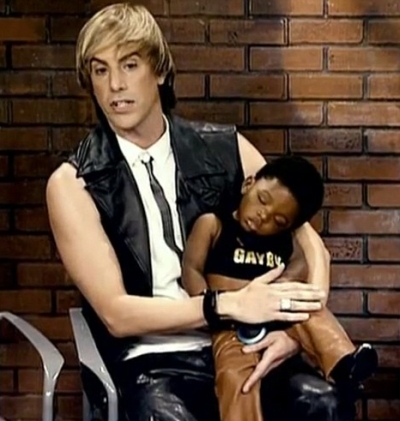
Bruno with fashion accessory (video)
From the NYT:
Fashion’s Blind Spot
By ERIC WILSON 
Five years ago, the fashion industry faced a reckoning over the startling lack of diversity among the models on major designer runways. Reacting to complaints that many shows and magazines included nothing but white models, Vogue, in its July 2008 issue, featured a substantial article that asked, in its headline, “Is Fashion Racist?”...
And since then, almost nothing has changed. 
The New York shows are as dominated by white models as they have been since the late 1990s, roughly at the end of the era of supermodels. Jezebel, a blog that has been tracking the appearance of minorities in fashion shows since the debate erupted, noted that the numbers are hardly encouraging. After a notable increase in 2009 that followed extensive news media coverage, the representation of black models has remained fairly steady until this year, when they accounted for only 6 percent of the looks shown at the last Fashion Week in February (down from 8.1 percent the previous season); 82.7 percent were worn by white models. 
In Europe, where Phoebe Philo of CĂ©line, Raf Simons of Dior and many others have presented entire collections using no black models at all, the opportunities have been even less favorable for minorities. 
Iman and her hubby, Lucifer Jones
“There is something terribly wrong,” said Iman, one of the most iconic models in the world, who later created a successful cosmetics company. Her experience in the fashion scene of the 1980s and ’90s, when designers like Calvin Klein, Gianni Versace and Yves Saint Laurent routinely cast black models without question, was starkly different than that of young nonwhite models today, when the racial prejudice is all but explicitly stated. The increased appearance of Asian models over the last decade, for example, is often described specifically in terms of appealing to luxury customers in China. 
“We have a president and a first lady who are black,” Iman said. “You would think things have changed, and then you realize that they have not. In fact, things have gone backward.”

My guess is that one reason for this trend away from black models is that global wealth is shifting away from America and Europe to Asia and some other places such as Brazil. Rich Asians and Latin Americans tend to find whites much more glamorous and appealing-looking than they find blacks. The rest of the world is a lot more racist than the North Atlantic.

Another reason is that fashion's gay mafia tend to be -- in their aesthetic tastes, feelings of superiority, and cruelty -- pretty much Nazis. (I finally made it through Bruno by Sacha Baron Cohen, who worked as a fashion model after college, and that's basically his point about gay fashionistas. If only Hitler had been allowed into art school ...)

Gay fashion designers barely even pay lip service to the dogmas of equality, so they never thought the rules of diversity applied to them. And for the last several years, they've been hearing constantly about what huge victims they are, so that's just made them even more self-centered and self-indulgent.

Similarly, gay men discriminate like mad in the fashion business against women who want to get into the field, but it's not a big deal because of Who? Whom?

Translating "Fiat Citizenship" into economicsese

My Taki's Magazine article "Fiat Citizenship" points out that the Schumer-Rubio plan to print up millions of documents for "the undocumented" is similar in principle to the Weimar Republic's plan in 1923 to print up trillions of marks. A reader translates my point that politicians love nickel and diming the public for the sizable benefit of lobbies into proper economicsese:
Nice article. "This willful ignorance isn’t surprising because politicians love giving big handouts to small numbers of people by nicking a small amount from big numbers of people." In Economics terminology/buzz words: politicians love doling out 'concentrated benefits with diffuse costs.' The low cost incurred by any single individual creates a 'collective action problem.' The same predicament was addressed in tort law by allowing class action lawsuits.

So, you can use this jargon when addressing economists. Of course, these days they are more devoted to adding to the wealth of their paymasters than of understanding how things work, so don't expect to induce much comprehension in them.

Amazon Art v. Sears Roebuck's Vincent Price Collection of Fine Art

Popular -- not fine -- art
Amazon now peddles fine art by name brand artists online.

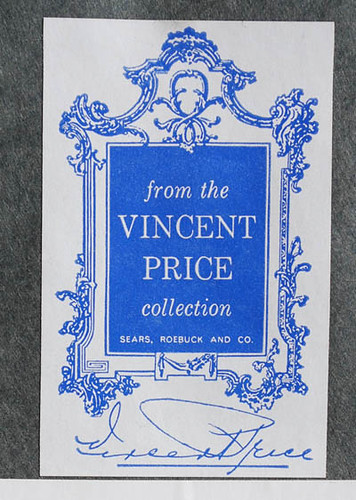
That reminds me that from 1962-1971, Sears sold art (typically prints) by famous artists, including Rembrandt, under the aegis of the cultured horror movie legend Vincent Price.

The retired Sears executive who taught my Marketing 101 course at UCLA's MBA school in 1980, George Struthers, was the man who signed the horror movie star to the deal. 
Vincent Price Collection of Fine Art 
Sears label
In 1962, ...Sears set out to end this isolation by merchandising art throughout the country, in a presentation from which pictures could be readily purchased to enrich American homes. Vincent Price was approached to take charge of this program. Price, although well-known by the public as an actor, was also known in the international art world as a collector, lecturer, former gallery-owner and connoisseur who spent a dozen years studying art at Yale, the University of London and other art centers abroad. 
Price was given complete authority to acquire any works he considered worthy of selection. He searched throughout the world for fine art to offer through Sears. He bought whole collections and even commissioned artists, including Salvador Dali, to do works specifically for this program. 
At first, the idea of a large merchandising organization, such as Sears, maintaining a serious, top-quality art collection met with skepticism. But the public - and the artists themselves - soon learned that Sears would not compromise with good taste or artistic quality. 
On October 6, 1962, the first exhibit and sale of "The Vincent Price Collection of Fine Art" took place in a Sears store in Denver, Colo. Original works of the great masters - Rembrandt, Chagall, Picasso, Whistler and more - as well as those of the best contemporary artists at the time were offered for sale in this first exhibit and throughout the program's existence. 
Items ranged in selling price from $10 to $3,000. Sears customers could also purchase items on an installment plan for as little as $5 down and $5 a month. 
Each work in the program was guaranteed as an original work of quality, just as Sears offered quality guarantees on its lawnmowers and TVs. The program was an instant success. So many pictures were snatched up the first day that an emergency shipment had to be flown in lest the walls be bare the next day. 
P. 370 of Sears Catalog
The program expanded in the weeks that followed, adding exhibits in 10 additional Sears stores including Hartford, Conn., Harrisburg, Penn., San Diego, Calif., Evansville, Ind., Madison, Wis., and Oklahoma City, Okla. After the successful exhibition and sale of these first 1,500 pieces, the program was expanded nationwide to all of Sears stores throughout the country, bringing original works of fine art to the American public in unprecedented quantity and quality. 
Works from the collection were also offered for sale through a special catalog in 1963 and 1964. In 1966, the Sears Vincent Price Gallery of Fine Art was opened in Chicago, Ill., providing a mass audience for talented, but less well-known, young artists. The collection also held temporary exhibits in several hundred communities throughout the country and permanent galleries operated in several cities. 
By 1971, when the program ended, more than 50,000 pieces of fine art passed through a constantly changing collection into American homes and offices.

Professor Struthers said Sears had a good run with it, but eventually had to call it off because by the 1970s, the price of the quality of art that Vincent Price was willing to put his name behind had inflated to way out of the range of Sears shoppers.

How authentic were these pieces? In the page from the Sears catalog above, the signed and numbered Picasso lithograph of a bull for $560 seems plausible, but the $800 Picasso oil painting of 12 square feet in a gold leaf frame sounds a little too good to be true if you are expecting Pablo to have personally put every daub of paint on a canvas coming out of his atelier.

Here's Price's daughter's* description of her father's business partnership with Sears. Price said this was his chance to democratize art collecting for the American public by putting to use all the tricks he'd learned over the years to scrimp when buying decent quality art. That attitude seems incredibly foreign to art collecting today, which is dominated by the conspicuous consumption of the ultra-rich with almost everybody else having lost interest in the subject.

Here's the training film Vincent did for Sears salesmen:
----
Yeah, I know what you are wondering, but Price had a child by each of his first two wives, and a third wife (no children).

Sticking the boot into Bloomberg again

Over the years, I've given Michael Bloomberg a hard time. Why? Well, the billionaire New York City mayor who likes to claim that he has "the seventh-largest army in the world" seems like a worthy foe.

One of Bloomberg's boasts has been that, based on rising test scores, he had fixed the New York City public schools: a few years ago, 82% of NYC students scored proficient or advanced in math! 

This braggadocio contributed to his political foes in Albany deciding to toughen the tests, with predictable results. From the NYT:
At their peak, in 2009, 69 percent of city students were deemed proficient in English, and 82 percent in math, under less stringent exams. After concluding the tests had become too easy, the state made them harder to pass in 2010, resulting in score drops statewide. ... Last year, ... 47 percent of city students passed in English, and 60 percent in math.
This year, New York State revamped the tests even more radically. ... 
In New York City, 26 percent of students in third through eighth grade passed the state exams in English, and 30 percent passed in math, according to the New York State Education Department. 

Kevin Drum points out that on the federal NAEP test, NYC is down slightly relative to the average big city over the last few years.
Statewide, 16 percent of black students and 18 percent of Hispanic students passed English exams, compared with 40 percent of white students and 50 percent of Asians.

There must be something uniquely peculiar about New York since the test score hierarchy turned out to be Asian: white: Hispanic: black. Who has ever seen that ranking before?
The exams were some of the first in the nation to be aligned with a more rigorous set of standards known as Common Core, which emphasize deep analysis and creative problem-solving. ... 

By the way, does anybody have an informed opinion on Common Core tests, which are currently slated to go into operation in another 44 states?

No Comment

From the NYT:
OP-ED CONTRIBUTOR 
Diversity and ‘Doctor Who’ 
By JENNIFER FINNEY BOYLAN

BELGRADE LAKES, Me. — YOU could hear the sighs of disappointment spreading across the nerd-universe on Sunday when the BBC announced, with much fanfare, that the Scottish actor Peter Capaldi would be the new star of “Doctor Who.”

For those readers who did not get beaten up in high school, “Doctor Who” is a beloved British sci-fi series about a character called the Doctor — a Time Lord who travels through space and time to battle evil. Thanks to a clever plot twist, the Doctor is able to regenerate into a new body whenever a mortal would die (or whenever an actor grows tired of the gig). As a result, the role has been played by 11 different men since the show went on the air in 1963. The current Doctor, Matt Smith, is stepping down this Christmas, and many fans had hoped that this time, a dozen cycles in, the Doctorship would finally go to a woman. 
Mr. Capaldi is a capable actor, and come his debut, I’ll be right there with my teenage boys, drinking Mountain Dew and cheering him on. But imagine if we were cheering for Helen Mirren instead, or for the comedian Miranda Hart, or for Emma Watson, the former Hermione Granger. If the Doctor can regenerate into any form, it seems, oh, just a little dispiriting, that time after time he invents himself as a white British male. 
As the news rolled out, I was reminded of the sinking feeling I had back in 2005, when the Vatican introduced Joseph Ratzinger as the new pope. No one, of course, expected a female pope, but after the long years of John Paul II’s sad decline, plenty of Catholics were hoping for at least a breath of fresh air. Benedict XVI may have been a lot of things, but fresh wasn’t one of them. It’s too soon to know about the new Pope Francis, but his recent comment about homosexuality (“If someone is gay and he searches for the Lord and has good will, who am I to judge?”) certainly got my attention. 
Maybe it was the election of Barack Obama that made it seem, fleetingly, as if there were no more glass ceilings, for offices from president to pontiff. While the president’s golden aura has dimmed considerably since 2008, the fact that an African-American occupies the highest elected office in the country remains a source of pride. Whether the 45th president is a woman (Hillary Rodham Clinton?) or a Latino (Marco Rubio?), it still feels, on a good day, as if we’ve entered a time when there are fewer limits on what men and women can aspire to. 
As a transgender woman, I was incredibly proud when, in 2010, Amanda Simpson became one of the first transgender people appointed by a president to an administrative position (a senior technical adviser in the Bureau of Industry and Security). In 2008, Joy Ladin became the first openly transgender professor to teach at Yeshiva University. While I have no skills in either industry or security, and I can barely explain the differences between Orthodox and Conservative Judaism, Ms. Simpson and Ms. Ladin’s accomplishments meant the world to me. Their triumphs felt, in a small way, as if they belonged to me, too. 
Still, I suspect that some institutions continue to view diversity as they view cholesterol — there’s a good kind and a bad kind. I attended a meeting of college department heads some years ago in which I, among other campus leaders, was urged by a dean to recruit faculty members from more “underrepresented groups.” I had to ask: “What kind of diversity are we talking about? Are you really telling me you want more transgender men and women?” There was, unsurprisingly, a little ripple of laughter in the room, as if the very idea of a community needing more people like me was amusing. The dean, to his credit, said: “Yes. We want everybody.” 
My grandfather, James Owen Boylan, never lived to see an Irish Catholic become president. But his great-grandchildren live in a world where an African-American is president and a pope speaks of gay people with what sounds like compassion. That’s progress. 
But unlike presidents or popes, we may not get that many more chances at a glass-shattering Doctor. According to long-held Doctor Who mythology, the character’s 13th regeneration could be his last. A few years back, the BBC overturned that theory, suggesting that the character is immortal. Regardless, even the most die-hard fans can’t expect the show to last forever. As the producers think about whom they want to take on the role next, they should keep in mind the way people’s hopes are lifted when they see someone breaking the glass ceiling, even when it’s for something as seemingly trivial as a hero on a science-fiction program. Equal opportunity matters — in Doctor Who’s universe as well as our own. 
Jennifer Finney Boylan, a professor of English at Colby College, is the author of “Stuck in the Middle With You: A Memoir of Parenting in Three Genders.”

A Confederacy of Whores v. D.A. King

The New York Times profiles former VDARE.com contributor D.A. King:
National Push by a Local Immigration Activist: No G.O.P. Retreat 
By JULIA PRESTON 
ATLANTA — He says the United States is filling up with immigrants who do not respect the law or the American way of life. He refers to Latino groups as “the tribalists,” saying they seek to impose a divisive ethnic agenda. Of his many adversaries, he says: “The illegal alien lobby never changes. It’s the Wall Street wing of the Republican Party joining forces with the Chamber of Commerce, the far left and the Democrats in an effort to expand cheap labor and increase voting for the Democratic Party.”

As Jonathan Swift might have said if he were alive today: "When a true patriot appears in the nation, you may know him by this sign, that the whores are all in confederacy against him."
D. A. King, who quit his job as an insurance agent a decade ago to wage a full-time campaign against illegal immigration in Georgia, is one reason this state rivals Arizona for the toughest legal crackdown in the country. With his Southern manners and seersucker jackets, he works the halls of the gold-domed statehouse, familiar to all, polite and uncompromising. 
Now, like other local activists around the country, he is looking beyond Georgia to stop the House of Representatives from following the Senate and passing legislation that would open a path to legal status for illegal immigrants. 
As lawmakers return to their home districts for the August recess, advocates like Mr. King are joining forces with national groups that oppose legalization and favor reduced immigration for an all-out populist push. ...
The zeal of militants like Mr. King is a problem for the House speaker, John A. Boehner of Ohio, and other Republican leaders, who are hoping to steer their divided caucus to pass a House version of legislation to fix the broken immigration system, which could include legal status for those who lack it — though probably not citizenship. 
Mr. King’s “respectful but firm” message for the speaker, he said in an interview, is that “any vote for legalization would be a matter of very great consequence for the people who voted for conservative congressmen from Georgia.” 
Mr. King says his wrath grew slowly, beginning in the 1990s with a feud with Mexican neighbors who disrupted the quiet of his leafy street. In Mr. King’s account, they parked fleets of run-down vehicles on their lawn and at one point housed 22 people in a jerry-built warren of rental rooms in the basement. 
He took the neighbor to court over code violations, and the conflict boiled for seven years until the family moved away. 
A visit in 2004 to the Southwest border convinced Mr. King that the country was facing “what was easily described as an invasion.” Returning to Georgia, he made common cause with the struggling father of a teenage boy killed in a car accident by a reckless driver who was an illegal immigrant. He named his organization the Dustin Inman Society, after the boy. 
... He nonetheless spared little in his description of Senator Marco Rubio, the Florida Republican who was one of the authors of the Senate bill, calling him a “smarmy and dishonest” turncoat. During the Senate debate, Mr. King designed and paid for thousands of bumper stickers as well as three large billboards along a commuter highway near Atlanta. 
“Help us stop RubiObama amnesty!” one big sign read, with President Obama’s name joined by his hallmark red-white-and-blue letter to that of Senator Rubio.
His billboards instructed drivers to call a senator from Georgia, Johnny Isakson. Mr. Isakson, who supported a comprehensive bill in 2007, voted against the Senate legislation this year. 
In Georgia, Mr. King has not been afraid to take on many adversaries, including the farmers and growers, business organizations, labor unions and Latinos. A big-shouldered former Marine, he often shows up with his own placards at rallies called by his opponents — just to let them know he is watching. 
“I was taught that we have an American culture to which immigrants will assimilate,” Mr. King said. “And I am incredibly resentful that’s not what’s happening anymore.” 
Mr. King, 61, runs his one-man operation from the small guest room of his home on a tree-shaded cul-de-sac in the Atlanta suburb of Marietta, equipped with an aging desktop computer and a chair that he acknowledges “needs a new coat of duct tape.” He lives on small donations, and to keep it all going he spent down his savings, ran up his credit cards, refinanced his house three times and “sold the stock my grandmother left me.” 
... Mr. King wants a lot more enforcement before the House does anything else on immigration. He sees the Senate bill as a scheme by Democrats to create legions of new government-dependent voters for their party. He feels certain House Republicans will ultimately reject it. 
“The tribalists will not make any difference with any Republican who has enough sense to get on an airplane every Monday and fly to Washington,” Mr. King said. 
... But Jerry Gonzalez, a Latino leader in Georgia who is one of Mr. King’s oldest rivals, pointed to new demographics that House lawmakers would have to consider. The number of registered Latino voters in the state grew to 184,000 in 2012 from 10,000 a decade earlier, with more than 200,000 legal immigrants eligible to become citizens. 
“If the Republican Party gets stuck with D. A. King and his extremist xenophobic narrative, they are setting themselves up for future failure,” said Mr. Gonzalez, executive director of the Georgia Association of Latino Elected Officials, or Galeo. 
Iron-Eyes Boehner,
chief of the Oompa-Loompa tribe

Louis XIV had inscribed on his cannons "The final argument of kings." Electing a new people is the final argument of the confederacy of whores. And absolutely none of them feel the slightest shame about importing ringers to win American elections.
One worrisome sign for Mr. King is that his donations are not increasing. But he is forging ahead, putting up new billboards on Georgia highways — and planning one with the face of John Boehner.

How is George Zimmerman white and this guy isn't?

Nonwhite Hispanic

In Reality TV news, the Hollywood Reporter announces a major breakthrough for diversity:
ABC Names First Non-White 'Bachelor' 
The next Bachelor has been revealed, and he represents a milestone for the ABC reality show. 
Host Chris Harrison announced Monday night that former Bachelorette suitor Juan Pablo Galavis will star in the next edition of ABC's The Bachelor.
Nonwhite Hispanic's mom

An ABC spokesperson confirmed to The Hollywood Reporter that the fan favorite -- a 32-year-old former soccer player from Venezuela now living in Miami -- will become the first non-Caucasian Bachelor or Bachelorette in franchise history.
There have been a total of nine Bachelorettes; Juan Pablo is the 17th Bachelor in 18 seasons, as Brad Womack starred on the show twice. 
While the franchise has featured a handful minorities as suitors -- African-American Will Reese also appeared on Desiree Hartsock's season, which just wrapped Monday night -- ABC and producer Warner Horizon TV have previously been accused of violating racial discrimination laws. 
A group of Nashville residents led by Nathaniel Claybrooks and Christopher Johnson brought a class-action lawsuit last year, alleging that the roles of the Bachelor and Bachelorette on the hit reality series have failed to feature non-white cast members and that civil rights law "plainly prohibits whites from refusing to contract with African Americans because of their race." 
The defendants pointed to the First Amendment as a bar against such claims. In October, a federal judge agreed and threw out the lawsuit. 
White Hispanic
Juan Pablo had been one of 25 men competing for Desiree's hand during the most recent season of The Bachelorette. He is a single father to a 4-year-old girl named Camila.

A reader asks, "How is this guy white and George Zimmerman isn't?"

Silicon Valley wants its own tame black President

With Barack Obama having Wall Street's back over the last five years (i.e., virtually no prosecutions for the events leading up to 2008), it's only natural that Silicon Valley leaders have been thinking about getting their own tame black President, too: namely, Cory Booker, a former Stanford football player, whose job as mayor of Newark makes it easy for him to hit the national broadcasts out of New York City. 

I haven't paid too much attention to Booker, but he seems like a more energetic and prepossessing personality than Obama, so the notion seems plausible that in a country with a large demand for black Presidents but a small supply of plausible ones, Booker would be worth investing money in.

Booker, a Democrat, is Plutocrat Friendly. In 2012 he even attacked the Obama campaign's attacks on Mitt Romney's private equity fortune, which the Romney campaign greatly appreciated.

A never-married 44-year-old, Booker is vaguely rumored either to have a white girlfriend in Brooklyn or to be gay. (Wikipedia has up a picture of him with his arm around Oprah's Friend Gayle, who is described as Booker's "long time friend" -- Oprah, by the way, is affiliated with Waywire). So it will be interesting to see what he does on the matrimonial front.

The NYT reports:
Mr. Booker personally has obtained money for the start-up, called Waywire, from influential investors, including Eric E. Schmidt, Google’s executive chairman. A year after its debut, Waywire has already endured a round of layoffs and had just 2,207 visitors in June, according to Compete, a Web-tracking service. The company says it is still under development. 

In June, I got more well over two orders of magnitude more unique visits.
Yet in a financial disclosure filed last month, Mr. Booker, 44, revealed that his stake in the company was worth $1 million to $5 million.

Woo-hoo! My 100% stake in iSteve must be worth a couple of orders of magnitude more than Booker's fractional stake, right? I mean, it's simple arithmetic. Oh ... except, I'm not Presidential Timber. Never mind.
Taken together, his other assets were worth no more than $730,000. 
That revelation, with just a week left in Mr. Booker’s campaign for the Democratic nomination for the United States Senate, shows how a few tech moguls and entrepreneurs, many of them also campaign donors, not only made a financial bet on the mayor’s political future but also provided the brainpower and financing to help create a company that could make him very rich. 
Waywire has also provided jobs for associates of Mr. Booker: the son of a top campaign supporter and his social media consultant, who is now on his Senate campaign staff. 
The company has a goal: making it easy to “collect, curate and share” videos from across the Web. But much about its operations and Mr. Booker’s role as chairman appears ill defined. 
Mr. Booker declined to answer questions about the details of Waywire’s finances, including what percentage of the company he currently owns. A spokesman said Mr. Booker had invested some of his own money in the company but refused to say how much. 
... The value of his shares could rise significantly, analysts say, should the company outrace competitors now puzzling over how to let users sift through the billions of Web video clips to find those that they want to watch. “Curation is the next big thing to happen to video,” said James L. McQuivey of Forrester Research.

Off topic, but I only vaguely get this whole "curation" mania. I don't recall dreaming when I was a little boy that I would grow up to be a museum curator. I was more into my Classic Comics about Frank "Bring 'Em Back Alive" Buck, a famous zookeeper who had many adventures capturing tigers and king cobras. Is "curation" like the urge to create a mix tape in order to try to inflict your musical tastes on others?
Mr. Booker has made a national reputation in seven years as the chief executive of Newark, New Jersey’s largest city and one of the country’s poorest. But his involvement in founding, financing and promoting a private business highlights the significance of his other constituency in the tech industry, which is seeking a bigger voice in national policy in Washington. ...
This spring, the widow of Steve Jobs, Laurene Powell Jobs, and the power couple Marc Andreessen and Laura Arrillaga-Andreessen held a fund-raiser for him.
And as a social media enthusiast, with more than 30,000 Twitter posts, Mr. Booker has cast himself as an ambassador between the high-tech world and his beleaguered city. His aides noted that he had leveraged his relationships to Newark’s benefit, including a pledge of $100 million to the city’s schools from Mark Zuckerberg, the Facebook founder. 
... Ms. Ross suggested in an interview that she saw in Mr. Booker a kindred social media spirit. She said she has wondered how the civil rights movement might have been different had the Rev. Dr. Martin Luther King Jr. had access to Twitter. 
... There is no question, however, that Mr. Booker’s star power has brought attention: Mr. Booker impressed an audience at the South by Southwest conference in March in Austin, Tex., in which he touted Waywire as a way to empower the politically disenfranchised. Other celebrity connections have helped the company: Waywire has put Andrew Zucker, 14, the son of Jeff Zucker, president of CNN, on its advisory board and given him stock options.

Andrew Zucker is politically disenfranchised because he won't be able to vote for four more years, so it's only right and fitting that he get some stock options.

August 6, 2013

Fiat Citizenship

From my new column in Taki's Magazine:
In the immigration debate, the conventional wisdom is that the solution to millions of “undocumented workers” is for the government to print up documents for them. ... 
Unfortunately, while people can learn from painful experiences, we’re not very good at drawing analogies. It ought to be readily apparent that Marco Rubio’s push to print up documents for millions of undocumented illegal aliens and tens of millions of new immigrants is similar to the discredited Juan Peron / Salvador Allende / Robert Mugabe school of economic management by printing up more money.

Read the whole thing there.

Zuckerberg's big immigration speech

The Daily Mail reports:
'Immigrants will be the job creators of tomorrow': Facebook's Mark Zuckerberg goes public with backing of immigration reform 
Made his remarks at San Francisco screening of documentary by activist and journalist Jose Antonio Vargas 
Disputed the notion that Silicon Valley leaders are just trying to secure more H1B visas for high-tech workers 
He said U.S. needs to embrace immigrants if it is to get ahead economically 
He has been teaching entrepreneurship classes and is saddened by limited further education opportunities for his students without documentation 
Facebook CEO Mark Zuckerberg spoke out publicly for the first time on Monday in favor of immigration reform, an issue he's been working on behind the scenes for several months. 
The 29-year-old billionaire made his remarks in San Francisco at the debut screening of 'Documented,' an autobiographical documentary by activist and journalist Jose Antonio Vargas.

Jose Antonio Vargas is the first Mexican illegal alien the media has been able to discover in many years of trying with adequate journalistic / self-publicizing talent. Not surprisingly, he's gay. More surprisingly, the Establishment couldn't even find an actual Mexican. Vargas is Filipino.
Wearing his trademark hoodie and sneakers, Zuckerberg disputed the notion that he and other Silicon Valley leaders are just trying to secure more H1B visas for high-tech workers. 
'This is something that we believe is really important for the future of our country - and for us to do what's right,' Zuckerberg told several hundred attendees, including House Minority Leader Nancy Pelosi and San Francisco Mayor Ed Lee, at the Yerba Buena Center for the Arts. 
Zuckerberg and his former Harvard University roommate Joe Green recently founded the organization Fwd.us to advocate for a pathway to citizenship for nearly 11 million immigrants living in the U.S. illegally.

... The Facebook Inc. founder said he first became aware of the need to change the immigration system while volunteering to teach a class on entrepreneurship at a Menlo Park school. Many of the students had been brought into the U.S. illegally.
'No matter where they were born, (these students) are going to be tomorrow's entrepreneurs and people creating jobs in this country,' he told the audience. 

Granted, their legal uncles and great-uncles who have been living in California for generations haven't done much in Silicon Valley, but everything is going to change right now. After all, what do I, Mark Zuckerberg, personally want more than more competition? If only they were legalized, Mexican illegal aliens will kick my ass in the tech marketplace, and what do I like more than losing money?
Of Jewish extraction, Zuckerberg's interest in immigration stems from the fact that his own great-grandparents arrived as immigrants via Ellis Island, to America, coupled with his experience teaching entrepreneurship at an after-school program. ... 
'My great-grandparents came through Ellis Island.  
'My grandfathers were a mailman and a police officer.  
'My parents are doctors. I started a company.  
'None of this could have happened without a welcoming immigration policy, a great education system and the world’s leading scientific community that created the internet.' 

See, I'm not making this up about Ellis Island Schmaltz.
At the top of the Fwd.us website it explains in bite-sized facts just why immigration is important to the future of America and reminds users that: '40 per cent of Fortune 500 companies were founded by immigrants or their children'

Fortune 500 firms? Where were they immigrants from? Aberdeen?
and that '57% of engineering grad students are immigrants. Many will have to leave if we don’t pass comprehensive immigration reform.'
Zuckerberg also called for higher standards and accountability in schools and increased focus on learning about science, technology, engineering and maths.
Today's knowledge and ideas-based economy, the 28-year-old Harvard dropout wrote, is very different from the economy of the 20th century that was based on natural resources, industrial machines and labor.

So, let's legalize the illegals so they can start inventing lots of new high tech.

Great art projects: The Modigliani Heads

As art techniques and technology developed over the centuries, the emphasis in art appreciation has shifted from celebrating the making of beautiful objects, which are now commonplace, to celebrating the conceiving of clever art projects. Admired art projects tend to comment upon art and/or be disturbing.

Of course, there is one type of unsettling art project that comments upon art that the art world is uncomfortable with, but that I find most interesting.

From a 1984 People article:
When the project began in July, it had the makings of a treasure hunt. That was when dredging started in the fosso reale ("royal ditch"), a junk-strewn canal in Livorno, Italy. Commissioned by the city council at a cost of $35,000, the dredge was sifting through seven feet of mud, in search of several sculpted stone heads. As legend told it, the heads had been deep-sixed 75 years ago by a hometown boy, the artist Amedeo Modigliani [1884-1920], in a fit of pique over his friends' criticism of the works. ... 
In her favor was the fact that only 26 Modigliani sculptures are known to exist. That is the more surprising because Modigliani, most readily recognized for his portraits of languid, long-nosed women, loved sculpting above all else. III health (he died in 1920 at 35 of tuberculosis and the effects of alcohol and hashish) forced him to trade his chisel for a brush. Thus the unearthing of additional sculptures would be a major event in the international art world. It would be especially important to Italy, which possesses few of his paintings and not one of his sculptures.  
DurbĂ©'s goal was to find the works in time for the 100th anniversary of Modigliani's birth this year. Many problems had to be solved. For instance, might the dredge's metal claws harm the sculptures? (The answer: rubber covering over the tips.) Work finally got underway on July 17. 
As hundreds looked on, the canal began to surrender an array of artifacts: several guns, a rocking horse, bicycles and fittings for a complete bathroom. At 9 a.m. on July 24 the first carving was found, then, eight hours later, a second. A third was retrieved August 9. Slightly smaller than the others, it measured 15 by 11 inches. When DurbĂ© saw them, she wept.  
Art experts rushed to Livorno. Critic Cesare Brandi called the find "very important and certainly Modiglianis." Jean Leymarie, director of the noted French Academy in Rome, pronounced them "a resurrection." The sculptures, dubbed Modi 1, 2 and 3, were disinfected and cleaned. Numbers 1 and 2 were promptly added to the show DurbĂ© had mounted in the Livorno museum for the Modigliani centenary. The works were reputedly insured for nearly $1.5 million. The city was euphoric.  
The joy, alas, was short-lived. Six weeks later the Italian weekly Panorama ran an article entitled The Livorno Hoax, in which three university students confessed to carving Modi 2 and throwing it into the canal. They said they made it in two afternoons, using a chisel, a screwdriver and a Black & Decker electric drill, copying the design from an illustration in DurbĂ©'s museum catalogue. They had chips of stone and photos to prove it. The boys claimed it was just a prank. "We thought, 'Why not help them find something?' " explained one. "It's not our fault so many people made a mistake."  
DurbĂ© was incredulous. She called the students "puppets being manipulated by someone," perhaps the Mafia or a political group. The critics supported her. The boys disputed that notion in a three-hour television special during which they created yet another fake "masterpiece."  
Oh, well, the canal had yielded two other Modiglianis, right? Wrong. Last month a Livorno dockworker (and ex-art student) named Angelo Froglia revealed himself to be the perpetrator of Modis 1 and 3. His purpose: "To reveal the false values of art critics and mass media." Compounding the insult, Froglia not only had a videotape of himself at work on the carvings but also provided a recipe for faking a Modigliani head: Find an old paving stone. Chip it about a bit, then marinate in Livorno mud, scouring powder and hydrochloric acid. Cook the stone slowly on a hot grill. Throw it in the Livorno canal late at night. Leave stone—and art critics—to stew until ready.  
Feeling well roasted, the critics admitted they had been carried away by the euphoria in Livorno. "We love Modigliani too much," said one. "This led us to betray ourselves." In the end the embattled museum curator salvaged only one small consolation. Because of the controversy, the exhibit attracted more than 40,000 visitors during its 10-week run, earning the museum and the city a $35,000 profit over the cost of dredging. "I don't feel at all diminished by this affair," DurbĂ© says bravely. "I fought for this and I would do it again." 
Actual Modigliani head

In fairness, a lone critic at the time vociferously doubted the dredged-up heads' authenticity and said that if they truly had been made by Modigliani, they were so bad that he was right to have thrown them in the canal.

So, the art world is really not all one big hoax. There actually are people who know what they are talking about, and most famous artists are quite skilled.

But, hoaxes and forgeries may well be the most interesting art projects going on in the art world in recent decades. But they appeal more to philosophers (e.g., the late Dennis Dutton) and to the People-reading public than to the big money art world, which find them distasteful and undermining. It's crucial to them for their rich clients not to worry much about whether their latest purchase is a genuine saint's relic artwork by a famous artist.

Epstein: The Sports Gene(s)

Here's a level-headed sounding new book by a Sports Illustrated writer:
The Sports Gene: Inside the Science of Extraordinary Athletic Performance
by David Epstein 
In high school, I wondered whether the Jamaican Americans who made our track team so successful might carry some special speed gene from their tiny island. In college, I ran against Kenyans, and wondered whether endurance genes might have traveled with them from East Africa. At the same time, I began to notice that a training group on my team could consist of five men who run next to one another, stride for stride, day after day, and nonetheless turn out five entirely different runners. How could this be? 
We all knew a star athlete in high school. The one who made it look so easy. He was the starting quarterback and shortstop; she was the all-state point guard and high-jumper. Naturals. Or were they? 
The debate is as old as physical competition. Are stars like Usain Bolt, Michael Phelps, and Serena Williams genetic freaks put on Earth to dominate their respective sports? Or are they simply normal people who overcame their biological limits through sheer force of will and obsessive training? 
The truth is far messier than a simple dichotomy between nature and nurture. In the decade since the sequencing of the human genome, researchers have slowly begun to uncover how the relationship between biological endowments and a competitor’s training environment affects athleticism. Sports scientists have gradually entered the era of modern genetic research. 
In this controversial and engaging exploration of athletic success, Sports Illustrated senior writer David Epstein tackles the great nature vs. nurture debate and traces how far science has come in solving this great riddle. He investigates the so-called 10,000-hour rule to uncover whether rigorous and consistent practice from a young age is the only route to athletic excellence. 

He cites Donald Thomas, a basketball player from the Bahamas, who took up high-jumping in early 2006 and won the World Championship in the summer of 2007. Still, for more complicated sports, the 10,000 hour rule seems reasonable. Of course, as Epstein emphasizes, 10,000 hours of practice is not sufficient. LeBron James is going to be better at you than basketball no matter how much you practice.
Along the way, Epstein dispels many of our perceptions about why top athletes excel. He shows why some skills that we assume are innate, like the bullet-fast reactions of a baseball or cricket batter, are not, and why other characteristics that we assume are entirely voluntary, like an athlete’s will to train, might in fact have important genetic components. 
This subject necessarily involves digging deep into sensitive topics like race and gender. Epstein explores controversial questions such as: 
Are black athletes genetically predetermined to dominate both sprinting and distance running, and are their abilities influenced by Africa’s geography? 
Are there genetic reasons to separate male and female athletes in competition? 
Should we test the genes of young children to determine if they are destined for stardom? 
Can genetic testing determine who is at risk of injury, brain damage, or even death on the field? 

Epstein claims there's a high correlation between football players getting brain damage and one allele of one gene. If true, it would make sense to have your son genetically tested before allowing him to play football.
Through on-the-ground reporting from below the equator and above the Arctic Circle, revealing conversations with leading scientists and Olympic champions, and interviews with athletes who have rare genetic mutations or physical traits, Epstein forces us to rethink the very nature of athleticism.

Here's an interview with Epstein.

It sounds rather like Jon Entine's 2001 book Taboo: Why Black Athletes Dominate Sports And Why We're Afraid To Talk About It, but recast somewhat for the self-help genre.

He says that in a test of simple reaction times, slugger Albert Pujols, three-time National League MVP, only scored at the 66th percentile compared to Washington U. of St. Louis undergrads. I don't know exactly what to make of this, but I've always found Arthur Jensen's work on reaction times doesn't map all that well to what's observable in sports. Clearly, there must be some complicated wrinkles to fully understanding reaction times that I've never managed to get clear in my head.

CNN: Here's a giant Marco McMillian story with no new news!

From CNN last month, the opening of an 18-page article:
Mysterious Mississippi murder stokes suspicions bred by an ugly past  
Beaten. Dragged. Burned. 
The words leave attorney Daryl Parks' lips like a barrage of gunfire in the sanctuary of Chapel Hill Missionary Baptist Church, where people have gathered not for prayer but for answers. 
Some wear "Justice for Marco" T-shirts. They are enraged over the investigation into the death of Marco McMillian, a young black gay mayoral candidate, whose broken body was discovered dumped downhill from a Mississippi River levee on February 26. 
Parks' words suggest the most heinous of murders. Here in the Mississippi Delta, they conjure even more: a chilling history of racial hatred.

Except that back in February a blood-covered young black man named Lawrence Reed, who was driving McMillian's stolen car, confessed to multiple witnesses that he had just murdered McMillian with his wallet chain.

They just can't admit defeat, can they?

What's next? A Michael Moore documentary about the Oberlin KKK rally?

NYT: "Bush drive for home ownership fueled housing bubble"

For six years, I've been pointing out that the mortgage meltdown of 2007 that kicked off the great recession of 2008 was tied to George W. Bush's successful 2002-2004 push to make mortgages easier for minorities to obtain. But if you Google "White House Conference on Increasing Minority Homeownership," there's not much interest in Bush's role. The first two hits are government archives, and the third is my 9/24/2008 post of Bush's 10/15/2002 speech at his conference. 

Interestingly, though, the sixth hit is a New York Times article from two months later that I'd never seen before, which closely follows and validates much of my argument:
Bush drive for home ownership fueled housing bubble 
By Jo Becker, Sheryl Gay Stolberg and Stephen Labaton 
Published: Sunday, December 21, 2008 
WASHINGTON — "We can put light where there's darkness, and hope where there's despondency in this country. And part of it is working together as a nation to encourage folks to own their own home." 
- President George W. Bush, Oct. 15, 2002 
... Eight years after arriving in Washington vowing to spread the dream of home ownership, Bush is leaving office, as he himself said recently, "faced with the prospect of a global meltdown" with roots in the housing sector he so ardently championed. 
There are plenty of culprits, like lenders who peddled easy credit, consumers who took on mortgages they could not afford and Wall Street chieftains who loaded up on mortgage-backed securities without regard to the risk. 
But the story of how the United States got here is partly one of Bush's own making, according to a review of his tenure that included interviews with dozens of current and former administration officials. 
From his earliest days in office, Bush paired his belief that Americans do best when they own their own homes with his conviction that markets do best when left alone. Bush pushed hard to expand home ownership, especially among minority groups, an initiative that dovetailed with both his ambition to expand Republican appeal and the business interests of some of his biggest donors. But his housing policies and hands-off approach to regulation encouraged lax lending standards. 
Bush did foresee the danger posed by Fannie Mae and Freddie Mac, the government-sponsored mortgage finance giants. The president spent years pushing a recalcitrant Congress to toughen regulation of the companies, but was unwilling to compromise when his former Treasury secretary wanted to cut a deal. And the regulator Bush chose to oversee them - an old school buddy - pronounced the companies sound even as they headed toward insolvency. 
As early as 2006, top advisers to Bush dismissed warnings from people inside and outside the White House that housing prices were inflated and that a foreclosure crisis was looming. ...
And both Paulson and his predecessor, John Snow, say the housing push went too far. 
"The Bush administration took a lot of pride that home ownership had reached historic highs," Snow said during an interview. "But what we forgot in the process was that it has to be done in the context of people being able to afford their house. We now realize there was a high cost." 
For much of the Bush presidency, the White House was preoccupied by terrorism and war; on the economic front, its pressing concerns were cutting taxes and privatizing Social Security, a government retirement and disability benefits program. The housing market was a bright spot: Ever-rising home values kept the economy humming, as owners drew down on their equity to buy consumer goods and pack their children off to college. 
Lawrence Lindsay, Bush's first chief economic adviser, said there was little impetus to raise alarms about the proliferation of easy credit that was helping Bush meet housing goals. 
"No one wanted to stop that bubble," Lindsay said. "It would have conflicted with the president's own policies." 
Today, millions of Americans are facing foreclosure, home ownership rates are virtually no higher than when Bush took office, Fannie and Freddie are in a government conservatorship, and the bailout cost to taxpayers could run in the trillions of dollars. 
As the economy has shed jobs - 533,000 last month alone - and his party has been punished by irate voters, the weakened president has granted his Treasury secretary extraordinary leeway in managing the crisis. 
... Darrin West could not believe it. The president of the United States was standing in his living room. It was June 17, 2002, a day West recalls as "the highlight of my life." Bush, in Atlanta to introduce a plan to increase the number of minority homeowners by 5.5 million, was touring Park Place South, a development of starter homes in a neighborhood once marked by blight and crime. 
West had patrolled there as a police officer, and now he was the proud owner of a $130,000 town house, bought with an adjustable-rate mortgage and a $20,000 government loan as his down payment - just the sort of creative public-private financing Bush was promoting. 
"Part of economic security," Bush declared that day, "is owning your own home." 
A lot has changed since then. West, beset by personal problems, has left Atlanta. Unable to sell his home for what he owed, he said, he gave it back to the bank last year. Like other communities across the United States, Park Place South has been hit with a foreclosure crisis affecting at least 10 percent of its 232 homes, according to Masharn Wilson, a developer who led Bush's tour. "I just don't think what he envisioned was actually carried out," she said. 
Park Place South is, in microcosm, the story of a well-intentioned policy gone awry. Advocating home ownership is hardly novel; Bill Clinton's administration did it, too. For Bush, it was part of his vision of an "ownership society," in which Americans would rely less on the government for health care, retirement and shelter. It was also good politics, a way to court black and Hispanic voters. 
But for much of Bush's tenure, government statistics show, incomes for most families remained relatively stagnant while housing prices skyrocketed. That put home ownership increasingly out of reach for first-time buyers like West. 
So Bush had to, in his words, "use the mighty muscle of the federal government" to meet his goal. He proposed affordable housing tax incentives. 
He insisted that Fannie Mae and Freddie Mac meet ambitious new goals for low-income lending. 
Concerned that down payments were a barrier, Bush persuaded Congress to spend as much as $200 million a year to help first-time buyers with down payments and closing costs. 

This bill, which Congress passed in 2004, was largely symbolic, but symbolism is important.
And he pushed to allow first-time buyers to qualify for government insured mortgages with no money down. Republican congressional leaders and some housing advocates balked, arguing that homeowners with no stake in their investments would be more prone to walk away, as West did. Many economic experts, including some in the White House, now share that view. 
The president also leaned on mortgage brokers and lenders to devise their own innovations. "Corporate America," he said, "has a responsibility to work to make America a compassionate place." 
And corporate America, eyeing a lucrative market, delivered in ways Bush might not have expected, with a proliferation of too-good-to-be-true teaser rates and interest-only loans that were sold to investors in a loosely regulated environment. But Bush populated the financial system's alphabet soup of oversight agencies with people who, like him, wanted fewer rules, not more. 
The president's first chairman of the Securities and Exchange Commission promised a "kinder, gentler" agency. The second was pushed out amid industry complaints that he was too aggressive. Under its current leader, the agency failed to police the catastrophic decisions that toppled the investment bank Bear Stearns and contributed to the current crisis, according to a recent inspector general's report. 
As for Bush's banking regulators, they once brandished a chain saw over a 9,000-page pile of regulations as they promised to ease burdens on the industry.  
When states tried to use consumer protection laws to crack down on predatory lending, the comptroller of the currency blocked the effort, asserting that states had no authority over national banks. 
The administration won that fight at the Supreme Court. But Roy Cooper, North Carolina's attorney general, said, "They took 50 sheriffs off the beat at a time when lending was becoming the Wild West."

State laws regarding lending, which tend to be older and less fashionable than federal laws, were generally better. They could make a difference, as the sharp distinction between Pennsylvania (strict regulations, fewer foreclosures) and Ohio (loose regulations, more foreclosures) showed.
The president did push rules aimed at requiring lenders to explain loan terms more clearly. But the White House shelved them in 2004, after industry-friendly members of Congress threatened to block confirmation of his new housing secretary. 
In the 2004 election cycle, mortgage bankers and brokers poured nearly $847,000 into Bush's re-election campaign, more than triple their contributions in 2000, according to the nonpartisan Center for Responsive Politics. The administration did not complete the new rules until last month. 
Today, administration officials say it is fair to ask whether Bush's ownership push backfired. Paulson said the administration, like others before it, "over-incented housing."

Indeed.

August 5, 2013

O'Hehir: Detroit went bankrupt because Republicans hate Smokey Robinson

Salon's movie critic Andrew O'Hehir is one of the more interesting liberal writers around because he notices things: e.g., he was practically the only mainstream film critic to be unsettled by Neill Blomkamp's District 9. O'Hehir is just about the only conventionally liberal film critic who is aware that many top filmmakers aren't conventional liberals. Of course, O'Herir doesn't have anything more intelligent to offer in response than the conventional wisdom of 1975, but he's at least not immune to pattern recognition.
Why the right hates Detroit 
How the fates of two great cities, Detroit and New Orleans, symbolize what's gone wrong with America 
BY ANDREW O'HEHIR

Two great American cities have now faced near-death experiences in the 21st century. While Detroit’s gradual slide into bankruptcy and the almost biblical inundation of New Orleans in 2005 look quite different on the surface, I’m more struck by the similarities. ... Then there’s the obvious but uncomfortable fact that both are cities with large black majorities, in a country where African-Americans are only about 13 percent of the population. 
But Detroit and New Orleans are not just cities where lots of black people happen to live. They are uniquely important and symbolic centers of African-American culture in particular and American culture in general, whose influence spread into every luxury high-rise, every suburban street and every farmhouse in the country. Both cities have been rigidly resegregated now, but at their cultural height both were places of tremendous fusion and ferment. Jazz was born from the children and grandchildren of kidnapped Africans learning to play European instruments for the dance parties of biracial French-speaking aristocrats; Berry Gordy’s great Motown recordings borrowed the Detroit Symphony’s string section to create what he called “the Sound of Young America,” driving white teenagers to shake a tail feather at sock hops across the land. ...
Is it pure coincidence that these two landmark cities, known around the world as fountainheads of the most vibrant and creative aspects of American culture, have become our two direst examples of urban failure and collapse? If so, it’s an awfully strange one.

Why? Why is it "awfully strange" that a local talent for party music correlates with a local lack of skill at administration? Shouldn't even movie reviewers have been introduced to the concept of cultural tradeoffs via Orson Welles' speech in The Third Man about how Switzerland had more civic virtues but fewer artistic accomplishments than Borgia Italy?

As I wrote during Hurricane Katrina:
No, the perfect storm was actually the combination of social and governmental incompetence at local, state, and federal levels—and unmentionable racial reality. 
Republican Presidents are supposed to provide adult supervision for crooked Democratic urban machines. But the White House is now occupied by George W. Bush ... 
The ineptitude displayed by the Louisiana state government is also unsurprising. The state is unique in having a Latin political tradition, ... a culture in which the Argentinean demagogue Juan Peron would have felt at home. 
The unofficial state motto is "Laissez les bons temps rouler" or "Let the good times roll." Compare that to New Hampshire's official motto of "Live free or die," which display a rather different understanding of freedom. Louisiana's reigning philosophy is freedom from responsibility. 
It's a general rule that the tastier the indigenous cuisine, the lousier the government. Its culture has provided America with jazz, A Street Car Named Desire, and the great American comic novel of the 20th Century, A Confederacy of Dunces. New Orleans is a nice place to visit. But you wouldn't want to raise your kids there. 
All this is now common parlance, more or less. What you won't hear, except from me, is that "Let the good times roll" is an especially risky message for African-Americans. The plain fact is that they tend to possess poorer native judgment than members of better-educated groups. Thus they need stricter moral guidance from society.

Black-run polities aren't doomed to failure, but they tend to have a smaller margin for error. Out of about 40 black African countries, Botswana, for example, has been ruled fairly well since independence, with some others improving over time. Others, not so much.
New Orleans itself is two-thirds black. It has had nothing but black mayors since 1978. All four of them are from the light-skinned "creole of color" elite, including the notorious Marc H. Morial, now head of the National Urban League. The city government is corrupt and lackadaisical. While the police department has perhaps rebounded from the depths it reached a decade ago when an officer was condemned to death for having a mother of three rubbed out by drug gangstas in his employ, nobody should be surprised that last week numerous officers ran away, and some even freelanced as looters. 
In a racially diverse democracy like New Orleans, voting for good government takes a backseat to voting for your tribe's representatives in the eternal ethnic tussle over slices of the pie. 

O'Herir goes on:
I’m tempted to propose a conspiracy theory: As centers of African-American cultural and political power and engines of a worldwide multiracial pop culture that was egalitarian, hedonistic and anti-authoritarian, these cities posed a psychic threat to the most reactionary and racist strains in American life. I mean the strain represented by Tom Buchanan in “The Great Gatsby” (imagine what he’d have to say about New Orleans jazz)

Oh, boy, Tom Buchanan again. Someday, I'm going to have to explain the racial emotions besetting F. Scott Fitzgerald. They are more complicated than many people today are capable of noticing.
or by the slightly more coded racism of Sean Hannity today. As payback for the worldwide revolution symbolized by hot jazz, Smokey Robinson dancin’ to keep from cryin’ and Eminem trading verses with Rihanna, New Orleans and Detroit had to be punished. Specifically, they had to be isolated, impoverished and almost literally destroyed, so they could be held up as examples of what happens when black people are allowed to govern themselves. 
Hang on, you can stop composing that all-caps comment – I don’t actually believe that what happened to Detroit and New Orleans resulted from anyone’s conscious plan. Real history is much more complicated than that. I do, however, think that narrative has some validity on a psychological level, and that some right-wingers in America are so delusional, so short-sighted and, frankly, so unpatriotic and culturally backward that they were delighted to see those cities fail and did everything possible to help them along. ...
In the wake of both Hurricane Katrina and the Detroit bankruptcy, many mainstream commentators have tried, with varying degrees of subtlety, to frame these events as “black stories,” and specifically as stories of black dysfunction and black political failure. I’m willing to bet that many white Americans still believe those hysterical early post-Katrina stories about New Orleans residents shooting at aid helicopters (all were later retracted or exposed as false), or believe there was widespread rape and murder among the 20,000 refugees in the Louisiana Superdome. (There were no homicides and only one reported sexual assault, an attempted rape.)

No, that's just part of the usual cover-up after a big riot. See this December 21, 2005 NPR story on how three months later, the authorities still didn't want to know how many rapes were committed during Katrina.

Mediawise, what happened in New Orleans was that the first day or two of the disaster were covered primarily by local TV news. Local TV has an "if it bleeds, it leads" mindset, so they put all sorts of horrifying news on the air for the national audience. After the early going, however, the Washington and New York bigfoot TV correspondents descended with an agenda of scrubbing the local story of chaos and recasting it instead as the event that would bring down George W. Bush (a not wholly undeserving villain, of course).
While the Detroit situation is normally described as a failure of tax-and-spend, pro-union liberal policies, the racial coding you’ll find on Fox News and elsewhere is crystal clear – and the reader comments on any Detroit-related article, on Salon as elsewhere, will curl your hair with overt racial hatred. ...
But the long, hot summer of 2013 – the summer of Paula Deen’s Aunt Jemima costumes and the upside-down O.J. verdict of the George Zimmerman case and the barely concealed conservative jubilation at Detroit’s demise – has reminded us that America’s ugly old-school racial narratives die hard, if they die at all. 

It's almost as if those old patterns still keep recurring.

Noticing patterns

From the AP:
A person familiar with the negotiations tells The Associated Press that all players targeted for drug suspensions other than Alex Rodriguez have accepted 50-game penalties from Major League Baseball.... 
The person says All-Stars Nelson Cruz of Texas, Jhonny Peralta of Detroit and Everth Cabrera of San Diego are among the 12 who accepted penalties Monday. 
Others include Yankees catcher Francisco Cervelli and outfielder Fernando Martinez; Philadelphia pitcher Antonio Bastardo; Seattle catcher Jesus Montero; New York Mets infielder Jordany Valdespin and outfielder Cesar Puello; Houston pitcher Sergio Escalona; San Diego pitcher Fautino De Los Santos; and free agent pitcher Jordan Norberto. 
MLB informed the Yankees on Sunday that [Alex] Rodriguez will be suspended for his links to the Biogenesis of America clinic ... 
Milwaukee outfielder Ryan Braun accepted a 65-game suspension two weeks ago, bringing to 14 the number of players - including Rodriguez - facing discipline in the probe, which was sparked when the Miami New Times published documents obtained from former Biogenesis associate Porter Fisher that linked several players to the clinic.

So, 13 players with Spanish surnames and Ryan Braun, a smart Valley Dude who weaseled his way to beating the rap once before by attacking the veracity of the poor bastard whose job it is to collect the urine samples of rich baseball players.

I've long been interested in the hidden history of the spread of performance-enhancing drugs. It's hard to come up with a history of performance-enhancing drug use in the U.S. because we only have records of those who got caught (leaving out those smart enough to not get caught), and, before testing, memoirs and inferences.

My guess is that steroids in American sports got started in the late 1950s in Olympic track and field, such as the weightlifting and throwing events. 

The geographic hotspots where PEDs made the leap into pro team sports likely included California (e.g., the 1963 San Diego Chargers) and the steel state of Pennsylvania, the home of barbell manufacturing and the doctor who invented Dianabol and gave it to the 1960 U.S. Olympic weightlifting team (e.g., the 1970s Pittsburgh Steelers).

But, at some point, the Latin connection (e.g., Jose Canseco of Miami) becomes obvious in baseball. Alex Rodriguez, for instance, was born in New York, moved to the Dominican Republic, then went to high school in Miami in the early 1990s. By the way, Rodriguez has been paid $353,000,000 to play baseball. 

Latin ballplayers used to be known as wiry middle infielders who didn't get many walks. Over time, they became known as big sluggers. There are various reasons for this evolution, but we shouldn't overlook the fact that steroids could be bought without a prescription in corner drug stores in the Dominican Republic. Much of the rise of DR in baseball has to do with 16-year-old professional ballplayers shooting up steroids.

A hazier possible link is that certain sports doctors in Spain and other Mediterranean countries sometime around the Barcelona Olympics of 1992 developed a variety of more sophisticated ways to use chemicals to enhance performance than just to shoot up with steroids. Is that connected to Miami?

Finally, and most tenuously, there might be some distant Latin cultural connection to Mediterranean body worship in Renaissance Italy (e.g., Michelangelo's David), Rome, and Greece.