February 18, 2013

Who likes "Fast & Furious" movies? NYT remains stumped

Jerry Seinfeld (light blue shirt, sans toupee) has really been working on his triceps and tan lately
From the New York Times:
‘Fast & Furious’ Stresses Social Side of Fandom

By BROOKS BARNES

LOS ANGELES — Despite selling $1.8 billion in tickets, Universal’s “Fast & Furious” car-racing series is Hollywood’s equivalent of a second-class citizen. 
It does not dazzle with computerized special effects like “Transformers” or feature rising young stars like “The Hunger Games.” It lacks the cultural cachet of “Harry Potter.” 
“We feel like underdogs most of the time,” said Vin Diesel, who leads the “Fast & Furious” cast. 
What “Fast & Furious” does have — and it has gone largely unnoticed — is an astounding online following. Its Facebook page has 24.9 million “likes,” more than any active film series except “Avatar.” Mr. Diesel has 39 million Facebook fans; among actors, only Will Smith has more. 
That kind of passion is making the next installment, “Fast & Furious 6,” one of the most anticipated movies of the summer. After an online promotional stunt coordinated by the studio to coincide with a Super Bowl ad, “Fast & Furious 6” is setting up one of the biggest box-office races of the year: Mr. Diesel and crew against “The Hangover Part III.”

But without Chris Dorner around to stand in-line to see "The Hangover Part III," it's just not going to be the same.
“We measured the various ways audiences talked about these films online, and ‘Fast 6’ blew everything else away,” said Ben Carlson, Fizziology’s president.

So, Brooks Barnes, NYT reporter, who are these people who like "Fast & Furious" movies? Enquiring minds want to know! I realize that you don't, personally, know any of them, but, surely, living as we do in the Age of Big Data, there must be information available to answer basic questions like: what are, say, their demographics?

Apparently not. As far as I can tell from reading this article, "Fast & Furious" films are liked by people who like films entitled "Fast & Furious."

Why do you want to know more? What are you, curious? If you are supposed to know more, you'll be informed of it through the proper channels.

NYT: "California Eases Tone as Latinos Make Gains"

"Students after school in Glen Avon, east of Los Angeles. Latinos now
make up more than two-thirds of many cities in that region."
From the New York Times:
California Eases Tone as Latinos Make Gains

By JENNIFER MEDINA

LOS ANGELES — A generation ago, California voters approved a ballot initiative that was seen as the most anti-immigrant law in the nation. Immigrants who had come to the country illegally would be ineligible to receive prenatal care, and their children would be barred from public schools.
But the law, which was later declared unconstitutional by the federal courts, never achieved the goal of its backers: to turn back the tide of immigrants pouring into the state. Instead, since the law was approved in 1994, the political and social reality has changed drastically across the state. Now, more California residents than ever before say that immigrants are a benefit to the state, according to public opinion polls from the Public Policy Institute of California. 
As Congress begins debating an overhaul of the immigration system, many in California sense that the country is just now beginning to go through the same evolution the state experienced over the last two decades. For a generation of Republicans, Gov. Pete Wilson’s barrages on the impact of immigration in the 1990s spoke to their uneasiness with the way the state was changing. Now many California Republicans point to that as the beginning of their downfall. 
Today, party leaders from both sides, and from all over the state, are calling for a softer approach and a wholesale change in federal policies.

Have you noticed how the prestige press's reporting on immigration policy is about the same in tone and lack of content as junior high school girls gossiping about the tone of people they don't like?

As Auntie Analog says, "The New York Times: the Newspaper of Broken Record."

Nicholas Wade reviews Napoleon Chagnon's autobiography

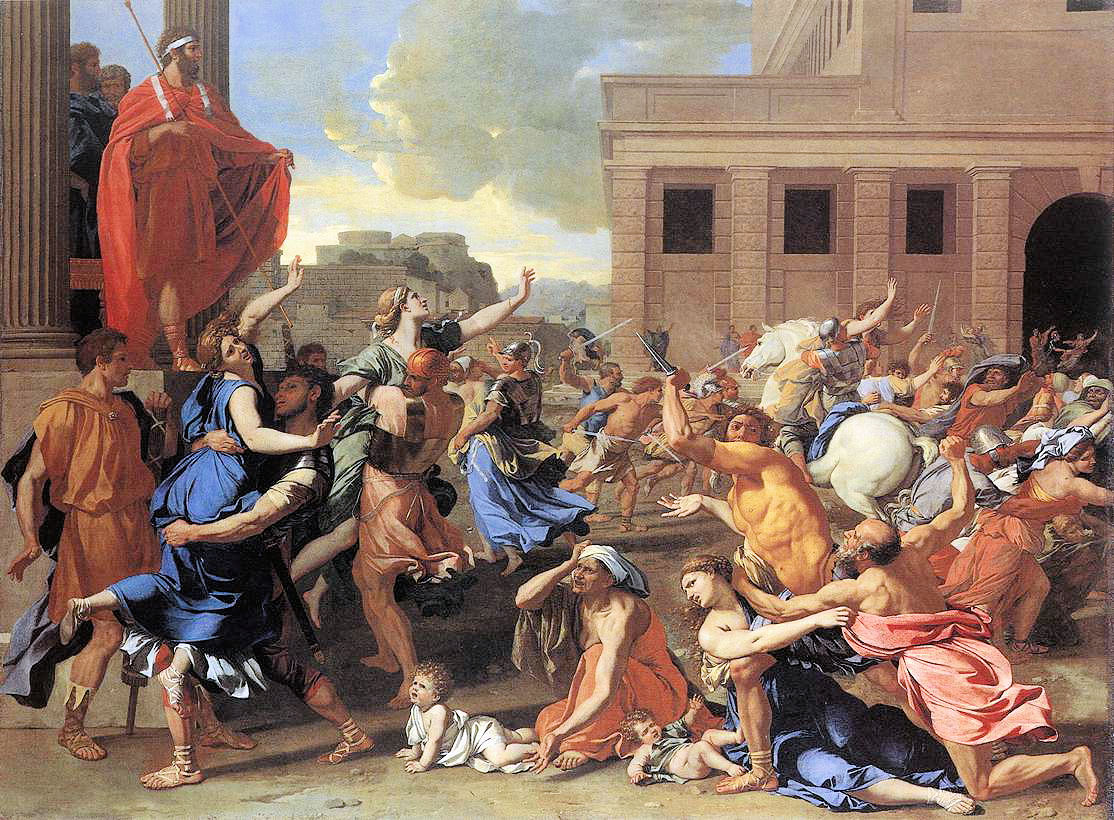
Nicolas Poussin, "Rape of the Sabine Women," 1637, Louvre:
A depiction of the legendary 750 BC abduction of neighboring
women by an early Roman raiding party
In the New York Times, science correspondent Nicholas Wade reviews anthropologist Napoleon Chagnon's autobiography Noble Savages:
Trained as an engineer before taking up anthropology, Dr. Chagnon was interested in the mechanics of how the Yanomamö worked. He perceived that kinship was the glue that held societies together, so he started to construct an elaborate genealogy of the Yanomamö (often spelled Yanomani.) 
The genealogy took many years, in part because of the Yanomamö taboo on mentioning the names of the dead. When completed, it held the key to unlocking many important features of Yanomamö society. One of Dr. Chagnon’s discoveries was that warriors who had killed a man in battle sired three times more children than men who had not killed. 
His report, published in Science in 1988, set off a storm among anthropologists who believed that peace, not war, was the natural state of human existence. Dr. Chagnon’s descriptions of Yanomamö warfare had been bad enough; now he seemed to be saying that aggression was rewarded and could be inherited. 
A repeated theme in his book is the clash between his empirical findings and the ideology of his fellow anthropologists. The general bias in anthropological theory draws heavily from Marxism, Dr. Chagnon writes. His colleagues insisted that the Yanomamö were fighting over material possessions, whereas Dr. Chagnon believed the fights were about something much more basic — access to nubile young women.

The distinction between competing over material possessions and competing over women seems pretty blurry. In general, the more productive cultures are ones that channel male agression over reproduction into economic rather than physical competition.

As an example of this, I was in Glendale on Saturday night and walked past hundreds of young Spanish-speaking people lined up to get into Giggles night club. They looked like they were intending to engage in a lot of conspicuous consumption that, judging by the tightness and tackiness of their clubbing costumes, they couldn't really afford.
In his view, evolution and sociobiology, not Marxist theory, held the best promise of understanding human societies. In this light, he writes, it made perfect sense that the struggle among the Yanomamö, and probably among all human societies at such a stage in their history, was for reproductive advantage. 
Men form coalitions to gain access to women. Because some men will be able to have many wives, others must share a wife or go without, creating a great scarcity of women. This is why Yanomamö villages constantly raid one another.
The raiding over women creates a more complex problem, that of maintaining the social cohesion required to support warfare. A major cause of a village’s splitting up is fights over women. But a smaller village is less able to defend itself against larger neighbors. The most efficient strategy to keep a village both large and cohesive through kinship bonds is for two male lineage groups to exchange cousins in marriage. Dr. Chagnon found that this is indeed the general system practiced by the Yanomamö.

And, I suspected, walking down the street, that some of the more disorderly patrons of Giggles tended, as the night wore on, to turn from competing for women via buying $285 bottle service to more direct means. When I got home, looking up Giggles on Google, I found this news story:
Chunk of man's eyebrow bitten off outside Giggles night club in Glendale 
October 01, 2012 
A 38-year-old North Hollywood man lost a chunk of his eyebrow early Sunday during a fight outside of Giggles Nightclub in Glendale, police said. 
Officers found the man, whose name wasn’t released, about 2 a.m. in the alley behind the night club in the 200 block of Brand Boulevard after receiving a call about a brawl involving 20 men, according to Glendale police reports. Police didn’t find the man’s attacker. 
The man told police another man bit his eyebrow, causing an inch-wide gash. 
Blood was dripping from the man’s face as he stood alongside another eight men who weren’t involved in the fight, police said. 
He told officers he and his friends were leaving the nightclub and were walking in the alley where there was a group of men fighting. 
The man was watching the fight when another male suddenly approached him from the left and bit his eyebrow, police said. 
He described the man as Latino, 5 foot 5 inches tall, about 200 pounds with an athletic build and short hair. The man was wearing blue jeans only.

Sadly, no Poussin is likely to immortalize this post-Giggles encounter in art worthy of the Louvre. I think Poussin could have done a lot with "5 foot 5 inches tall, about 200 pounds with an athletic build ... wearing blue jeans only."

Betty Friedan v. the Lavender Menace

Lesbians wearing "Lavender Menace" t-shirts protest Betty Friedan in 1970.
Their signs say, "The Women's Movement Is a Lesbian Plot!"
A half-century after the publication of Betty Friedan's book The Feminine Mystique, her name is much in the news. I always thought the most interesting thing about her was that when she was the founding president of the National Organization for Women in 1966-1970, she publicly denounced what she called the "Lavender Menace:" the tendency for lesbians to hijack any organization with the word "women" in the title. 

Eventually, in 1977, Friedan submitted to lesbian power within the women's movement, but her many warnings in the decade before then that lesbians were taking over organized feminism make fascinating reading.

In the early 1990s, researching what became my article Why Lesbians Aren't Gay, I wanted to see if Friedan's predictions had turned out true. So, back in this pre-Web age, I joined the National Organization for Women to get their newsletter.

The post-Friedan NOW newsletter came printed in black ink, with one highlight color ... lavender ink. Much of the content was focused solely on lesbian concerns. The national leader of N.O.W. in the 1990s, Patricia Ireland, had a husband somewhere, but also a female partner who seemed to be around more.

So, score one for Betty Friedan's powers of prescience. 

Obama to study brain, says Neanderthal cloning expert

From the New York Times:
Obama Seeking to Boost Study of Human Brain 
By JOHN MARKOFF 
Published: February 17, 2013 
The Obama administration is planning a decade-long scientific effort to examine the workings of the human brain and build a comprehensive map of its activity, seeking to do for the brain what the Human Genome Project did for genetics.

George M. Church, a molecular biologist at Harvard, said he was helping to plan the project, the Brain Activity Map.

Dr. Church was most recently in the news speculating about cloning a lot of Neanderthals.

Do they really want to know what they'll find?

First report of 2012 white vote in all 50 states

My new VDARE article is the first to reveal how the white electorate voted in 2012 in each of the 50 states. (The widely publicized exit poll last November ignored 20 states, including giant Texas.)

On the lessons of the 2012 vote:
The message you’ve heard ever since the election is that the Republicans lost because of the amnesty issue and therefore they must agree to amnesty and a path to citizenship. You know, the New York Times and the POTUS have all been explaining to the Republican Party how they need to pass amnesty right now for their own good. And, as I said earlier, if Republicans can’t trust the leadership of the Democratic Party to look out for their partisan interests, who can they trust? 
Yet the states in which Romney came close to winning are typically ones where he just did not get enough of the white vote. 
Consider Ohio, where Romney lost 52-48 overall by only getting a grand total of 54 percent of the white vote. Almost anywhere in modern America, Republicans have to win more than 54 percent of whites to win. 
Here are some other north central states where Romney came fairly close:  
Pennsylvania: 54 percent of the white vote
Iowa: 48 percent
WI 49 percent
Minnesota 47 percent
Michigan 53 percent  
Romney couldn’t get the job done in these northern states, not because of the tidal wave of Hispanics, but because he just didn’t get enough whites to show up and vote for him.

Read the whole thing there.

Unraveling the genetic code behind IQ

From the Wall Street Journal:
A Genetic Code for Genius? 
In China, a research project aims to find the roots of intelligence in our DNA; searching for the supersmart
... In the spring of 2010, a theoretical physicist called Stephen Hsu from the University of Oregon visited BGI. Dr. Hsu was also interested in the genetics of cognitive ability, so the pair joined with other colleagues to launch the BGI intelligence project. 
One part of the plan called for shifting to saliva-based DNA samples obtained from mathematically gifted people, including Chinese who had participated in mathematics or science Olympiad training camps. 
Another involved the collection of DNA samples from high-IQ individuals from the U.S. and other countries, including those with extremely high SAT scores, and those with a doctorate in physics or math from an elite university. In addition, anyone could enroll via BGI's website if they met the criteria. 
The Shenzen government agreed to pay for half the project, and BGI said it would pitch in the other half, says Mr. Zhao. 
160 and over: IQ of high-intelligence individuals in the BGI study 
Most of the samples so far have come from outside of China. The main source is Dr. Plomin of King's College, who for his own research had collected DNA samples from about 1,600 individuals whose IQs were off the charts. Those samples were obtained through a U.S. project known as the Study of Mathematically Precocious Youth, now in its fourth decade. 
Dr. Plomin tracked down 1,600 adults who had enrolled as kids in the U.S. project, now based at Vanderbilt University. Their DNA contributions make up the bulk of the BGI samples. 
Dr. Hsu embarked on his own marketing drive. When giving science talks at various institutions, including the California Institute of Technology, Taiwan's Academy of Science and Google, GOOG +0.64% he exhorted listeners to sign up for the study. 
BGI's website has so far attracted about 500 qualifying volunteers. 

This stuff's complicated, so I wouldn't be surprised if this winds up taking a lot longer than Mr. Zhao, a 20-year-old wunderkind, thinks it will take.

America's least literate cities: What could be the common denominator?

The annual list of America's cities where reading is most and least popular has come out again, and once more America's most literate pundits remain baffled by why reading is popular in some metropolitan areas but not in others:

America's 5 most literate cities:
5. Denver, Colo.
4. Pittsburgh, Pa.
3. Minneapolis, Minn.
2. Seattle, Wash.
1. Washington, D.C.

America's five least literate cities:
5. Anaheim, Calif.
4. El Paso, Texas
3. Stockton, Calif.
2. Corpus Christi, Texas
1. Bakersfield, Calif.

You know what we need to fix the problems of Anaheim, El Paso, Stockton, Corpus Christi, and Bakersfield?

More immigration. 

Granted, I'm not sure exactly why, but I've been reading a lot of punditry lately, and that seems to be solution for just about everything, so why not literacy?

February 17, 2013

What's the gayest state in the Union?

Gallup and professor Gary Gates have called up over 200,000 people and asked them, "Do you, personally, identify as lesbian, gay, bisexual, or transgender?" 

(By the way, I can never remember what the T in LGBT stands for: Transexual? Transvestite? Presumably, you can make a living on the academic conference circuit having a strong opinion on what the "T" should stand for and why your kind of Ts are most oppressed and therefore most deserving.)

Nationally, 3.5% say "Yes," which isn't too surprising or even interesting. It reminds me of the Onion football headline: "Both teams satisfied with three-and-a-half-yard carry." The Los Angeles Times ran an entire article on these results without mentioning the national average figure, which is a lot less than the Kinsey 10% number that all right-thinking people promoted for decades.

Of the 50 states, the gayest is Hawaii, which also isn't surprising. Hawaii has long been a destination for semi-closeted celebrities downshifting their careers, like Jim "Gomer Pyle" Nabors in 1976.
In general, the term "downshifting" comes to mind when looking at the top of the list: many of the the states at the top look like lower cost, quieter places for homosexuals to head for when the bright lights of San Francisco (Oregon, Nevada), Los Angeles (Hawaii, Nevada), and New York (Vermont, Maine) start to lose their luster. 

Gay downshifting/retirement is a pretty big deal economically, as I noticed when I visited Palm Springs last year. The overall Palm Springs area is a vast exurban metropolis? exopolis?, while the actual municipality of Palm Springs, the original core, is now mostly inhabited by older homosexuals downshifting or retired from entertainment industry careers or the like. The whole place has been transformed into a fantasy land of early 1960s Suburban Moderne interior decoration. It's like you are five years old again and your mom is taking you to visit the house of her most upscale social-climbing friend, who has just redecorated in Space Age colors.

A gay male reader pointed out that Palm Springs even has a golf course, Indian Canyons, favored by that most minuscule of all demographics: gay male golfers. (He estimates there are about 30 gay male regulars at Indian Canyons.)

In general, a visit to Palm Springs suggests that the overall national population doesn't seem to be getting particularly gayer in the 21st Century, that there are a huge number of old gays from the 1970s around. The only young males around in downtown Palm Springs are the Mexican streetwalkers.

Other questions inspired by the list: is the big difference between South Dakota (4.4%) and North Dakota (1.7%) just caused by small sample sizes, or is South Dakota just gayer than North Dakota? I am reminded of the various serious attempts made by North Dakota legislators over the last generation to change the name of their state to the more manly-sounding "Dakota."

One important question for these kind of surveys where the goal is to come up with precise estimates of quite small percentages is how large the random error rate is in answering questions. I wouldn't be surprised if, say, one percent of respondents mishear or misunderstand the question, which would tend to falsely narrow the spread among states.

February 16, 2013

Buss as boss

Dr. Jerry Buss, one of the most successful sports team owners ever, is said to be dying of cancer at age 79. The former USC chemistry professor turned real estate investor bought the Los Angeles Lakers basketball team in 1979, and they have won ten NBA titles for him. 

I saw Buss once,  in an aisle at the Forum before a 1981 Lakers game, as he talked to a half-dozen of his lowest-paid employees -- security guards, vendors, ushers -- each of whom he seemed to know by name, same as if they were Buss's employees named Magic or Kareem. On Buss's arm was a  blonde actress / model / whatever around age 20 who rolled her eyes in boredom, sighed, and tapped her foot as Buss joked with his minimum wage workers. She radiated the unspoken message, "Jerry, I want to go back to the Owner's Suite and do coke, now!" He paid her absolutely no attention, but his scruffy part-time workers clearly appreciated that they had their millionaire playboy boss's full focus while the starlet did not. They looked like they'd do anything for Dr. Buss.

I walked away from that scene thinking, "This Buss guy, he's going to do pretty well for himself as a boss."

Happy International Galton Day

To complement the growing annual celebration of International Darwin Day on Charles Darwin's birthday of February 12, I'm introducing International Galton Day on Francis Galton's birthday of February 16.

Galton was of course a Victorian polymath whose inventions include the silent dog whistle, the weather map you see on TV every evening, and the practical use of fingerprints in crime-fighting. (Others had the notion before Galton of using fingerprints in detection, but had been stymied by how to retrieve matching fingerprints from filing cases full of them.)

Galton was also a giant in the history of statistics. U. of Chicago professor Stephen M. Stigler published in 2010 in the Journal of the Royal Statistical Society
Darwin, Galton and the Statistical Enlightenment 
On September 10th, 1885, Francis Galton ushered in a new era of Statistical Enlightenment with an address to the British Association for the Advancement of Science in Aberdeen. In the process of solving a puzzle that had lain dormant in Darwin's Origin of Species, Galton introduced multivariate analysis and paved the way towards modern Bayesian statistics. The background to this work is recounted, including the recognition of a failed attempt by Galton in 1877 as providing the first use of a rejection sampling algorithm for the simulation of a posterior distribution, and the first appearance of a proper Bayesian analysis for the normal distribution.

Stigler periodically gives a talk entitled “The Five Most Consequential Ideas in the History of Statistics.” From the Harvard Gazette:
On Monday (Sept. 29), [Stigler] stayed in town to address about 50 students and professors in a crowded third-floor classroom in the Science Center. Stigler’s talk, in professional terms, was inflammatory: “The Five Most Consequential Ideas in the History of Statistics.”... 
The first idea was to combine observations in order to arrive at a simple mean. This “ species of averaging,” said Stigler, found expression in 1635, through the work of English curate and astronomer Henry Gellibrand. 
... The “root-N rule” is the second consequential idea, said Stigler. That’s the notion, first articulated in 1730, that the accuracy of your conclusions increases relative to the rate you accumulate observations. Specifically, to double that accuracy, you have to increase the number of observations fourfold. 
Third on the list is the idea of “the hypothesis test,” the statistical notion that mathematical tests can determine the probability of an outcome. This idea (though not the sophisticated math now associated with it) was in place by 1248, said Stigler, when the London Mint began periodically to test its product for composition and weight. 
The fourth and fifth consequential ideas in statistics both had the same source, said Stigler — an 1869 book by Victorian polymath Francis Galton. “Hereditary Genius” was a mathematical examination of how talent is inheritable. 
Galton discovered through a study of biographical compilations that a “level of eminence” within populations is steady over time and over various disciplines (law, medicine). Of the one in 4,000 people who made it into such a compilation, one-tenth had a close relative on the same list. 
This led to what Stigler called the fourth consequential idea: the innovative notion that statistics can be evaluated in terms of internal measurements of variability — the percentiles of bell curves (in statistics terms, “normal distribution”) that in 1869 Galton started to employ as scales for talent. 
The fifth idea was based upon an empirical finding. In a series of studies between 1869 and 1889, Galton was the first to observe the phenomenon of regression toward the mean. 
Essentially, the idea posits that in most realistic situations over time — Galton studied familial height variations, for example — the most extreme observed values tend to “regress” toward the center, or mean. 
If he could extend his list of consequential ideas in statistics, Stigler said he would include random sampling, statistical design, the graphical display of data, chi-squared distribution, and modern computation and simulation.

Peter Turchin on the Big Picture

Peter Turchin is a professor at the U. of Connecticut who started out in zoology and ecology and has moved over time into human history from a quantitative standpoint, searching for general patterns. He was born in Russia (his father was prominent dissident Valentin Turchin). His historical theorizing benefits from his knowing much about Russia, which few Americans do. Whether or not his theories -- e.g., the rise and fall of social cohesion, the meta-ethnic frontier, overproduction of elites, and so forth -- are right (I'd say he's on to something), you'll still learn a lot of fascinating stuff from him about the history of the Russian frontiers in Siberia and on the steppe.

Turchin has a new article "Return of the Oppressed" in Aeon Magazine on cycles of inequality:
In his book Wealth and Democracy (2002), Kevin Phillips came up with a useful way of thinking about the changing patterns of wealth inequality in the US. He looked at the net wealth of the nation’s median household and compared it with the size of the largest fortune in the US. The ratio of the two figures provided a rough measure of wealth inequality, and that’s what he tracked, touching down every decade or so from the turn of the 19th century all the way to the present. In doing so, he found a striking pattern. 
We found repeated back-and-forth swings in demographic, economic, social, and political structures 
From 1800 to the 1920s, inequality increased more than a hundredfold. Then came the reversal: from the 1920s to 1980, it shrank back to levels not seen since the mid-19th century. Over that time, the top fortunes hardly grew (from one to two billion dollars; a decline in real terms). Yet the wealth of a typical family increased by a multiple of 40. From 1980 to the present, the wealth gap has been on another steep, if erratic, rise. Commentators have called the period from 1920s to 1970s the ‘great compression’.

That's what I recall from my avid study of the Guinness Book of World Records around 1969: the records for wealthiest man and highest income were really boring. The wealthiest man was, I think I recall, oilman J. Paul Getty, but if you adjust for inflation, the old time capitalists like Rockefeller in roughly 1900 or Ford in 1925 were richer. Nobody seemed to be really richer in 1969 than in 1929. Similarly, the highest annual income was something like the chairman of G.M. making a million dollars per year. Boring.
The past 30 years are known as the ‘great divergence’. Bring the 19th century into the picture, however, and one sees not isolated movements so much as a rhythm. In other words, when looked at over a long period, the development of wealth inequality in the US appears to be cyclical. And if it’s cyclical, we can predict what happens next. 
An obvious objection presents itself at this point. Does observing just one and a half cycles really show that there is a regular pattern in the dynamics of inequality? No, by itself it doesn’t. But this is where looking at other historical societies becomes interesting. In our book Secular Cycles (2009), Sergey Nefedov and I applied the Phillips approach to England, France and Russia throughout both the medieval and early modern periods, and also to ancient Rome. All of these societies (and others for which information was patchier) went through recurring ‘secular’ cycles, which is to say, very long ones. Over periods of two to three centuries, we found repeated back-and-forth swings in demographic, economic, social, and political structures. And the cycles of inequality were an integral part of the overall motion. ...
So it looks like the pattern that we see in the US is real. Ours is, of course, a very different society from ancient Rome or medieval England. It is cut off from them by the Industrial Revolution and by innumerable advances in technology since then. Even so, a historically based model might shed light on what has been happening in the US over the past three decades. 
First, we need to think about jobs. Unless other forces intervene, an overabundance of labour will tend to drive down its price, which naturally means that workers and their families have less to live on. One of the most important forces affecting the labour supply in the US has been immigration, and it turns out that immigration, as measured by the proportion of the population who were born abroad, has changed in a cyclical manner just like inequality. In fact, the periods of high immigration coincided with the periods of stagnating wages. The Great Compression, meanwhile, unfolded under a low-immigration regime. This tallies with work by the Harvard economist George Borjas, who argues that immigration plays an important role in depressing wages, especially for those unskilled workers who compete most directly with new arrivals. 
Immigration is only one part of a complex story. Another reason why the labour supply in the US went up in the 19th century is, not to put too fine a point on it, sex. The native-born population was growing at what were, at the time, unprecedented rates: a 2.9 per cent growth per year in the 1800s, only gradually declining after that. By 1850 there was no available farmland in Eastern Seaboard states. Many from that ‘population surplus’ moved west, but others ended up in eastern cities where, of course, they competed for jobs with new immigrants. 
This connection between the oversupply of labour and plummeting living standards for the poor is one of the more robust generalisations in history. 
... The tug of war between the top and typical incomes doesn’t have to be a zero-sum game, but in practice it often is.

This is well said. It's common to see people who have taken Economics 101 inform you that things don't have to be a zero-sum game, which is true. But in practice, they often are.
... Naturally, the conditions affecting the labour supply were different in the second half of the 20th century in the US. An important new element was globalisation, which allows corporations to move jobs to poorer countries (with that ‘giant sucking sound’, as Ross Perot put it during his 1992 presidential campaign). But none of this alters the fact that an oversupply of labour tends to depress wages for the poorer section of the population. ...
Falling wages isn’t the only reason why labour oversupply leads to inequality. As the slice of the economic pie going to employees diminishes, the share going to employers goes up. Periods of rapid growth for top fortunes are commonly associated with stagnating incomes for the majority. Equally, when worker incomes grew in the Great Compression, top fortunes actually declined in real terms. ... 
It is relatively easy to understand the periods when the wealthy bent the agenda to suit their interests (though of course, not all rich people care exclusively about their own wealth). How, though, can we account for the much more broadly inclusive policies of the Great Compression era? And what caused the reversal that ended the Gilded Age and ushered in the Great Compression? Or the second switch, which took place around 1980?
History provides another clue. Unequal societies generally turn a corner once they have passed through a long spell of political instability. Governing elites tire of incessant violence and disorder. They realise that they need to suppress their internal rivalries, and switch to a more co-operative way of governing, if they are to have any hope of preserving the social order. We see this shift in the social mood repeatedly throughout history — towards the end of the Roman civil wars (first century BC), following the English Wars of the Roses (1455-85), and after the Fronde (1648-53), the final great outbreak of violence that had been convulsing France since the Wars of Religion began in the late 16th century. 
Put simply, it is fear of revolution that restores equality. And my analysis of US history in a forthcoming book suggests that this is precisely what happened in the US around 1920. ...
Reforms that ensured an equitable distribution of the fruits of economic growth turned out to be a highly effective counter to the lure of Bolshevism. 
These were the years of extreme insecurity. There were race riots (the ‘Red Summer of 1919’), worker insurrections, and an Italian anarchist terrorist campaign aimed directly at the elites. The worst incident in US labour history was the West Virginia Mine War of 1920—21, culminating in the Battle of Blair Mountain. Although it started as a workers’ dispute, the Mine War eventually turned into the largest armed insurrection that the US has ever seen, the Civil War excepted. Between 10,000 and 15,000 miners armed with rifles battled against thousands of strikebreakers and sheriff deputies. ... Add to all this the rise of the Soviet Union and the wave of socialist revolutions that swept Europe after the First World War, triggering the Red Scare of 1921, and you get a sense of the atmosphere. Quantitative data indicate that this period was the most violent in US history, second only to the Civil War. It was much, much worse than the 1960s.

That's generally been my impression: that the U.S. underwent a nervous breakdown during the second Wilson Administration, and then recovered under the underrated Harding.
The US, in short, was in a revolutionary situation, and many among the political and business elites realised it. They began to push through a remarkable series of reforms.

Wilson's reforms and foreign adventuring contributed to the scary years of 1917-1921. But over many decades, there's a general continuity of direction in the first half of the 20th Century in how WASP elites settled old differences amongst themselves in order to create the modern but stable country that won the Big One, went to the Moon, and prevailed in the Cold War.
In 1921 and 1924, Congress passed legislation that effectively shut down immigration into the US. Although much of the motivation behind these laws was to exclude ‘dangerous aliens’ such as Italian anarchists and Eastern European socialists, the broader effect was to reduce the labour surplus. Worker wages grew rapidly.

The subject of immigration had been studied by responsible leaders in a depth that's unimaginable today. Congress set up United States Immigration Commission in 1907, for example. After four years of work, it issued the 41-volume Dillingham report. Today, the notion of writing 41 volumes on the impact of immigration sounds horrifying. Didn't they know back then you aren't supposed to know anything about immigration other than that diversity is our strength?

Here's the kind of man who was involved in the Immigration Commission: Senator Henry Cabot Lodge (R-MA). Wikipedia explains:
He was cousin to the American polymath Charles Peirce. In 1872, [Lodge] graduated from Harvard College... In 1874, he graduated from Harvard Law School ... After traveling through Europe, Lodge returned to Harvard, and in 1876, became the first student of Harvard University to graduate with a Ph.D. in Political Science. His teacher and mentor during his graduate studies was Henry Adams; Lodge would maintain a lifelong friendship with Adams. Lodge wrote his dissertation on the ancient Germanic origins of Anglo-Saxon government.

Uh, uh, obviously an uneducated ignoramus nativist!

Back to Turchin:
At around the same time, federal income tax came in and the rate at which top incomes were taxed began to increase. Somewhat later, provoked by the Great Depression, other laws legalised collective bargaining through unions, introduced a minimum wage, and established Social Security. 
The US elites entered into an unwritten compact with the working classes. This implicit contract included the promise that the fruits of economic growth would be distributed more equitably among both workers and owners. In return, the fundamentals of the political-economic system would not be challenged (no revolution). The deal allowed the lower and upper classes to co-operate in solving the challenges facing the American Republic — overcoming the Great Depression, winning the Second World War, and countering the Soviet threat during the Cold War. 
It almost goes without saying that there was a racist and xenophobic underside to all this. The co-operating group was mainly native-born white Protestants.

For example, women's suffrage was a pro-WASP ploy. WASP women were much more liberated than immigrant women, so giving women more power gave WASPs more power. (Prohibition was tied into women's suffrage. WASP feminists hated men drinking, so if they were going to get the vote, politicians had better pass Prohibition to mollify them.)
African-Americans, Jews, Catholics and foreigners were excluded or heavily discriminated against. Nevertheless, while making such ‘categorical inequalities’ worse, the compact led to a dramatic reduction in overall economic inequality. ...
It is no coincidence that the life of Communism (from the October Revolution in Russia in 1917 to the fall of the Berlin Wall in 1989) coincides almost perfectly with the Great Compression era. The Red Scares of, firstly, 1919—21 and then 1947—57 suggest that US elites took the Soviet threat quite seriously. More generally, the Soviet Union, especially in its early years, aggressively promoted an ideology that was highly threatening to the political-economic system favoured by the US elites. Reforms that ensured an equitable distribution of the fruits of economic growth turned out to be a highly effective counter to the lure of Bolshevism. 
Nevertheless, when Communism collapsed, its significance was seriously misread. It’s true that the Soviet economy could not compete with a system based on free markets plus policies and norms that promoted equity. Yet the fall of the Soviet Union was interpreted as a vindication of free markets, period. The triumphalist, heady atmosphere of the 1990s was highly conducive to the spread of Ayn Randism and other individualist ideologies. The unwritten social contract that had emerged during the New Deal and braved the challenges of the Second World War had faded from memory.

It was not just individualist ideologies that flourished after the collapse of a credible military rival to the U.S., but also, famously, "globalist" ideologies, which are anti-nationalist and thus anti-patriotic and thus pro-elite and pro-inequality.

February 15, 2013

How Israel deals with past mistakes in immigration policy

With the Washington establishment agreeing that what America needs right now is to double down on guest workers and amnesty for illegal aliens, it’s worthwhile to notice how a serious country such as Israel deals with past mistakes in immigration policy. 
In America, we try not to learn from the past. For example, in all the talk this year about a new amnesty, how often have you heard mention of one of the 1986 amnesty’s chief unanticipated consequences: the subsequent Hispanic baby bubble? 
This drove up the total fertility rate among foreign-born Latinas from 3.2 in 1987 to 4.4 in 1991 before finally subsiding back to the baseline by 2000. (The replacement rate, by the way, is 2.06.)


David Plouffe: "Bigger problem [GOP has] got with Latinos isn’t immigration. It’s their economic policies ..."

Robert Draper writes a long article in the New York Times called "Can the Republicans Be Saved from Obsolescence?" that mostly consists of younger GOP operatives like Patrick Ruffini explaining how they aren't to blame for the Romney Campaign and how they would have been awesome if anybody had hired them, what with their digital wizardry and all.

I presume there's a good story out there somewhere about the Romney campaign and its multitudinous consultants that would involve the terms "conflict of interest" and "financial malfeasance," but this isn't it. 

However, when you finally get to p. 8, there's an interview with David Plouffe, manager of the 2008 Obama campaign and who just retired from being Senior Adviser to the President to go make money. Plouffe, who has just about the best track record in American politics of knowing what he's talking about when it comes to winning elections, points out that everything you've read since the election is wrong:
But, I asked Plouffe, wasn’t the G.O.P. just one postmodern presidential candidate — say, a Senator Marco Rubio — away from getting back into the game? 
Pouncing, he replied: “Let me tell you something. The Hispanic voters in Nevada, Colorado and New Mexico don’t give a damn about Marco Rubio, the Tea Party Cuban-American from Florida. You know what? We won the Cuban vote! And it’s because younger Cubans are behaving differently than their parents. It’s probably my favorite stat of the whole campaign. So this notion that Marco Rubio is going to heal their problems — it’s not even sophomoric; it’s juvenile! And by the way: the bigger problem they’ve got with Latinos isn’t immigration. It’s their economic policies and health care. The group that supported the president’s health care bill the most? Latinos.”

All this Rubio / "path to citizenship" talk, it's just a Democratic honey trap to lure Republicans in to their destruction. Ask Plouffe.

February 14, 2013

At least Rubio has Univision on his side, right?

Okay, so Stephen Colbert had a little fun at the expense of Senator Marco Rubio and his case of flop sweat on national TV, but that can't hurt the GOP's Great Tan Hope because, as everybody knows, Spanish-language network Univision is the big dog in the TV ratings these days. And Univision loves Rubio! 

Right? I mean, like most Republicans, my Espanol habloing is a little rusty, but my impression is that all these people whose names end in a vowel are best friends: the Mexicans, the Cubans, the Guatelombians, the Domingoans, the Costa Nostras,  the Guyanese, the New Guyanese, the Philippinos, the Borneoeans, the Burmanese ... they're all amigos, right? And they all watch Univision.

So, because Univision's got Rubio's back, he's a sure thing in 2016.

Oh, wait ... From Business Insider:
A top assistant to a Univision news boss trashed Sen. Marco Rubio on his aide's Facebook page, calling the Republican lawmaker a "loser" and "a token slave boy." 
It's the latest attack in a lengthy feud between the Florida senator and the powerful Spanish-language network that conservatives charge is anti-GOP and anti-Rubio. ...
"Oh. wow, the loser is going to speak after our President," Artiles wrote on spokesman Alex Burgos' Facebook page at 9:33 p.m. Wednesday. "Anything to get publicity. Ask him to do us a favor and stay home that night." 
Sentiments like that reflect the prevailing political feeling among Univision's higher-ups at its Doral headquarters, say Univision insiders. Artiles is executive assistant to Daniel Coronell, Univision's vice president of news. 
The network is owned by a major Democratic donor [Haim Saban, who brought us Mighty Morphin' Power Rangers] who has accused Rubio and other Republicans of having an "anti-Hispanic" stand on immigration that's "despicable." 
In August, someone used Univision's official Facebook account to attack Rubio during the Republican National Convention in Tampa. 
"Beyond his ideology, Rubio is a mediocre politician who contradicts the values he says he represents. Jeb Bush is more Latino and talented than him," the Facebook posting said. ...
And a year before that Facebook incident, Rubio clashed with Univision's news chief, Isaac Lee, when his news team decided to run a story about a quarter-century-old drug bust involving the senator's brother-in-law. 
Univision began reporting the drug-bust story after Rubio rebuffed repeated interview requests with the network, which had been critical of Rubio's opposition to liberal immigration policies that Univision personalities have promoted. 
She then used a diminutive term for Rubio's first name, "Marquito," and proceeded to compare him to a Disney dwarf, a "token slave boy" and a "fool" who was passed over by Republican Mitt Romney on his presidential ticket last November. ...
"I see that all the mojoncitos ['little turds'] have come out to defend the principal turd, Marquito," she wrote in Spanish. "I am laughing all the way to the White House :)."  ...
Artiles: "Curbelo, the riffraff might be you. I haven't said anything 'riffraffy.' Wake up and join the Democratic Party unless you want to remain losers all your lives." ...
Artiles: "Curbelo, losers are the ones who lost the elections, this is what is called freedom of expression. We are all professionals and being parents is nothing out of this world, nor because of that does one stop being a little turd. And Marquito only wants to talk about immigration NOW because he lost. I know well all his lies and his vanity." ...
In the New Yorker piece, Lee acknowledged the network covers immigration with a bias.

As opposed to ...

I'm drawing a blank here on networks that cover immigration without a bias.
"According to Univision's news president, Isaac Lee, the network is openly committed to 'pro-Hispanic' immigration reform," the New Yorker wrote. 
The owner of Univision, major Democratic donor Haim Saban, was more partisan than Lee and fumed in an email to the New Yorker over the way that the GOP presidential candidates boycotted a proposed Florida debate in January in retaliation for the network's report on Rubio and his brother-in-law. 
Said Saban: "The fact that Rubio and some Republican presidential candidates have an anti-Hispanic stand that they don't want to share with our community is understandable but despicable." 

"Our community," Haim?

A President Rubio could put an end to all this divisiveness by just ordering a drone strike on John Tanton

For years, the Southern Poverty Law Center has been arguing that the only reason anybody in America has the slightest doubts about immigration is because of the malign influence of one man, a Michigan ophthalmologist named John Tanton. 

Now, Sen. Marco Rubio is spreading the SPLC's line.

From the Washington Post:
Effort to change immigration law sparks internal battle within GOP 
By Peter Wallsten, Published: February 13 
A new battle has flared inside the Republican Party in recent days as supporters of more-liberal immigration laws wage a behind-the-scenes campaign to discredit the influential advocacy groups that have long powered the GOP’s hard-line stance on the issue. 
The campaign, largely waged in closed-door meetings with lawmakers and privately circulated documents, is another sign of how seriously many establishment Republicans are pursuing an immigration overhaul in the wake of last year’s elections, in which the GOP lost Hispanic voters by an overwhelming margin to President Obama. 
Much of the party’s sharp language on immigration during the election campaign, which Republican strategists blamed for alienating Hispanics, was drawn from the research and rhetoric of the advocacy groups. 
Now, Republicans pushing the party to rethink its approach to the issue are accusing those groups — Numbers USA, the Center for Immigration Studies (CIS), and the Federation for American Immigration Reform (FAIR) – of masquerading as conservative. Critics say the groups and some of their supporters are pressing an un­or­tho­dox agenda of strict population control that also has included backing for abortion, sterilization, and other policies at odds with conservative ideology. 
“If these groups can be unmasked, then the bulk of the opposition to immigration reform on the conservative side will wither away,” said Alfonso Aguilar, executive director of the Latino Partnership for Conservative Principles and a leading organizer of the effort. 
Officials from the groups say they are the victims of a smear campaign that unfairly characterizes their mission. They acknowledge that some key figures in their past held a wide range of views on population growth and abortion, as do some current members, but the groups accuse their critics of pushing guilt-by-association arguments to distract from the merits of the case for restricting immigration. 
The groups have provided the intellectual framework and grass-roots muscle for opposing legislation that would legalize millions of illegal immigrants. 
Well-funded and politically savvy, the groups produce research papers, testify at congressional hearings and appear frequently in the media to push for reducing immigration. Numbers USA reports that its members have inundated the office of Sen. Marco Rubio (R-Fla.) with 100,000 faxes this year warning him that his central role in pursuing changes in immigration laws could damage his future political prospects. ...
Conservatives who are taking on the groups, including Rubio, anti-tax activist Grover Norquist and officials of the Catholic Church, argue that the three organizations are motivated by far different philosophies than many of their Republican allies realize. Among those views: that population growth from increased migration threatens the environment. 
The Republicans orchestrating the campaign against the groups have long rejected their views on immigration, and liberal immigration advocates have long made a practice of attacking the organizations. Now, with such GOP leaders as House Speaker John A. Boehner (Ohio) saying immigration legislation is a priority, some Republicans see an opportunity to loosen what they say has been the groups’ stranglehold on party orthodoxy.

Uh ... George W. Bush? Karl Rove? Grover Norquist? John McCain?

I'm fascinated by how impervious the world is to doing simple reality checks on assertions, such as by thinking briefly about the immigration views of recent Republican Presidents/nominees.

How exactly do Roy Beck and Mark Krikorian have a "stranglehold on party orthodoxy" compared to those guys who have all pushed more immigration? We immigration reductionists have managed to block disastrous initiatives by Bush and McCain by having better facts and logic, not by any stranglehold.
Rubio’s aides last week brought one of the organizers of the effort to undermine the groups, Mario H. Lopez, a party strategist on Hispanic politics, to a regular meeting of GOP Senate staffers, where Lopez distributed literature about the groups’ backgrounds and connections. Rubio also raised concerns about the groups’ leanings during a recent conference call on immigration with conservative activists. 
Rubio’s spokesman, Alex Conant, said the senator “has argued that some groups that oppose legal immigration should not be considered part of the conservative coalition,” adding that the “vast majority of Republicans strongly support legal immigration.” 
Kevin Appleby, director of immigration policy for the U.S. Conference of Catholic Bishops, said in an e-mail to The Post that “pro-life legislators should think twice about working with these groups, as their underlying goals are inconsistent with a pro-life agenda.” ...
The critics, however, argue that the three groups have misled conservatives. These critics point to reports on the FAIR and Numbers USA Web sites, for instance, that warn of environmental devastation from unchecked population growth, and they are circulating a 1993 report by CIS researchers sympathetic to contraception and the RU-486 abortion pill. 
In the latest issue of an anti-abortion journal, The Human Life Review, the Hispanic GOP strategist Lopez accuses the groups of “hijacking” the immigration debate for their own purposes. He argues that population-control advocates “have built, operated, and funded much of the anti-immigration movement in the United States.” 
“Those who seek to advance the pro-life cause should not allow themselves to be fooled by those whose work is ultimately diametrically opposed to the right to life,” Lopez writes. 
The article has created a stir in conservative circles. It ascribes the vision behind the groups to John Tanton, a controversial Michigan-based leader in the “zero population growth” movement, who co-founded FAIR in 1979 and later helped start Numbers USA and CIS. 
In a 2001 letter by Tanton being circulated as part of the current campaign, he laid out his idea to “move the battle lines on the immigration question in our favor” by convincing Republican lawmakers that “massive immigration imperils their political future.” The goal, he wrote, was to “change Republicans’ perception of immigration so that when they encounter the word ‘immigrant,’ their reaction is ‘Democrat.’ ” Organizers of the campaign against the groups found the letter at the University of Michigan’s Bentley Historical Library, which houses Tanton’s papers.

And, boy, was Tanton ever wrong! Oh, wait ...
An aide to Tanton, now 78, said Tanton was unable to speak. But the aide, K.C. McAlpin, said Tanton was an “ardent conservationist” who was being targeted in a “sort of McCarthyism game that the far left has been playing and is now being played by some people who call themselves conservatives.” 

I've never met the man, but if the SPLC/Rubio line is right about his influence, we ought to add Dr. Tanton's face to Mount Rushmore.
The dispute has prompted some tense encounters in recent days. 
When word spread, for instance, that Rubio’s staff was bringing Lopez to the Senate aides meeting last week, other Senate offices contacted the three groups, each of which sent a representative. 
“It was awkward,” said one staffer, speaking on the condition of anonymity to discuss a private meeting. The staffer described the critics’ tactics as “over the top,” saying the groups have been a “great resource” for data, research and expert testimony. 
Another testy moment occurred recently at the weekly conservative strategy session hosted by Norquist when Lopez stood to present his arguments. Hans von Spakovsky, a former Justice Department official in the George W. Bush administration who now works at the conservative Heritage Foundation, spoke up to defend the credibility of the Center for Immigration Studies. 
“I haven’t heard folks take on the substantive arguments CIS is making and saying why they’re wrong,” said von Spakovsky, who declined to discuss details of what happened in the off-the-record meeting. “Instead you just get these scurrilous attacks.”

How's this whole Marco Rubio thing working out for the GOP, anyway?

Here's the article. Maybe someday I can bring myself to read it.

Here's the question I have: Does anybody ever notice that there's something funny (in both senses of the word) in the idea that appears to be universal among both the media and the Republican Brain Trust that, well, of course, Marco Rubio should be one to negotiate amnesty and a path to citizenship because, if he plays his cards right, he could someday ride these lawbreakers-turned-voters to the White House!

I'm not talking about how extremely unlikely that outcome is, I'm talking about how ethically tainted is the Brain Trust's best case scenario of

Rubio elects a new people --> The new people elects Rubio President

Or is the concept of "conflict of interest" just some old white man's quibble that we have no use for in the vibrant new United States of Diversity?

NYT: Race does exist

From today's New York Times:
A Genetic Glimpse Into Recent Human Evolution 
By NICHOLAS WADE 
Gaining a deep insight into human evolution, researchers have identified a mutation in a critical human gene as the source of several distinctive traits that make East Asians different from other races. 
The traits – thicker hair shafts, a greater number of sweat glands, characteristically identified teeth and smaller breasts – are the result of a gene mutation that occurred some 35,000 years ago, the researchers have concluded. 
The discovery explains a crucial juncture in the evolution of East Asians. But the method can also be applied to some 400 other sites on the human genome. The DNA changes at these sites, researchers believe, mark the turning points in recent human evolution as the populations on each continent diverged from each other. 
The first of those sites to be studied contains the gene known as EDAR. Africans and Europeans carry the standard version of the gene, but in most East Asians one of the DNA units has mutated. ...
The finding that the gene has so many effects raises the question of which one was the dominant trigger for natural selection. 
Dr. Sabeti said the extra sweat glands could have been the feature favored by natural selection, with all the other effects being dragged along in its train. 
“We’re the only mammals to have changed their entire hair pattern. So the changes in teeth, hair and breasts — it’s very possible they are the passengers and thermoregulation is the key,” she said, referring to the sweat glands’ role in cooling the body. 
East Asians are sometimes assumed to have evolved in a cold environment because of their narrow nostrils, which conserve heat, and the extra eyelid fat that insulates the eye. But the Broad team calculates that the EDAR variant arose some 35,000 years ago in central China and that the region was then quite warm and humid. Extra sweat glands would have been advantageous to the hunter gatherers who lived at that time. 
But Joshua Akey, a geneticist at the University of Washington in Seattle, said he thought the more likely cause of the gene’s spread among East Asians was sexual selection. Thick hair and small breasts are visible sexual signals which, if preferred by men, could quickly become more common as the carriers had more children. The genes underlying conspicuous traits, like blue eyes and blonde hair in Europeans, have very strong signals of selection, Dr. Akey said, and the sexually visible effects of EDAR are likely to have been stronger drivers of natural selection than sweat glands. 
Yet a third view is held by Dr. Kamberov who believes that each of the effects of the EDAR variant may have been favored by natural selection at a different time. A series of selections on different traits thus made the variant version so common among East Asians. About 93 percent of Han Chinese carry the variant, as do about 70 percent of people in Japan and Thailand, and between 60 and90 percent of Native Americans, a population descended from East Asians. 

I pointed out in VDARE.com way back in 2003 that the Science section of the New York Times was doing excellent work pointing out repeatedly how the latest DNA evidence was undermining the trendy conventional wisdom that Race Does Not Exist.